Front Seat Laws in California 2027 Expert Legal Guide
Under California law, children must be at least 8 years old or 4 feet 9 inches tall to ride in the front seat of a vehicle. Violating these passenger safety regulations results in steep fines, court costs, and DMV penalty points that can impact auto insurance rates.
In California for 2027, children must be at least 8 years old OR reach a height of 4 feet 9 inches to legally sit in the front seat of a vehicle. Even if your child meets these criteria, state safety guidelines and pediatric experts strongly recommend keeping all children in the back seat until they turn 13.
Navigating California child passenger safety laws can be confusing for parents and caregivers. Knowing the exact thresholds protects your children from injury and shields you from costly traffic citations, penalty points, and mandatory court appearances.
Key Takeaways
- Children must be 8 years old or 4’9″ tall to sit up front.
- Rear seating is legally required for younger children unless specific exceptions apply.
- Vehicles without rear seats legally permit child front-seat placement with proper restraints.
- Fines for first-time child restraint violations start at around $100 plus court fees.
- Safety experts strongly recommend keeping children in the back seat until age 13.
What Causes Child Passenger Safety Violations in California
Misunderstanding Age Versus Height Thresholds
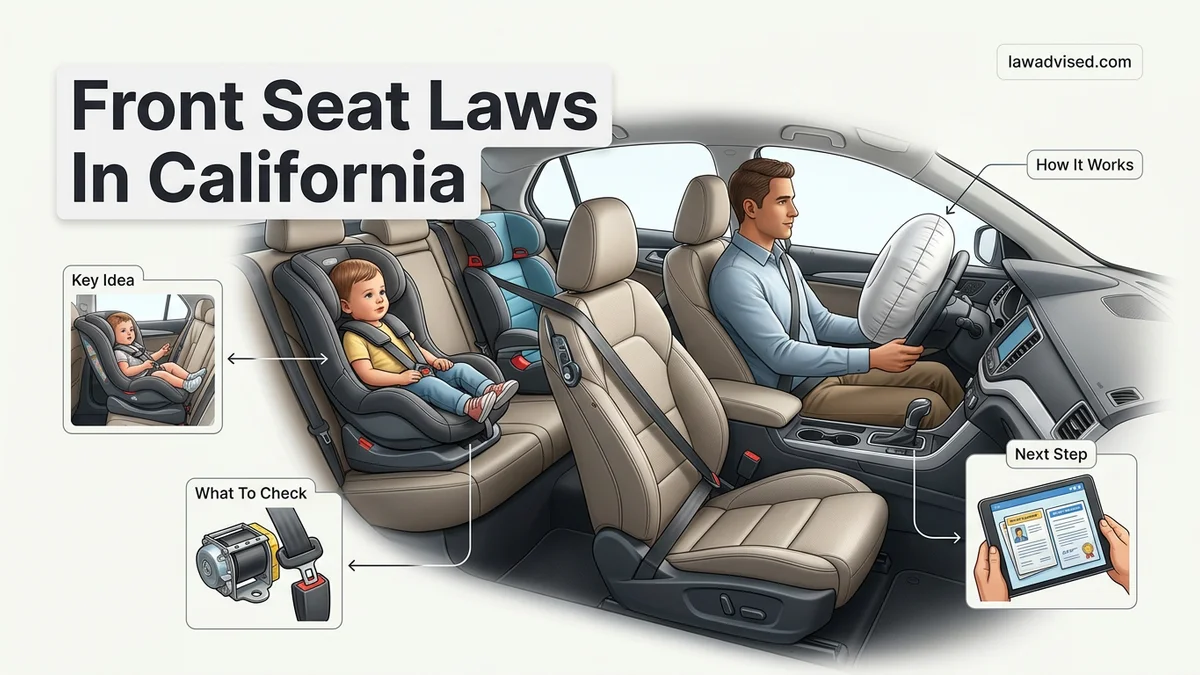
Many drivers mistakenly believe that a child can move to the front seat simply by turning a certain age, such as 6 or 7. California Vehicle Code Section 27360 mandates that children must satisfy both age and height metrics for proper restraint placement. If your 7-year-old child is tall enough to meet the 4-foot-9-inch requirement, they may legally sit up front, but failing to meet either condition means they belong in the rear. Relying on age alone causes numerous accidental infractions during routine traffic stops.
Ignoring Rear-Seat Priority Rules
Parents often transition children to the front seat prematurely out of convenience, lack of legroom, or behavioral issues in the back. Under 2027 enforcement standards, law enforcement officers actively issue citations when children under 8 sit in the front without meeting explicit legal exceptions. Standard practice requires children to utilize the rear seats where airbag deployment poses significantly less risk of severe upper-body trauma.
How to Fix Front Seat Compliance and Secure Child Passengers Properly
Measuring Your Child Accurately
You must verify your child’s height and weight using reliable measuring tools rather than estimates. Standard household tape measures work well, but you should check your child against the 4-foot-9-inch benchmark while they stand flat-footed against a wall. If your child falls even an inch short, keep them secured in the back seat using an appropriate booster seat or car seat matched to their exact body size.
Understanding Legal Front-Seat Exceptions
California law permits children under 8 to sit in the front seat under very specific, limited circumstances. You can legally place a younger child in the front only if:
- Your vehicle has no rear seats, such as in a two-seater pickup truck or sports car.
- The rear seats are side-facing jump seats.
- The rear seats are already fully occupied by other children under the age of 8.
- Medical reasons require the child to ride in the front under the direct supervision of an adult.
- The passenger airbag is deactivated properly if an exception forces a rear-facing child seat into the front.
What If Your Vehicle Lacks Rear Seats or Has Emergency Exceptions
California vehicle code recognizes that not every automobile is equipped with a standard back row. Pickups, two-seater sports cars, and specific commercial vehicles present unique passenger configurations. According to the California Highway Patrol (CHP), children may ride in the front seat under strictly regulated circumstances.
Vehicles Without Rear Seating Infrastructure
If a vehicle lacks rear seats entirely, a child safety seat may be installed in the front passenger position. However, stringent mechanical requirements apply. Front-seat safety restraints must be fully operational, and the vehicle manufacturer must not prohibit forward child seat placement. Transporting a child in the front of a standard sedan when rear seats are functional remains strictly illegal under California law.
Airbag Deactivation and Emergency Exemptions
Active airbags pose a fatal risk to infants and young children facing forward or backward in the front seat. Per 2027 safety standards, vehicles with front passenger seats must feature a functional airbag deactivation system if children under eight occupy that space. Law enforcement agencies note that medical emergencies provide the only immediate exemption to standard seating rules. Parents should never utilize the front seat for convenience when rear seating capacity exists.
Proven Strategies to Avoid Fines and DMV Point Penalties
Violating California front seat and child restraint laws carries steep financial penalties and impacts driving records. First-time violations often incur base fines exceeding $100, which escalates past $500 with court fees and assessment charges. Furthermore, convictions add one point to the driver’s DMV record, potentially triggering insurance rate spikes.
Compliance Best Practices for Drivers
Proactive measures ensure complete compliance with updated 2027 transportation codes. Adhering to structured protocols prevents costly citations and guarantees maximum child passenger safety:
- Verify that all children under the age of eight are secured in a federally approved car seat or booster seat in the rear row.
- Confirm that seatbelt fitment crosses the child’s chest and shoulder properly if they have graduated to adult safety belts in the rear.
- Schedule an annual inspection at a local California Highway Patrol office or certified inspection station to validate correct seat installation.
- Review vehicle owner manuals regarding passenger weight thresholds and airbag sensor deployment parameters.
- Keep printed or digital proof of professional car seat installations in the glove compartment during long-distance travel.
What If It Still Doesn’t Work?
Drivers facing persistent installation challenges or contested ticket citations must take decisive action to resolve compliance issues. Utilize these verified steps if standard adjustments fail:
- Consult a nationally certified Child Passenger Safety (CPS) technician to evaluate complex seat configurations or tight back-row spaces. Professional inspections typically range from free community events to $50 private appointments.
- Contact the vehicle manufacturer’s customer service hotline to request specialized seatbelt extension hardware if standard belts prove inadequate for bulky car seats.
- Visit a licensed mechanic to repair malfunctioning rear seatbelt buckles or anchor points, with diagnostic services averaging $100 to $250.
- Hire a traffic defense attorney if fighting an unfair child restraint citation in California superior court, where legal representation fees generally start around $300.
- Utilize official California court traffic school diversion programs to dismiss point penalties upon successful ticket rectification.
Conclusion
Navigating California front seat laws requires strict adherence to age, height, and vehicle design mandates to protect young passengers and avoid severe financial penalties. Proactive safety measures, such as proper rear-row restraint utilization and regular equipment inspections, eliminate the risk of costly citations. According to verified research and expert sources from the California Highway Patrol, maintaining total compliance remains the single most effective defense against traffic infractions. Schedule a certified car seat inspection today to ensure your vehicle meets all current 2027 legal standards before your next journey.
❓ Frequently Asked Questions
What does California law specifically state about front seat placement?
California Vehicle Code requires all children under the age of 8 to be secured in an appropriate car seat or booster seat in the rear seat of the vehicle. Front seat placement is strictly prohibited unless specific statutory exceptions are met.
Are airbags dangerous for children sitting in the front seat?
Yes, active front airbags deploy at high speeds and can cause severe or fatal injuries to children. Even if a child meets the legal height requirement of 4 feet 9 inches, safety agencies advise keeping them in the back seat until they turn 13.
What should I do if my vehicle has no back seat, like a pickup truck?
If your vehicle does not have rear seats, a child may sit in the front seat. However, you must deactivate the passenger airbag if possible and ensure the child is properly secured in a federally approved car seat or booster seat matching their age, height, and weight.
Can younger siblings take the rear seats, forcing an older child up front?
If all rear seats are already occupied by children under 8 years of age who are also using proper car seats, an older child may legally sit in the front seat. The vehicle must be completely filled with younger children for this exception to apply.
How can I check if a booster seat is compliant with California law?
Ensure the booster seat meets federal safety standards and matches the manufacturer’s specified height and weight limits for your child. It must be used with a lap-and-shoulder belt combination, never a lap-only belt.
Can I attend traffic school to clear a child restraint ticket in California?
Whether you can attend traffic school for a child safety violation is at the discretion of the court and the specific county prosecutor. Typically, traffic school is reserved for moving violations, but some judges offer it upon proof of correct car seat installation.

Ismail Hossain is the founder of Law Advised. He is an Divorce, Separation, marriage lawyer. Follow him.