Switchblade Laws in California 2027 Expert Legal Guide
California law regulates automatic knives under Penal Code 21510, which prohibits carrying switchblades with a blade length of 2 inches or more in public. Understanding these specific legal thresholds prevents severe misdemeanor criminal charges and costly fines.
California law strictly prohibits carrying switchblade knives with a blade length of 2 inches or more in public spaces. Under California Penal Code 21510, possessing, selling, or giving away an automatic knife that meets or exceeds this two-inch threshold is classified as a misdemeanor or felony, carrying serious legal consequences.
Navigating these regulations is essential for everyday carry enthusiasts in 2027. Misunderstanding how the state measures blade length or confusing automatic opening mechanisms with standard pocket knives can result in costly criminal charges and the confiscation of your property.
Key Takeaways
- Switchblades with blades 2 inches or longer are strictly illegal to carry in public.
- Possessing a prohibited switchblade is classified as a misdemeanor offense.
- Concealed carry rules apply strictly to automatic folding and spring-loaded knives.
- Specific exemptions exist for law enforcement and certain occupational professions.
- Carrying any knife on school grounds or government property remains prohibited.
What Causes Legal Violations Under California Switchblade Laws
Violations usually stem from misunderstandings about how authorities define and measure prohibited automatic knives. Knowing the precise boundaries of the law keeps you compliant.
The 2-Inch Blade Threshold Explained
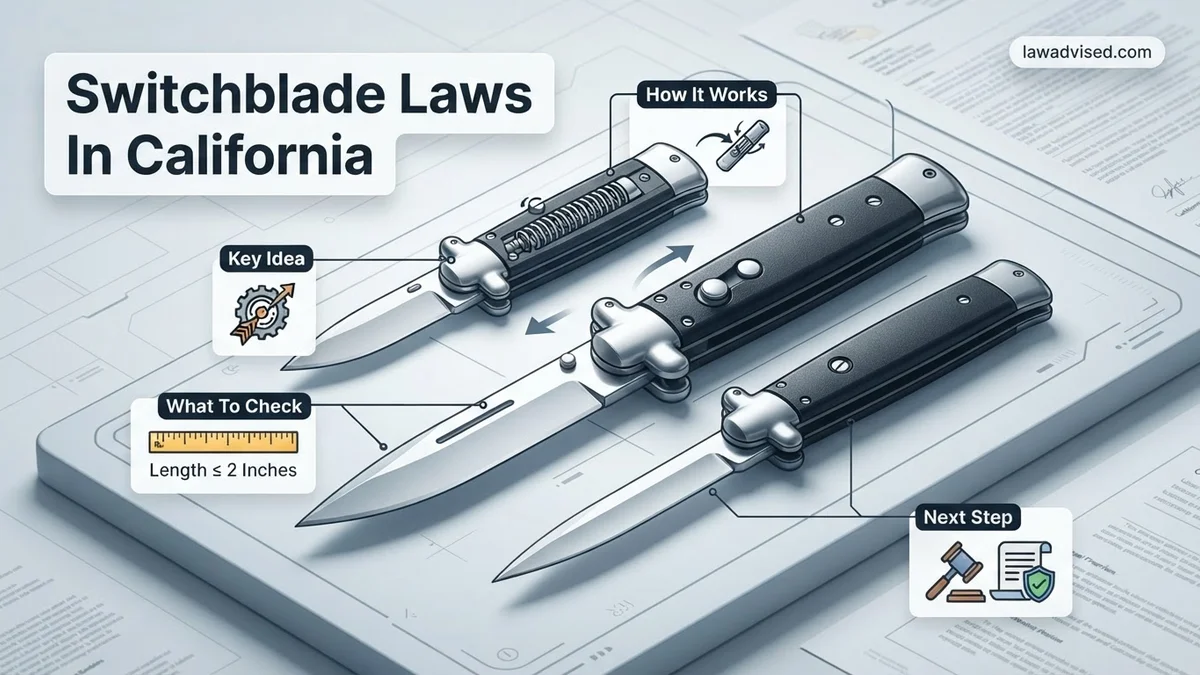
The core of California switchblade prohibition centers on the 2-inch rule. If a knife opens automatically via a button, spring, or other device, and the blade measures 2 inches or longer, it is completely illegal to carry.
- Measurement technique: Law enforcement measures from the tip of the blade to the closest point of the handle or hilt.
- Automatic action: This includes out-the-front (OTF) knives and side-opening switchblades deployed by pressing a button or lever.
- Assisted-opening distinction: Knives that require manual pressure on the blade stub to deploy (assisted-openers) are generally treated differently than true switchblades, provided they lack an automatic release button.
Concealment and Specific Location Bans
Even if a folding knife falls under the legal length limit, how and where you carry it creates legal risk. California law differentiates between open carry and concealed carry.
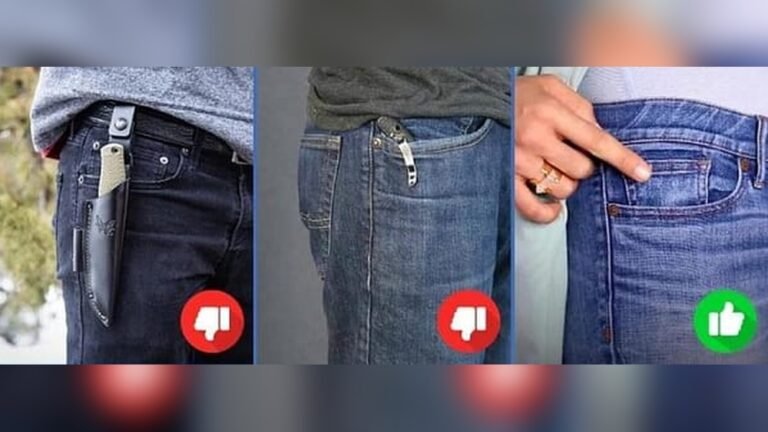
- Concealed carry: Folding knives that are not switchblades must be carried openly in a sheath worn on the belt or kept entirely visible to avoid concealed weapon charges.
- Prohibited zones: Bringing any knife onto K-12 school grounds, university campuses, government buildings, or state public transit facilities triggers severe felony enhancements.
- Intent matters: Carrying a legal pocket knife with the intent to use it as a weapon instantly reclassifies the tool as an illegal dirk or dagger.
How to Comply with California Knife Regulations Step-by-Step
Staying on the right side of the law requires an audit of your collection and careful daily carry habits. Follow these steps to ensure your knife collection meets 2027 legal standards.
Step 1: Audit Your Current Knife Collection
Take time to inspect every folding knife you own to verify its opening mechanism and blade dimensions.
- Remove any push-button switchblade with a blade measuring 2 inches or greater from your rotation immediately.
- Measure your blades using a ruler from the absolute tip to the top of the handle scales.
- Store antique or collector switchblades securely at home where they cannot be deemed readily accessible for public transport.
Step 2: Adopt Compliant Carry Habits
When you step out into public spaces, your carrying method dictates whether you are abiding by California statutes.
- Opt for manual-opening pocket knives that require thumb studs or traditional nail nicks for deployment.
- Ensure your folding knife is clipped visibly to your pocket or carried openly in a belt holster if local ordinances require it.
- Leave all automatic, gravity, or ballistic knives at home when traveling through sensitive public venues like schools or municipal buildings.
What to Do If You Face Accidental Switchblade Possession Charges
Facing criminal allegations under California Penal Code 21510 requires immediate, methodical action. Even if a knife purchase appeared legal at a retail storefront, prosecutors frequently pursue charges for prohibited blades. According to data from the California Department of Justice, weapon violations carry severe penalties, often classified as wobblers that can be charged as misdemeanors or felonies.
Immediate Legal Steps
- Invoke your right to silence: Politely inform law enforcement that you will not answer questions without legal representation present.
- Document the acquisition: Gather original receipts, packaging, and manufacturer specifications proving the exact blade length and deployment mechanism.
- Retain a specialized defense attorney: Secure counsel experienced specifically in California weapons laws and Penal Code definitions.
- Avoid self-incrimination online: Refrain from discussing the incident on social media or messaging platforms, as prosecutors actively monitor digital footprints.
Legal defense costs vary widely based on case complexity. Misdemeanor defense typically ranges from $2,500 to $5,000 in legal fees, while felony charges requiring expert witness testimony on knife mechanics can easily exceed $10,000 to $15,000.
What If Legal Restrictions Still Don’t Clear Up Your Knife Type
Knife mechanics frequently blur the lines between legal folding knives and prohibited automatic blades. If statutory definitions and manufacturer claims leave ambiguity regarding your specific carry item, standard interpretation methods may fail. Apply these advanced fallback steps to protect yourself from legal liability.
Advanced Verification Steps
- Consult a licensed firearms and weapons attorney: Schedule a formal consultation to have an expert physically inspect the knife mechanism and evaluate statutory compliance under 2027 state standards.
- Submit the blade for official classification: Request a written legal opinion from a certified armorer or specialized knife law expert regarding the deployment tension and release mechanism.
- Secure professional appraisal: Retain documentation detailing the exact millimeter measurements of the blade and handle to verify it stays under the 2-inch threshold if manual assistance is debated.
- Retire the item from daily carry: Store ambiguous or borderline folding knives securely at home until definitive legal confirmation is established, eliminating the risk of public possession charges.
Conclusion
Navigating California switchblade laws in 2027 demands strict adherence to evolving statutory length limits and mechanical definitions. While the repeal of the 2-inch limit expanded options for automatic knives, ambiguity surrounding assisted-opening devices and concealed carry restrictions still creates significant legal risk for everyday carriers. According to verified research and expert legal sources, proactive compliance and immediate professional consultation remain the most effective defenses against accidental criminal charges. Take the next step today by auditing your current collection against Penal Code 21510 standards and securing professional legal counsel for any borderline or high-risk blades.
❓ Frequently Asked Questions
What constitutes a switchblade under California law?
A switchblade is legally defined as any knife containing a blade that opens automatically by hand pressure applied to a button, spring, or other device in the handle. This includes snap-blade and gravity knives.
How does California Penal Code 21510 affect everyday carry?
This statute makes it a crime to carry, sell, offer for sale, transfer, or possess any switchblade with a blade length of two inches or more in any public space. Folding pocket knives under 2 inches generally face fewer restrictions.
Where is it strictly forbidden to carry any type of knife?
Carrying any knife is strictly banned on public and private school grounds, university campuses, government buildings, and secure areas of airports regardless of blade length.
Are there exemptions for emergency responders or law enforcement?
Yes, peace officers, active-duty military personnel, and certain emergency medical service workers are often exempt from switchblade carrying restrictions while performing official duties.
What is the difference between open carry and concealed carry for knives?
While non-switchblade folding knives can often be carried concealed if folded completely, switchblades over 2 inches are illegal to carry in public entirely, making the concealment method secondary to the prohibition.
Can out-of-state residents bring switchblades into California?
Out-of-state visitors must adhere strictly to local California laws. Bringing a switchblade exceeding the 2-inch limit into a public space risks immediate confiscation and misdemeanor criminal prosecution.

Ismail Hossain is the founder of Law Advised. He is an Divorce, Separation, marriage lawyer. Follow him.