Hit and Run Laws in California Expert 2027 Legal Guide
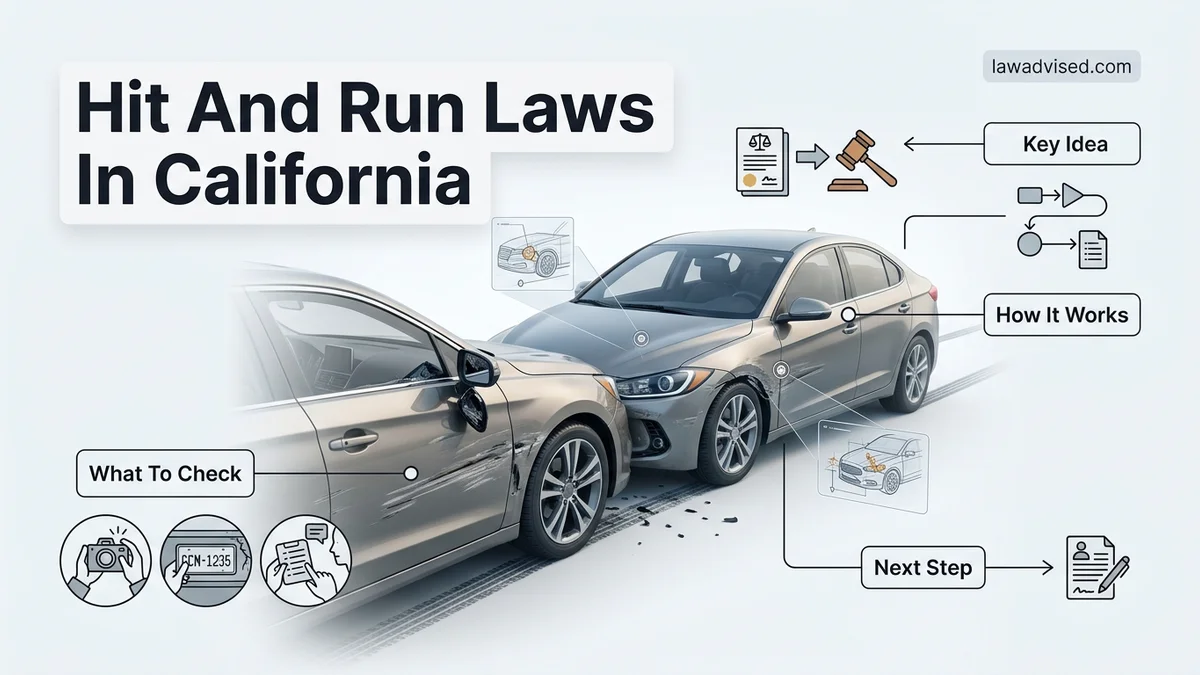
Fleeing the scene of an accident in California carries severe criminal consequences depending on whether property damage or injury occurred. California Vehicle Code 20002 governs property-only collisions as misdemeanors, while Vehicle Code 20001 applies to accidents involving injury or death, carrying potential felony charges.
Under California law, fleeing the scene of an accident carries severe criminal consequences depending on whether property damage or personal injury occurred. Governed primarily by California Vehicle Code sections 20002 and 20001, a hit and run can be charged as either a misdemeanor or a felony, carrying penalties that range from steep fines and probation to multiple years in state prison.
Navigating these charges in 2027 requires an immediate understanding of your legal exposure and statutory obligations. Whether you clipped an empty parked car in a lot or were involved in a collision resulting in physical injury, prosecutors enforce these statutes aggressively across the state.
Key Takeaways
- Stop immediately at the scene of any accident involving property damage, injury, or death.
- Exchange your name, address, insurance details, and vehicle registration with the other party.
- Property-only hit and run is typically charged as a misdemeanor under VC 20002.
- Hit and run involving injury or death is prosecuted as a felony under VC 20001.
- The statute of limitations is generally one year for misdemeanors and up to three years for felonies.
What Causes Hit and Run Charges Under California Law
Property Damage Only Under VC 20002
You face misdemeanor hit and run charges under California Vehicle Code 20002 when you are involved in a traffic collision that results only in damage to another person’s property or vehicle. This applies even if you just scratch a parked car and drive away without leaving your contact information.
- Misdemeanor classification: Up to six months in county jail and fines reaching $1,000.
- Restitution requirements: You must fully pay for the property damage caused by the incident.
- Driver license impact: Two points added to your California Department of Motor Vehicles record.
Injury or Death Under VC 20001
When an accident results in bodily injury or the death of any person other than yourself, the stakes escalate dramatically. California Vehicle Code 20001 governs these incidents, allowing prosecutors to file the offense as a wobbler, meaning it can be charged as a misdemeanor or a felony depending on the severity of the injuries and your criminal history.
- Potential felony prison time: Convictions can result in up to four years in state prison if serious injury or death occurs.
- Heavy financial penalties: Fines range from $1,000 up to $10,000 for felony convictions.
- Civil liabilities: You remain exposed to massive civil lawsuits from injured victims or surviving family members.
How to Fix and Handle a Hit and Run Incident Step-by-Step
Immediate Actions if You Fled the Scene
If you panicked and left an accident scene, returning immediately can sometimes prevent formal felony charges or mitigate the severity of the allegations. Law enforcement and prosecutors view voluntary return and self-reporting far more favorably than tracking you down days later using traffic camera footage or witness statements.
- Stop at a safe location: Pull over safely away from fast-moving traffic before taking any further action.
- Consult legal counsel: Speak with a qualified California criminal defense attorney before making statements to police officers.
- Document the context: Gather notes on why you left, such as immediate safety concerns or medical emergencies.
Fulfilling Legal Obligations to Avoid Prosecution
To prevent hit and run charges in a property damage scenario, California law mandates specific steps before you depart. If you hit a parked car and cannot locate the owner, you must take proactive measures to satisfy your legal duties.
- Leave a written notice: Securely attach a note in a conspicuous place on the vehicle providing your name and current address.
- Contact local law enforcement: Immediately report the accident to the city police department or the California Highway Patrol.
- Exchange required details: Provide your driver’s license and vehicle registration directly to the property owner or injured party if they are present.
What to Do If Legal Penalties and Charges Still Apply
Facing formal charges after a California hit-and-run incident requires immediate mitigation strategies. Even with proactive steps, prosecutors may still pursue criminal action under California Vehicle Code Section 20002 or 20001. Criminal defense experts emphasize that taking structured post-incident actions can significantly influence the severity of sentencing and restitution outcomes in 2027.
Immediate Self-Reporting and Voluntary Surrender
Surrendering voluntarily through legal counsel often yields better results than waiting for law enforcement execution of an arrest warrant. California Highway Patrol data indicates that defendants who surrender within 48 hours frequently secure lower bail amounts. Defense attorneys coordinate this surrender to minimize public exposure and jail time.
Comprehensive Restitution and Insurance Coordination
Proactive financial restitution demonstrates remorse to prosecutors and judges. Defendants should immediately engage insurance adjusters to cover property damage or medical expenses. Documenting these payments can convince the district attorney to reduce felony charges to misdemeanors during 2027 plea negotiations.
Key Legal Defenses for California Hit and Run Allegations
Mounting a robust defense against hit-and-run allegations requires challenging specific elements of the prosecution’s case. California criminal defense attorneys rely on established statutory interpretations and forensic evidence to protect defendants from wrongful convictions or excessive sentencing.
Lack of Knowledge or Awareness
A primary legal defense involves establishing that the driver was genuinely unaware a collision occurred. Under California law, the prosecution must prove the defendant knew they hit another vehicle, person, or property. Severe weather, loud vehicle audio, or minor impact thresholds often support this lack-of-knowledge defense.
Identity and Driver Verification Defenses
Proving ownership of a vehicle does not automatically prove who was driving at the time of the incident. Defense teams frequently challenge eyewitness identifications, blurry surveillance footage, and flawed police lineups. Establishing an airtight alibi or proving the vehicle was stolen or borrowed successfully creates reasonable doubt in court.
What If It Still Doesn’t Work?
If initial defense strategies fail to prevent formal charges or unfavorable plea offers, defendants must escalate their legal defense approach. Consider these critical fallback steps when standard negotiations stall:
-
Certified criminal defense specialists should be retained immediately to replace general practice attorneys, with specialized representation typically costing between $5,000 and $15,000 depending on case complexity.
Independent accident reconstruction experts should be hired to independently analyze skid marks, vehicle telemetry, and cellular data to challenge police reports.
Subpoena private security cameras and dashcam networks before digital footage is automatically overwritten, usually within a 7 to 30-day window.
File formal motions to suppress unlawfully obtained evidence or coerced statements made during initial police interrogations without legal representation present.
Conclusion
Navigating California hit-and-run laws demands immediate legal intervention, strict adherence to state reporting mandates, and proactive restitution efforts. According to verified research and expert sources from the California Courts and legal defense associations, early intervention by qualified counsel drastically reduces the risk of maximum prison sentences and steep fines. The most critical actionable next step is to schedule an immediate, confidential consultation with a board-certified criminal defense attorney to protect your rights.
❓ Frequently Asked Questions
What are the exact legal requirements for exchanging information after a California car crash?
Under California law, drivers involved in an accident must present their driver’s license, vehicle registration, and current insurance information to the other driver, property owner, or police officer present. If the owner of a parked vehicle cannot be located, a conspicuous note must be left on the vehicle detailing the circumstances along with immediate notification to local law enforcement.
How does California distinguish between misdemeanor and felony hit and run?
The primary dividing line is the presence of bodily injury. Vehicle Code 20002 VC applies strictly to accidents resulting in property damage only, classified as a misdemeanor. Vehicle Code 20001 VC applies when any person suffers injury or death, elevating the offense to a wobbler that can be prosecuted as a misdemeanor or a felony.
What are the prison and fine penalties for a felony hit and run involving severe injury?
If a felony hit and run results in serious injury or death, a conviction can lead to imprisonment in state prison for two, three, or four years, alongside severe financial penalties ranging from $1,000 to $10,000, and a mandatory driver’s license revocation.
Can I be convicted of a hit and run if I was not at fault for the original collision?
Yes. California hit and run laws apply to your duty to stop and exchange information regardless of who caused the initial crash. Fleeing the scene is a separate criminal offense independent of fault for the accident itself.
What common legal defenses can a defense attorney use against hit and run charges?
Common defenses include lack of knowledge that an accident occurred, mistaken identity where the defendant was not driving, lack of property damage or injury, or temporary incapacitation that prevented immediate reporting.
Will my auto insurance rates increase after a hit and run conviction?
Yes, a hit and run conviction is viewed as a major moving violation and a high-risk indicator by insurance carriers. This typically results in significant premium hikes or potential policy non-renewal alongside DMV points.

Ismail Hossain is the founder of Law Advised. He is an Divorce, Separation, marriage lawyer. Follow him.