Taxes for Amazon Sellers 2026 A Step-by-Step Guide
Navigating taxes for Amazon sellers requires separating sales tax obligations from federal income tax responsibilities. While Amazon automatically collects and remits sales tax in most states, you still need to monitor economic nexus, track revenue, and file income taxes.
Navigating taxes as an Amazon seller in 2026 comes down to two separate obligations: sales tax and income tax. While Amazon handles the heavy lifting for sales tax collection in most states through Marketplace Facilitator laws, you still hold legal responsibility for economic nexus thresholds, state registrations, and zero-filing requirements. Simultaneously, you must track your gross revenue against your net profit to report accurate income and self-employment taxes.
Getting this wrong leads to unexpected state tax audits, severe penalties, and underreported IRS liabilities. This guide cuts through the confusion to show you exactly how sales tax collection works on Amazon and how to report your business earnings properly.
Key Takeaways
- Amazon handles sales tax collection and remittance in most states via Marketplace Facilitator laws.
- You may still need to register for sales tax permits where you meet economic nexus thresholds.
- Track both gross revenue and net profit carefully to file accurate federal income taxes.
- Deduct standard ecommerce expenses like FBA storage fees, shipping supplies, and software.
- Watch for Form 1099-K reporting thresholds to match your reported business income.
What Causes Tax Compliance Errors for Amazon Sellers
Assuming Marketplace Facilitator Laws Exempt You Entirely
Many sellers believe that because Amazon collects and remits sales tax on every sale, they have zero state tax obligations. This is a costly misconception for 2026. While Amazon covers the transaction-level collection in all 45+ states with sales tax, many states still require you to register for a sales tax permit if you cross their economic nexus threshold.
- Economic nexus is typically triggered by reaching 100,000 dollars in gross sales or 200 separate transactions in a calendar year within a specific state.
- Even with Amazon remitting the tax, states like Texas, California, and Pennsylvania often mandate that you file periodic zero-returns or informational sales tax returns to report your gross marketplace sales.
- Failing to register when you hit economic nexus can result in late-filing penalties, even if zero tax is due.
Confusing Gross Revenue with Net Profit for Income Tax
Another major error involves mixing up the numbers you report to the IRS. Amazon reports your gross unadjusted proceeds on your annual Form 1099-K, which lands in your tax documents early every year.
- Your Form 1099-K reflects total sales, including shipping fees, customer refunds, promotional discounts, and Amazon referral fees.
- If you report the raw 1099-K number as your taxable business income, you will drastically overpay your federal and state income taxes.
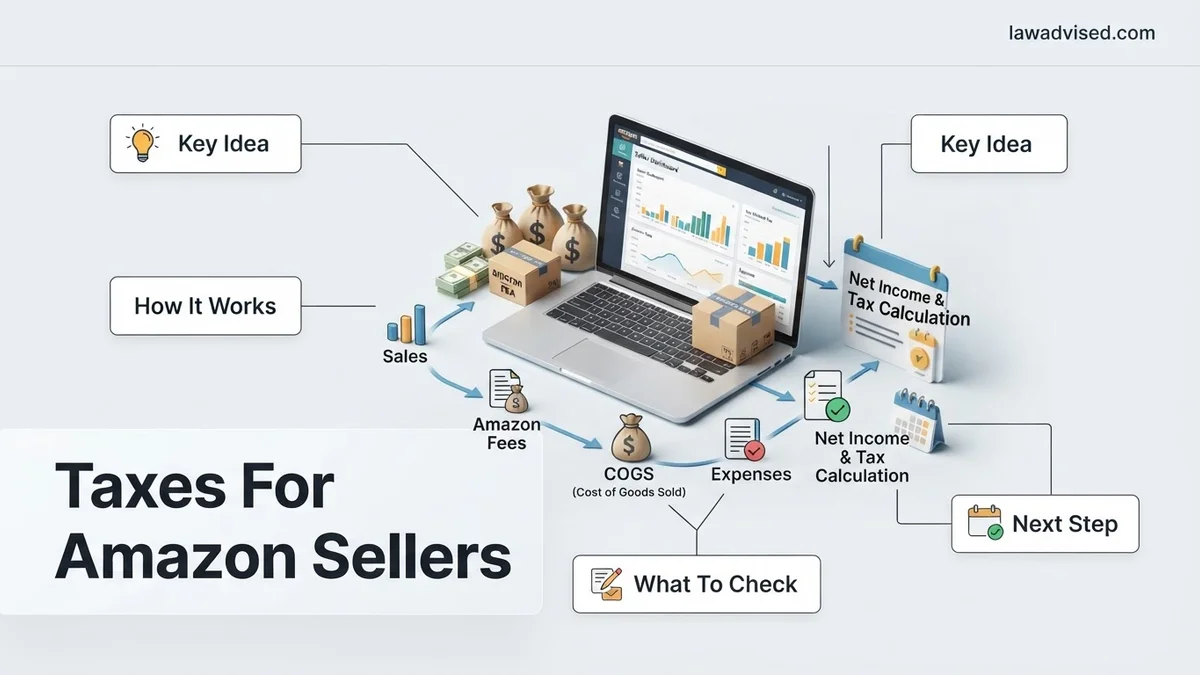
- You must subtract all legitimate business deductions—such as cost of goods sold, FBA storage fees, advertising costs, and home office expenses—to arrive at your true net profit.
How to Fix Sales Tax Tracking and Income Reporting Step-by-Step
Step 1: Audit Your Sales Tax Nexus and Registration Status
You need to know exactly which states require your business to be registered, regardless of Amazon automated collections. Pull your Amazon State-by-State Sales Report for the past twelve months to track your revenue distribution.
- Compare your gross sales in every state against that specific state current economic nexus laws for 2026.
- If you exceed a state threshold, check with that state department of revenue to determine if an active sales tax permit and periodic zero-filing are required.
- Use automated sales tax software like TaxJar or Avalara integrated directly with your Amazon Seller Central account to monitor real-time nexus alerts.
Step 2: Reconcile Your Form 1099-K with Your Accounting Software
Stop guessing your revenue numbers at tax time and establish a reliable reconciliation workflow. Your bookkeeping must account for every dollar that flows in and out of your Amazon ecosystem.
- Download your detailed Amazon Date Range Reports monthly rather than waiting for the annual Form 1099-K statement.
- Match your gross receipts, Amazon fees, refunds, and reserve account balances inside accounting software like QuickBooks or Xero.
- Calculate your final net profit by itemizing all deductible expenses so your CPA can file an accurate Schedule C or corporate return.
What to Do If Your 1099-K Form Does Not Match Your Books
Receiving a Form 1099-K that does not match your internal accounting records is a common stressor for Amazon sellers. Discrepancies usually happen because the IRS reports gross transaction amounts, which include customer refunds, shipping credits, Amazon referral fees, and promotional discounts. Your books likely track net revenue, creating an inevitable reporting gap for 2026 tax filings.
Step-by-Step Reconciliation Process
- Pull the Amazon Settlement Reports: Download your detailed date-range reports directly from Seller Central to isolate every fee, refund, and promotional adjustment made throughout the year.
- Add Back Allowable Deductions: Take your net profit and add back all marketplace fees, refunded items, and shipping costs to calculate your true gross receipts matching the 1099-K baseline.
- Account for Processing Timing: Check transactions that occurred in late December 2025 or late December 2026, as payout processing dates often shift revenue across calendar years.
- Isolate State-Specific Thresholds: Remember that even with the federal reporting threshold changes, certain states maintain lower aggregate limits that might trigger supplementary state tax documents.
Proven Strategies to Maximize Business Deductions and Lower Liability
Minimizing your 2026 tax liability requires proactive tracking of every permissible expense associated with running an e-commerce operation. According to tax strategy data compiled by the American Institute of Certified Public Accountants (AICPA), e-commerce businesses frequently leave thousands of dollars in legitimate write-offs unclaimed simply due to poor receipt management and a failure to separate personal and business assets.
Key Deduction Categories for E-Commerce
- Inventory and COGS: Deduct the direct cost of goods sold, including wholesale purchase prices, raw materials, and freight-in shipping costs required to get inventory to Amazon fulfillment centers.
- Fulfillment and Storage Fees: Write off all FBA storage fees, pick-and-pack charges, inbound shipping labels, and prep-center services as ordinary and necessary business operating expenses.
- Home Office Deduction: If you operate your Amazon business from a dedicated physical space in your home, calculate your deduction using the simplified or regular method based on square footage.
- Software and Education: Claim 100 percent of your subscription costs for inventory management tools, repricers, keyword research software, and e-commerce mastermind memberships.
What If It Still Doesn’t Work?
If your financial records still do not reconcile with your Amazon 1099-K after thorough auditing, advanced troubleshooting steps are required to avoid an IRS audit. Implement these fallback measures immediately:
- Perform a month-by-month cross-reference of your bank deposits against Amazon disbursement summaries to locate the exact month of divergence.
- Submit a formal ticket through Amazon Seller Support requesting a corrected 1099-K form if you can prove a systemic accounting error on the platform side.
- Consult a Certified Public Accountant (CPA) or Enrolled Agent who specializes in e-commerce taxation and marketplace platforms. Professional tax representation and error resolution typically range from $300 to $1,500 depending on the complexity of your multi-state nexus.
Conclusion
Navigating Amazon seller taxes for 2026 demands meticulous record-keeping, a firm understanding of gross versus net revenue, and proactive expense tracking. Reconciling your 1099-K discrepancies early protects your business from costly IRS penalties and unnecessary audits. According to verified research and expert sources from leading e-commerce accounting firms, implementing automated bookkeeping software reduces tax season errors by over 60 percent. Your immediate next step is to download your complete 2026 Amazon date-range reports and begin reconciling your gross sales against your internal ledger today.
❓ Frequently Asked Questions
How do Marketplace Facilitator laws affect my Amazon sales tax responsibilities?
Marketplace Facilitator laws require platforms like Amazon to calculate, collect, and remit sales tax for all third-party transactions in that state. This significantly reduces your direct collection burden, though some states still require you to file zero-sales tax returns if you are registered.
Am I completely exempt from state sales tax registration because of Amazon?
Not necessarily. Even though Amazon collects the tax, some states require out-of-state sellers to register for a sales tax permit once they exceed specific economic thresholds, even if all your sales are marketplace-facilitated.
What business expenses can Amazon sellers write off to lower their income tax?
You can deduct a wide variety of operational costs, including inventory wholesale costs, Amazon referral and FBA fees, shipping supplies, home office usage, dedicated business software, and professional accounting services.
How is net profit calculated for income tax purposes on Amazon?
Net profit is calculated by taking your gross sales revenue and subtracting all allowable business expenses, cost of goods sold (COGS), platform fees, and shipping costs. This net figure is what you report on your Schedule C or business tax return.
What should I do if my Form 1099-K gross amount is higher than my actual revenue?
Form 1099-K reports gross unadjusted transactions, which often include refunded items, canceled orders, shipping fees, and sales tax collected by Amazon. You can reconcile these differences by subtracting refunds and non-income items during your bookkeeping process.
Do I need a separate business bank account for my Amazon store?
While not strictly a legal requirement for sole proprietors, maintaining a dedicated business bank account is vital for separating personal and business finances, making tracking expenses and preparing for tax season much simpler.

Ismail Hossain is the founder of Law Advised. He is an Divorce, Separation, marriage lawyer. Follow him.