Taxes for Etsy Sellers 2026 Step-by-Step Expert Guide
Navigating taxes for Etsy sellers requires separating income tax obligations from sales tax responsibilities. Etsy automatically collects and remits sales tax in most states, but sellers must still report shop income, track eligible business expenses, and file federal tax returns accurately.
As an Etsy seller in 2026, your core tax obligation is reporting your net business income on your personal tax return using Schedule C, while letting Etsy handle the heavy lifting for state sales tax collection and remittance in most jurisdictions. You must track your revenue, subtract legitimate business expenses, and understand how the IRS views your shop.
Ignoring these obligations leads to unexpected tax bills and penalties. Mastering your income taxes and sales tax responsibilities protects your profit margins and keeps your shop compliant with federal and state laws.
Key Takeaways
- Etsy handles sales tax in most states via marketplace laws, but out-of-state economic nexus rules still require monitoring.
- Expect Form 1099-K if your sales exceed federal or state reporting thresholds.
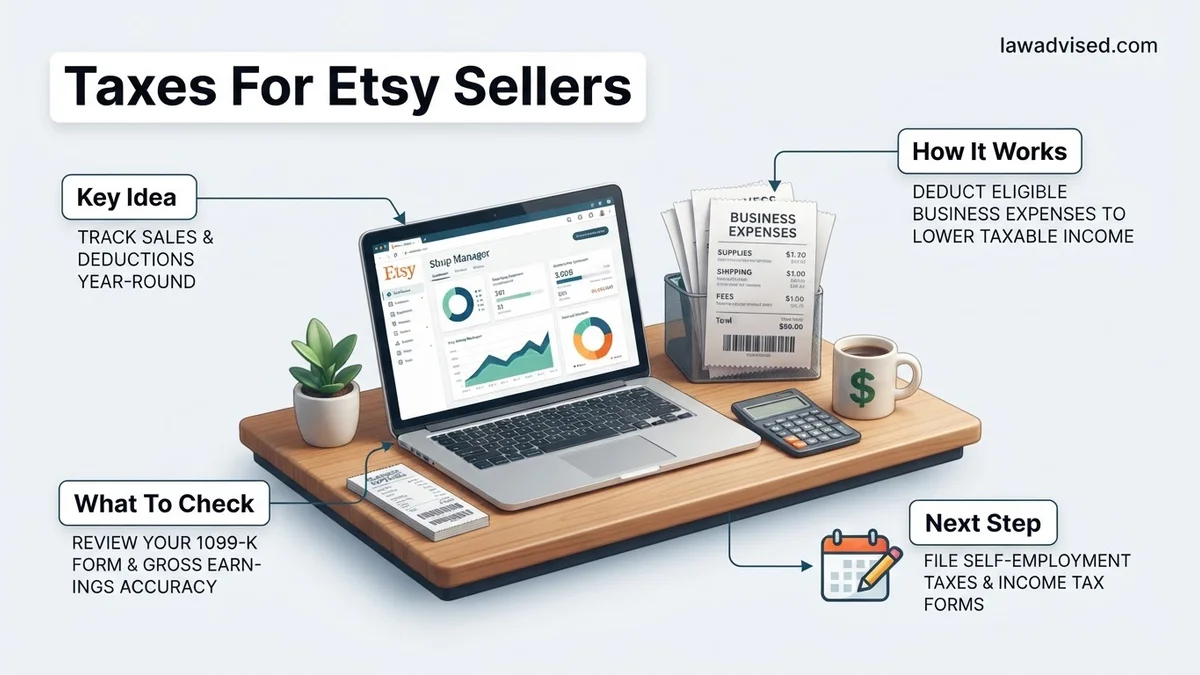
- Track all ordinary business expenses to lower your taxable net income.
- File Schedule C alongside your personal tax return if operating as a sole proprietor.
- Set aside money for quarterly estimated tax payments to avoid underpayment penalties.
What Causes Tax Confusion for Etsy Sellers and How Income Taxes Work
Many sellers get overwhelmed because they confuse gross revenue with taxable profit, or they misunderstand what the IRS expects from a hobby versus a legitimate business. Your income tax obligations depend strictly on your net earnings, which you calculate by subtracting your business expenses from your total sales.
Decoding the Form 1099-K Thresholds
The IRS requires payment processors to report your gross sales. For the 2026 tax year, the federal reporting threshold for Form 1099-K sits at $5,000.
- If your gross sales on Etsy exceed $5,000 in 2026, you and the IRS will receive a 1099-K form.
- Even if you make less than $5,000 and do not receive a 1099-K, you are still legally required to report all your Etsy income on your taxes.
- Your 1099-K shows gross sales, meaning it does not account for Etsy fees, shipping costs, or refunds. You must deduct these expenses yourself.
Filing Schedule C as a Sole Proprietor or Single-Member LLC
Most Etsy sellers operate as sole proprietors or single-member LLCs, meaning business profits pass straight through to your personal tax return.
- You will use IRS Schedule C (Profit or Loss From Business) to report your gross receipts and itemize your deductions.
- Net earnings over $400 from your Etsy shop also trigger self-employment tax obligations, which cover your Social Security and Medicare contributions via Schedule SE.
- Keep meticulous records of your Etsy fees, supplies, shipping materials, home office use, and a portion of your internet bill to lower your taxable profit.
How to Fix Sales Tax Compliance and Handle Marketplace Facilitator Laws
Sales tax used to require registering in dozens of states and manually filing returns for every order. Fortunately, marketplace facilitator laws have largely automated this process for Etsy sellers, shifting the primary collection burden away from individual shops.
Understanding Marketplace Facilitator Laws on Etsy
Etsy operates as a marketplace facilitator under the tax laws of all U.S. states and many international regions. This means Etsy is legally required to calculate, collect, and remit state and local sales tax on your behalf for almost every transaction.
- When a customer in New York buys a handmade mug from your California-based shop, Etsy collects the New York sales tax and pays it directly to New York State.
- You do not need to register, collect, or remit state sales tax for standard sales made directly through the Etsy checkout platform in facilitator states.
- Check your monthly Etsy CSV statements to see exact sales tax amounts that Etsy automatically handled for you.
When You Still Need to Worry About Sales Tax
While Etsy handles marketplace transactions, you may still face state-specific tax obligations outside of the core platform.
- Out-of-State Economic Nexus: If you sell items through your own independent website (like a standalone Shopify store) in addition to Etsy, those non-Etsy sales count toward state-specific economic nexus thresholds—often $100,000 in sales or 200 transactions.
- Local Sales and Craft Fairs: If you sell your Etsy items locally at craft fairs, pop-up markets, or in-person brick-and-mortar locations, you are personally responsible for collecting and remitting local sales tax to your state’s department of revenue.
Step-by-Step Guide to Tracking Expenses and Filing Schedule C
Filing your Etsy business taxes correctly requires reporting your net income on IRS Schedule C alongside your Form 1040. Accurate expense tracking legally lowers your adjusted gross income, ensuring you only pay taxes on true profits. According to certified public accounting data, small e-commerce sellers routinely miss up to twenty percent of eligible write-offs by relying solely on bank statements rather than dedicated bookkeeping software.
How to Complete Schedule C
- Calculate Gross Receipts: Pull your total 2026 sales data from your Etsy Financial Ledger, including product prices, shipping fees charged to buyers, and collected sales tax where applicable.
- Compile Total Deductions: Add up all allowable business expenses categorized by the IRS, including Etsy listing fees, offsite ads, packaging materials, shipping postage, and a calculated home office deduction.
- Determine Net Profit or Loss: Subtract your total deductible expenses from your gross receipts to find your final net profit figure.
- Transfer to Line 31: Enter your final net profit or loss figure onto Line 31 of Schedule C and carry that amount over to your primary Form 1040 individual income tax return.
What If Your Etsy Shop Still Owes More Than Expected or You Missed a Payment
Discovering a massive tax bill or realizing you missed a quarterly estimated payment can cause severe anxiety for modern e-commerce entrepreneurs. The IRS and state tax agencies provide structured paths to resolve unexpected liabilities without triggering catastrophic penalties, provided you act proactively before receiving an official audit notice.
Recommended Recovery Steps
- File on Time Regardless of Payment: Submit your 2026 tax return by the official April deadline even if you cannot afford the total balance due, which completely avoids the much steeper failure-to-file penalty.
- Apply for an IRS Payment Plan: Set up a short-term payment extension for up to 180 days or an installment agreement through the official IRS online payment portal for monthly structured payments.
- Engage a Qualified Tax Professional: Consult a Certified Public Accountant or Enrolled Agent specializing in e-commerce taxation if your liability exceeds five thousand dollars or involves multi-state nexus issues. Professional representation fees typically range from three hundred to fifteen hundred dollars depending on complexity.
- Adjust 2027 Estimated Payments: Recalculate your projected quarterly tax liabilities for the upcoming year immediately to prevent recurring shortfalls.
Conclusion
Navigating Etsy seller taxes requires diligent record-keeping, precise expense categorization, and a clear understanding of IRS Schedule C requirements. Failing to track deductions or missing estimated payments can quickly lead to unexpected financial burdens and costly penalties. According to verified research and expert tax sources, establishing automated quarterly reviews is the single most effective defense against year-end e-commerce tax surprises. One actionable next step is to sync your Etsy shop with specialized accounting software today to categorize your current year transactions automatically.
❓ Frequently Asked Questions
What is a Form 1099-K and when will Etsy send it to me?
Form 1099-K is an IRS informational return showing your gross payment volume through Etsy Payments. Etsy provides this form to you and the IRS if your sales meet federal thresholds or lower state-specific requirements.
How do marketplace facilitator laws affect my Etsy sales tax duties?
Marketplace facilitator laws require platforms like Etsy to collect and remit sales tax on behalf of sellers for transactions shipped to states with these laws. This relieves individual sellers of collecting state sales tax in those jurisdictions, though direct sales outside Etsy have separate rules.
What should I do if my Etsy sales don’t trigger a Form 1099-K?
Even if you do not receive a Form 1099-K from Etsy, you are still legally required to report all business income to the IRS. Check your shop payment account statements to tally your total gross receipts for the year.
How do I calculate quarterly estimated tax payments for my Etsy business?
If you expect to owe $1,000 or more in taxes when filing your return, you generally need to make quarterly estimated tax payments using IRS Form 1040-ES. Calculate these based on your projected annual net profit, self-employment tax, and income tax bracket.
Can I deduct the cost of supplies I bought before opening my Etsy shop?
Yes, start-up costs and inventory purchased prior to officially launching your Etsy business can often be deducted or amortized as business expenses once your shop begins active operations.
Do I need to register a formal LLC for my Etsy shop for tax purposes?
An LLC is not strictly required to sell on Etsy; many sellers operate as sole proprietors. However, an LLC can provide added legal protection and potential tax flexibility as your handmade business grows.

Ismail Hossain is the founder of Law Advised. He is an Divorce, Separation, marriage lawyer. Follow him.