W4 for Dependents Step-by-Step Guide for 2026
Incorrectly filling out Step 3 of the IRS Form W-4 can lead to an unexpected tax bill or a drastically reduced paycheck. This guide breaks down exactly how to claim qualifying children and other dependents to ensure the right amount of tax is withheld from your pay in 2026.
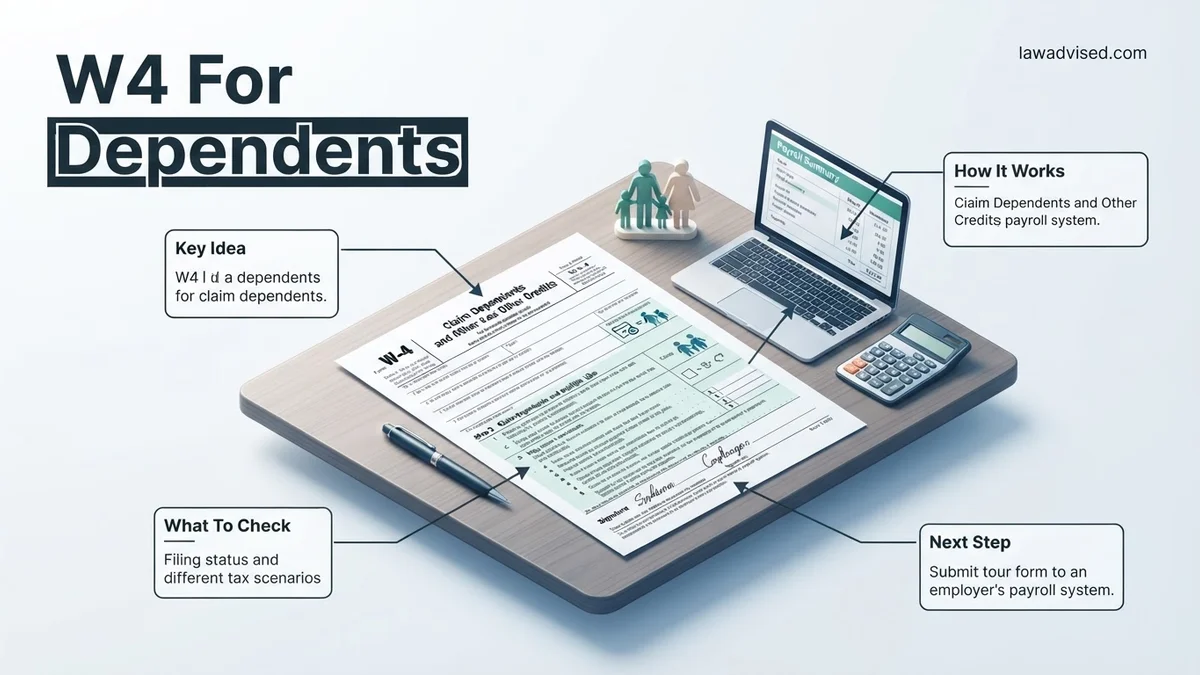
You claim dependents on the IRS Form W-4 in Step 3 (Claim Dependents) to directly reduce your federal income tax withholding and increase your take-home pay. Instead of using old-school withholding allowances, the modern W-4 requires you to calculate a precise dollar amount based on the number of qualifying children and other dependents you have.
Getting this step right prevents you from lending your hard-earned money to the IRS interest-free all year or facing a surprise tax bill in April 2027. Below, you will find out exactly what causes calculation errors and how to complete Step 3 accurately.
Key Takeaways
- Multiply qualifying children under age 17 by $2,000 to determine your main dependent credit.
- Include other eligible dependents, such as older qualifying relatives, for a $500 credit each.
- Only claim dependents on one W-4 if you and your spouse both work.
- Overestimating your dependent credits on the W-4 will result in owing taxes at year-end.
- Review and update your W-4 whenever your family or financial situation changes.
What Causes Incorrect Dependent Withholding on the W-4
Most paycheck withholding errors happen because people misunderstand how the IRS evaluates dependents or confuse tax credits with deductions. When you fill out your W-4, a mistake in Step 3 throws off your entire tax trajectory for the year.
Confusing Tax Credits with Tax Deductions
The biggest pitfall is treating Step 3 like a simple headcount of your family members. Step 3 asks for a dollar amount, not a quantity.
- The IRS uses Step 3 to apply the Child Tax Credit and the Credit for Other Dependents directly to your withholding.
- Entering the number of children instead of the total dollar value will leave you dangerously under-withheld.
- For 2026, assuming standard legislative guidelines, these credits directly lower the total tax your employer takes out of each paycheck.
Failing to Vet Dependent Eligibility
Another major trigger for incorrect withholding is claiming individuals who do not meet strict IRS definitions. If you claim someone who legally qualifies as a dependent on your 2026 tax return, but fail the W-4 rules, your math breaks down.
- Qualifying children generally must be under age 17 at the end of the tax year and have a valid Social Security number.
- Other dependents, like elderly parents or college-age relatives, qualify for a different, lower credit amount.
- Failing to separate these two categories means your calculated withholding amount will be completely wrong.
How to Fix Step 3 of Your W-4 for Dependents Step-by-Step
Fixing or completing Step 3 requires a straightforward mathematical calculation. You do not need an accounting degree, just accurate information about your household and a calculator.
Calculating Your Qualifying Child Amount
Start by counting every child in your household who meets the strict IRS rules for the Child Tax Credit.
- Multiply the number of qualifying children under age 17 by the standard credit amount.
- For the 2026 tax year, the baseline Child Tax Credit is typically valued at $2,000 per qualifying child (subject to phase-outs for high-income earners).
- Write this total sub-figure down. For example, two qualifying children equal $4,000.
Adding Other Dependents and Finalizing the Total
Next, account for any other individuals you financially support who do not qualify for the primary Child Tax Credit.
- Multiply the number of other dependents (such as aging parents or college students aged 17 and older) by $500.
- Add this figure to your qualifying children subtotal from the previous step.
- Enter this final combined dollar amount on the blank line in Step 3 of your W-4 form and hand it to your employer’s payroll department.
How to Verify Dependent Eligibility and Income Limits
Claiming dependents incorrectly on your Form W-4 can trigger a massive tax bill or an unwanted audit from the IRS. Before updating your withholding in 2026, you must confirm that your qualifying children or relatives meet current statutory guidelines. Tax experts emphasize that verification protects against severe under-withholding penalties.
Qualifying Child Criteria for 2026
To claim a dependent under the qualifying child rules, they must pass specific relationship, age, and residency tests mandated by federal tax code:
- Age Limits: The child must be under the age of 19 at the end of 2026, or under age 24 if they are a full-time student for at least five months of the year.
- Residency Test: The individual must live with you for more than half of the calendar year, with temporary absences for education or medical care counting as time present.
- Financial Support: The dependent cannot provide more than 50 percent of their own financial support during the 2026 tax year.
Qualifying Relative and Income Thresholds
If you are claiming an aging parent or a relative, stricter financial rules apply under current IRS guidelines. According to data from the Tax Policy Center, the gross income limit for a qualifying relative is adjusted annually for inflation. For the 2026 tax year, your relative’s gross taxable income must generally remain below the statutory threshold of $5,050. Furthermore, you must provide more than half of their total financial support for the entire calendar year to legally claim the dependent credit on your W-4 form.
What If Your Take-Home Pay Still Doesn’t Match Your Expectations
Sometimes adjusting your Form W-4 for dependents does not immediately yield the expected paycheck amount. Payroll departments often require two to three pay cycles to process updates. If your 2026 net pay remains inaccurate after waiting, specific troubleshooting steps can identify the root cause.
Troubleshooting Withholding Discrepancies
- Review Your Paystub Deductions: Check if other pre-tax deductions, such as health savings accounts or retirement contributions, changed simultaneously and impacted your net total.
- Confirm Employer Processing: Contact your human resources or payroll department to verify that they actually entered the exact figures from your submitted 2026 W-4 into their software.
- Re-run the Tax Estimator: Input your most recent year-to-date earnings into the IRS Tax Withholding Estimator tool to ensure outside income or a working spouse did not offset your dependent credits.
- Consult a Certified Public Accountant: If complex investments or multi-state income streams complicate your withholding, schedule a consultation with a licensed tax professional. Hiring a CPA typically ranges from $200 to $500 depending on the complexity of your return.
Conclusion
Optimizing your Form W-4 for dependents prevents inaccurate tax withholding and secures your hard-earned cash throughout the year. By accurately calculating your credits and verifying dependent eligibility under 2026 rules, you eliminate the risk of a surprise tax bill. According to verified research and expert financial sources, proactive withholding management is the single most effective way to optimize household cash flow. Take the next actionable step today by logging into your employer portal to review and update your W-4 selections.
❓ Frequently Asked Questions
What is the exact mathematical formula for Step 3 on the W-4?
To calculate your total in Step 3, multiply the number of qualifying children under 17 by $2,000, then multiply the number of other dependents by $500, and add those two figures together.
Who officially qualifies as a dependent for tax withholding purposes?
A qualifying child must be under 17, have a valid Social Security number, and be claimed as a dependent on your tax return. Other dependents include older children, elderly parents, or relatives who meet specific financial support tests.
How does claiming dependents in Step 3 affect my actual tax refund?
Step 3 adjusts your paycheck withholding to account for tax credits you will receive, which reduces the amount of tax taken out per pay period. This directly increases your take-home pay throughout the year rather than waiting for a lump-sum refund.
Can I claim a child born during the tax year on my current W-4?
Yes, you can submit a new Form W-4 to your employer as soon as your child is born to immediately start receiving the withholding benefit for the rest of the year.
What should I do if my income is too high to qualify for child tax credits?
The Child Tax Credit phases out for higher-income earners. If your income exceeds the IRS threshold, you should consult the IRS Tax Withholding Estimator to calculate the correct Step 3 entry.
Is it better to claim zero dependents to get a bigger tax refund?
Claiming zero dependents causes your employer to withhold the maximum amount of tax, resulting in a large refund but smaller paychecks. Most financial experts recommend accurate withholding so you keep your own money throughout the year.

Ismail Hossain is the founder of Law Advised. He is an Divorce, Separation, marriage lawyer. Follow him.