W4 for Second Job Step-by-Step Guide to Correct 2026
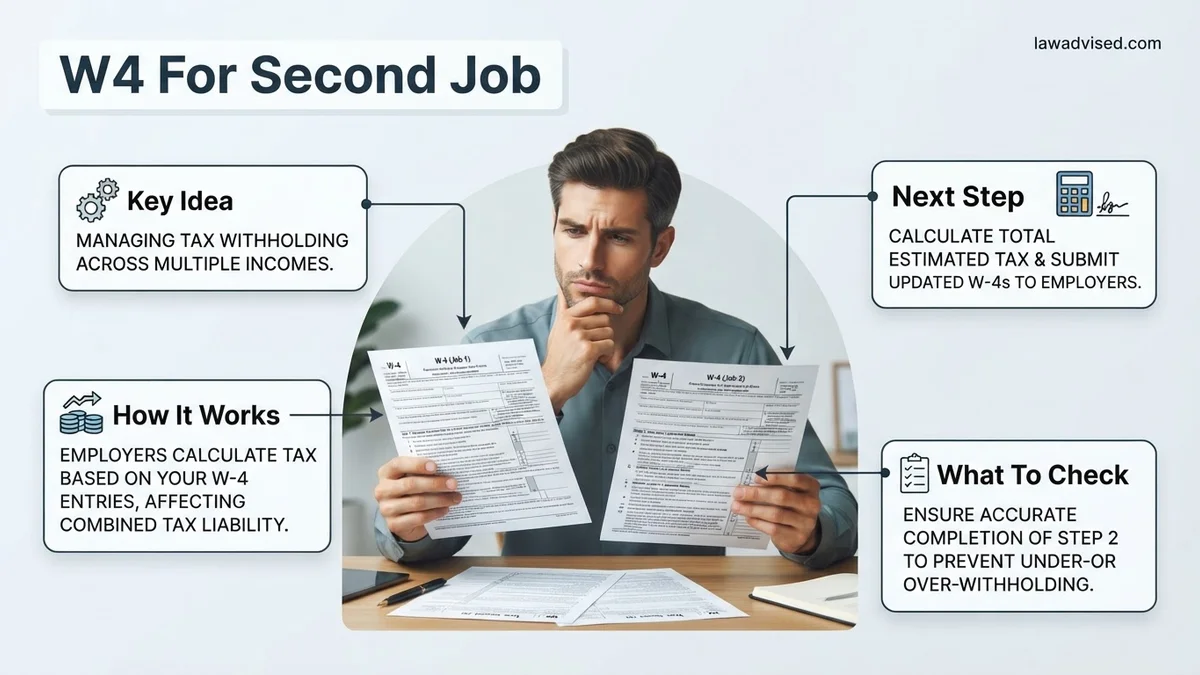
Filling out a W-4 for a second job is critical to avoid owing hundreds or thousands of dollars at tax time due to combined income bracket jumps. Step 2 of the modern W-4 form provides three distinct methods to balance your withholdings accurately. Choosing the right method depends entirely on whether your two jobs pay similar amounts or vastly different salaries.
To avoid a massive tax bill or severe underpayment penalties in 2026, you must fill out Step 2 on Form W-4 whenever you take on a second job. Because tax brackets are progressive, your second job’s income stacks on top of your primary income, pushing your total earnings into a higher marginal tax bracket than either employer realizes on their own.
When you hold two jobs simultaneously, neither employer sees the other paycheck. This structural blind spot causes both payroll departments to apply the standard deduction and lower tax brackets independently, leaving you critically under-withheld by year-end unless you use the Multiple Jobs Worksheet or the IRS Tax Withholding Estimator.
Key Takeaways
- Use Step 2 of the W-4 to prevent under-withholding on a second job.
- The IRS Tax Withholding Estimator offers the most precise calculation for multi-job earners.
- Checking the Step 2(c) box works best when you hold two jobs that pay roughly equal amounts.
- Apply the Multiple Jobs Worksheet only if you have exactly two jobs and want a manual calculation.
- Submit a new W-4 to your employer whenever your income or job status changes.
Why Failing to Update Your W-4 for a Second Job Causes Tax Bills
The Illusion of the Standard Deduction
Every employer assumes they are your only source of income when calculating your periodic tax withholding. Your primary job gives you the full benefit of the 2026 standard deduction, shielding a large portion of your earnings from federal income tax. When your second job applies that exact same standard deduction logic, the IRS essentially gives you a double discount on tax-free income.
This duplication means both payroll systems withhold taxes as if you earn less total money than you actually do. When April arrives, your combined income pushes you into a tax bracket that neither employer accounted for, triggering an unexpected balance due.
Progressive Tax Brackets and Job Stacking
The United States uses a progressive income tax system where different portions of your income are taxed at increasing rates. Consider a practical 2026 scenario where your main job pays seventy thousand dollars and your second job pays thirty thousand dollars.
- Your primary job withholds taxes assuming your income stops at seventy thousand dollars.
- Your second job withholds taxes assuming your income starts at zero and maxes out at thirty thousand dollars.
- In reality, your combined one hundred thousand dollar income crosses into a higher marginal tax bracket.
- The tax difference between those isolated brackets and your actual combined bracket creates your end-of-year tax liability.
How the Multiple Jobs Withholding Trap Creates Underpayment
The Mechanism of Payroll Blindness
Payroll software operates strictly inside a vacuum. Your human resources department has no legal obligation or technical capability to track your external income streams. Without explicit instructions via your W-4, the withholding algorithm treats your second paycheck as your baseline earnings. This guarantees that your effective tax rate will be set too low.
To counteract this blindness, the IRS designed Step 2 of the W-4 specifically to bridge the gap between separate payroll systems. Ignoring this step is the single most common reason taxpayers face underpayment penalties.
Avoiding Surprises with Proactive Adjustments
Fixing this trap requires shifting your mindset from treating jobs as isolated events to managing your household tax liability as a single unit. You must intentionally increase your withholding at one or both jobs to account for the combined income effect. Failing to do so shifts the burden of tax collection from payroll withholding to a lump-sum payment that you must cough up out of pocket.
By proactively adjusting your forms now, you ensure that your 2026 tax liability is evenly distributed across every pay stub throughout the year.
Step-by-Step Guide to Fixing Your W-4 Using the Three Methods
According to Internal Revenue Service withholding guidelines, taxpayers managing multiple streams of income must choose one of three distinct methods to allocate their tax liability. Selecting the correct approach ensures your employer withholds the precise amount needed for the 2026 tax year.
Method 1: Using the IRS Tax Withholding Estimator
- Gather your most recent pay stubs from all active jobs alongside your spouse’s stub if filing jointly.
- Navigate to the official IRS Tax Withholding Estimator online tool.
- Input your estimated annual income, current withholding amounts, and job start dates as prompted.
- Follow the generated summary to input the exact dollar amount into Step 4(a) or Step 4(c) of your new Form W-4.
Method 2: Using the Multiple Jobs Worksheet
- Locate the Multiple Jobs Worksheet found on page 3 of the official 2026 Form W-4 instructions.
- Find your estimated annual wage range for your highest-paying job and your second job on the intersecting table.
- Take the corresponding dollar figure from the table and write it on Step 4(b) of the W-4 for your highest-paying job.
- Leave Steps 2(b) through 2(c) blank on your second job’s W-4 to prevent excessive over-withholding.
Method 3: Checking the Box on Form W-4
- Confirm that you only hold two jobs total and that their pay scales are relatively comparable.
- Check the box labeled in Step 2(b) on the Form W-4 for both of your active jobs.
- Submit the updated paperwork to both payroll departments simultaneously.
- Verify on your next pay stubs that the standard higher withholding rate has been applied to both positions.
What If It Still Doesn’t Work?
If your subsequent pay stubs or your final 2026 tax return calculation still display discrepancies after submitting your updated W-4 forms, targeted intervention is necessary. Financial advisors note that standard withholding formulas can struggle with volatile commission structures or sudden mid-year salary adjustments.
- Review your exact year-to-date withholding figures against your actual cumulative earnings every quarter to catch deviations early.
- Submit an additional flat-dollar withholding amount in Step 4(c) on your primary job’s W-4 to compensate for any persistent shortfall.
- Consult with a certified public accountant (CPA) or an enrolled agent to conduct a mid-year tax projection. Professional consultations for multi-job withholding reviews typically range from $150 to $350.
- Set up direct quarterly estimated tax payments using IRS Form 1040-ES if your employer’s payroll system is unable to process your manual W-4 adjustments correctly.
Conclusion
Failing to update your W-4 for a second job frequently results in unexpected tax bills and financial penalties when filing season arrives. According to verified research and expert sources from the American Institute of Certified Public Accountants (AICPA), proactive tax planning remains the most effective defense against under-withholding liabilities. Take action today by logging into your employer payroll portal and submitting your corrected 2026 Form W-4.
❓ Frequently Asked Questions
How does Step 2 of the W-4 form work for multiple jobs?
Step 2 addresses the fact that standard withholding tables assume each job is your only source of income. By utilizing options a, b, or c in Step 2, you force the payroll system to account for your higher combined tax bracket.
When should I use the Multiple Jobs Worksheet instead of checking the box?
The Multiple Jobs Worksheet is ideal when your two jobs pay vastly different amounts, such as one full-time job making $80,000 and a side gig making $10,000. Checking the box for both in this scenario would result in excessive tax withholding.
What happens if I ignore Step 2 on my second job’s W-4?
If you leave Step 2 blank on both forms, each employer will calculate your tax withholding based solely on that individual job’s salary. This pushes your total combined income into a higher tax bracket without enough taxes being withheld, leading to a surprise tax bill.
Can I have extra money withheld in Step 4(c) instead of using Step 2?
Yes, you can calculate your expected tax shortfall and write a specific extra dollar amount to withhold per pay period in Step 4(c). This is a popular manual alternative if you prefer precise control over your cash flow.
Do I need to update my W-4 every year?
You do not legally have to submit a new W-4 every year, but it is wise to review your withholding annually or whenever you experience major life changes like a marriage, raise, or second job.
How do I check if my current withholding is correct?
You can run your current paystubs and tax documents through the IRS Tax Withholding Estimator online to see your projected tax liability for the year.

Ismail Hossain is the founder of Law Advised. He is an Divorce, Separation, marriage lawyer. Follow him.