Who Needs to File a Tax Return in 2026 Expert Guide
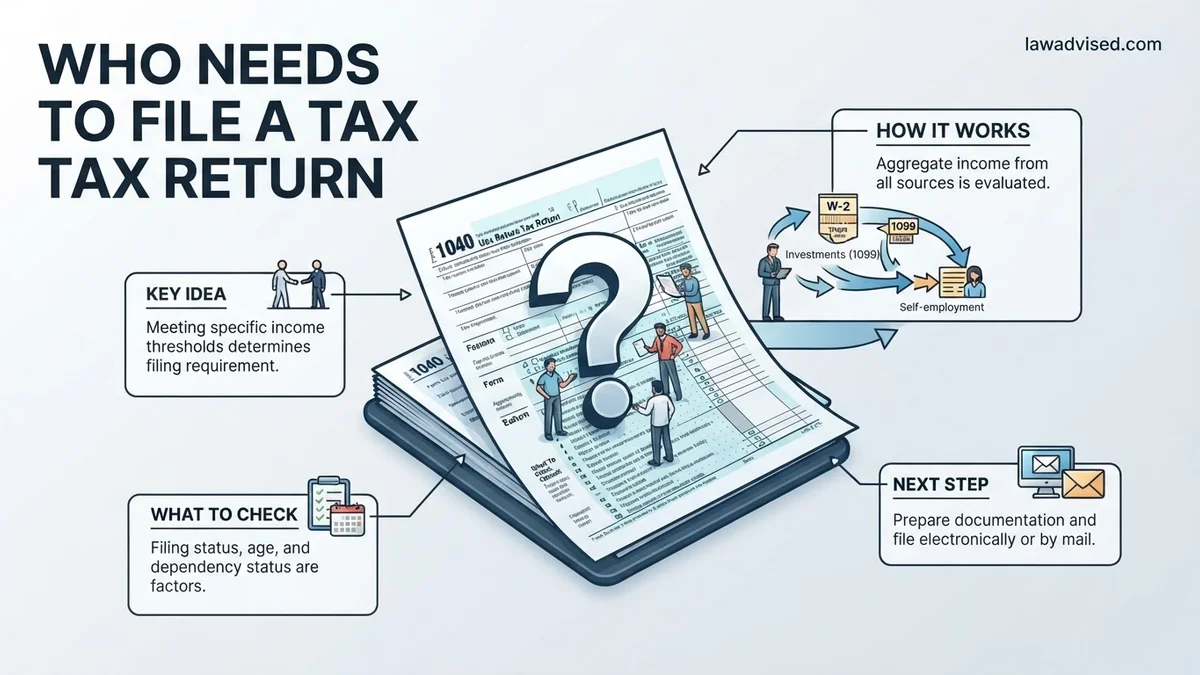
Determining who needs to file a tax return depends primarily on your total gross income, filing status, and age for the 2026 tax year. Even if you fall below the mandatory income thresholds, certain self-employment rules or health insurance subsidies may still require you to submit a federal return.
Whether you need to file a federal income tax return in 2026 depends primarily on your total gross income, your age, and your filing status. If your income stays below the IRS statutory thresholds, you are generally not required to file, but waiting until tax season to check can lead to missed refunds or costly penalties.
Figuring out your obligation early saves you from unnecessary stress and ensures you claim any money the government actually owes you. Let us break down the exact rules for the 2026 tax year so you know your legal standing immediately.
Key Takeaways
- Check your filing status to find your specific income threshold.
- Self-employed individuals must file if net earnings reach $400 or more.
- Dependents have strict, lower income limits for filing requirements.
- Filing is mandatory if you took marketplace health insurance subsidies.
- Always file to claim a refund, even if you are not required.
What Triggers the Requirement to File a Tax Return
General Income and Age Thresholds
For most taxpayers, the IRS sets the baseline filing requirement by matching your gross income against the standard deduction for your specific filing status. If your income crosses that statutory line, filing a return is mandatory.
- Single filers under 65: You must file if your gross income is at least equal to the standard deduction for 2026.
- Married couples filing jointly: Both incomes are combined, and the threshold increases to account for two people.
- Seniors (65 and older): The IRS grants an extra standard deduction boost, meaning you can earn slightly more before a return becomes mandatory.
Special Non-Income Triggers
You might earn very little money and still be legally required to file a federal tax return. Certain financial activities bypass the standard income thresholds entirely and force an IRS filing.
- Self-employment earnings: If your net earnings from self-employment reach $400 or more, you must file to pay self-employment tax, even if your overall income is low.
- Health savings accounts: Taking a distribution from an HSA, Archer MSA, or Medicare Advantage MSA without proper qualifying medical expenses triggers a mandatory filing.
- Advanced premium tax credits: If you or a family member enrolled in health insurance through the marketplace and received advance credit payments, you must reconcile them on your tax return.
How to Determine Your Filing Status and Income Thresholds
Standard Deduction Baselines by Status
Your filing status is the foundational puzzle piece for your 2026 tax obligations. It dictates which standard deduction column applies to your household and sets your personal income ceiling.
- Single: The baseline standard deduction applies strictly to unmarried individuals or those considered unmarried on the last day of the year.
- Married Filing Jointly: Combined incomes of spouses are measured against a much higher joint deduction limit.
- Head of Household: Designed for unmarried individuals who pay more than half the cost of keeping up a home for a qualifying dependent.
Adjustments for Seniors and Dependents
Age and dependency status alter the standard math. If you reach age 65 by the end of 2026, your filing threshold increases because your standard deduction gets an upward adjustment. Conversely, if someone else can claim you as a dependent on their tax return, your rules change dramatically. Dependents face much lower unearned and earned income limits before a mandatory filing is triggered.
Always review your specific situation against these IRS guidelines before assuming you are entirely off the hook for 2026.
Step-by-Step Guide to Evaluating Special IRS Filing Exceptions
Determining your tax obligation in 2026 goes beyond basic income thresholds. Many taxpayers overlook special IRS rules that mandate filing regardless of gross income. According to data from the Treasury Inspector General for Tax Administration (TIGTA), millions of eligible Americans miss out on refunds or face compliance penalties because they misunderstand these specific criteria.
1. Check Self-Employment and Gig Economy Earnings
If you earned net earnings of $400 or more from self-employment, independent contracting, or freelance work, you must file a federal tax return. This requirement applies even if your overall income falls below the standard deduction limit. The IRS enforces this rule to collect Self-Employment Tax for Social Security and Medicare.
2. Review Premium Tax Credit and HSA Distributions
Did you or a family member purchase health insurance through the Health Insurance Marketplace in 2025 or 2026? If you received advance payments of the Premium Tax Credit, you are legally required to file a return to reconcile those subsidies. Additionally, taking distributions from a Health Savings Account (HSA), Archer MSA, or Medicare Advantage MSA requires Form 8889 submission, triggering a mandatory filing requirement.
3. Assess Household Employment and Retirement Plan Transactions
You must file a return if you owe special taxes, such as the Alternative Minimum Tax (AMT), or if you owe recaptured investment credits. Furthermore, making a non-qualified withdrawal from an IRA or 401(k) plan, or failing to take required minimum distributions (RMDs), mandates reporting on your annual tax forms.
What to Do If You Missed the Deadline or Need to File Anyway
Missing the annual tax filing deadline can feel overwhelming, but the IRS provides structured paths to resolve late filings and secure unclaimed refunds. Financial experts note that acting quickly minimizes cumulative penalties and interest charges on unpaid balances.
1. File Your Return Immediately
If you owe taxes, submit your return as soon as possible to stop the Failure-to-File penalty, which accrues at 5 percent of unpaid taxes per month. The Failure-to-Pay penalty is much lower, sitting at 0.5 percent per month. Filing promptly reduces your overall financial liability.
2. Request Penalty Abatement
Taxpayers with a history of compliance can request a First-Time Penalty Abatement from the IRS. According to IRS guidelines, you may qualify to have late-filing and late-payment penalties waived if you have clean filing records for the past three tax years and reasonable cause for the delay.
3. Claim Your Unclaimed Refunds
Unlike unpaid tax debts, the IRS does not penalize you for filing late if you are owed a refund. However, federal law imposes a three-year statute of limitations. You must file your 2025 return by April 2029 to claim any withheld or estimated tax overpayments.
What If It Still Doesn’t Work?
Navigating complex filing requirements or resolving historical compliance issues can outstrip DIY software capabilities. When automated tax tools fail to clarify your filing status or IRS notices become unmanageable, consider these fallback steps:
- Consult a Certified Public Accountant (CPA) or Enrolled Agent (EA): Licensed tax professionals can review multi-year compliance issues and negotiate directly with the IRS on your behalf. According to the National Society of Accountants, hiring a CPA for a standard itemized return typically ranges from $300 to $500, while complex representation can cost between $1,500 and $3,500.
- Utilize IRS Free File or Volunteer Income Tax Assistance (VITA): If your adjusted gross income falls below IRS thresholds—typically $79,000 or less for 2026—access guided tax preparation software at no cost through IRS.gov.
- Contact the Taxpayer Advocate Service (TAS): For unresolved systemic tax issues or severe financial hardship caused by IRS delays, reach out to this independent organization within the IRS for free, specialized assistance.
Conclusion
Determining whether you need to file a tax return in 2026 requires evaluating your gross income, dependency status, and specific life events against updated IRS thresholds. Failing to file when required leads to mounting penalties, while failing to file when owed a refund leaves money on the table. According to verified research and expert tax sources, reviewing your financial documents early prevents costly compliance errors. Your actionable next step is to gather your W-2s, 1099s, and health insurance forms today to run your numbers through a verified IRS-approved filing calculator.
❓ Frequently Asked Questions
What happens if I don’t file a tax return when I am supposed to?
Failing to file when required can lead to failure-to-file penalties, interest charges, and the potential loss of any refunds owed to you by the IRS.
Does investment income count toward my filing threshold?
Yes, unearned income like dividends, capital gains, and interest counts toward your gross income and can push you over the mandatory filing threshold.
Are scholarship funds considered taxable income for filing requirements?
Portions of scholarships used for living expenses rather than qualified tuition and related expenses are taxable and count toward filing thresholds.
What if I am married—can we file separately?
Married couples can choose to file separately, but doing so often lowers the income threshold required to trigger a mandatory tax filing.
Do I need to file a state tax return if I file a federal one?
State tax filing requirements are separate from federal rules, though most states tie their filing thresholds closely to federal income levels.
How do I check if my employer reported my income to the IRS?
You can view your tax records and reported income directly by accessing your online account transcript on the official IRS website.

Ismail Hossain is the founder of Law Advised. He is an Divorce, Separation, marriage lawyer. Follow him.