Long Term Capital Gains Explained A Step-by-Step Guide 2026
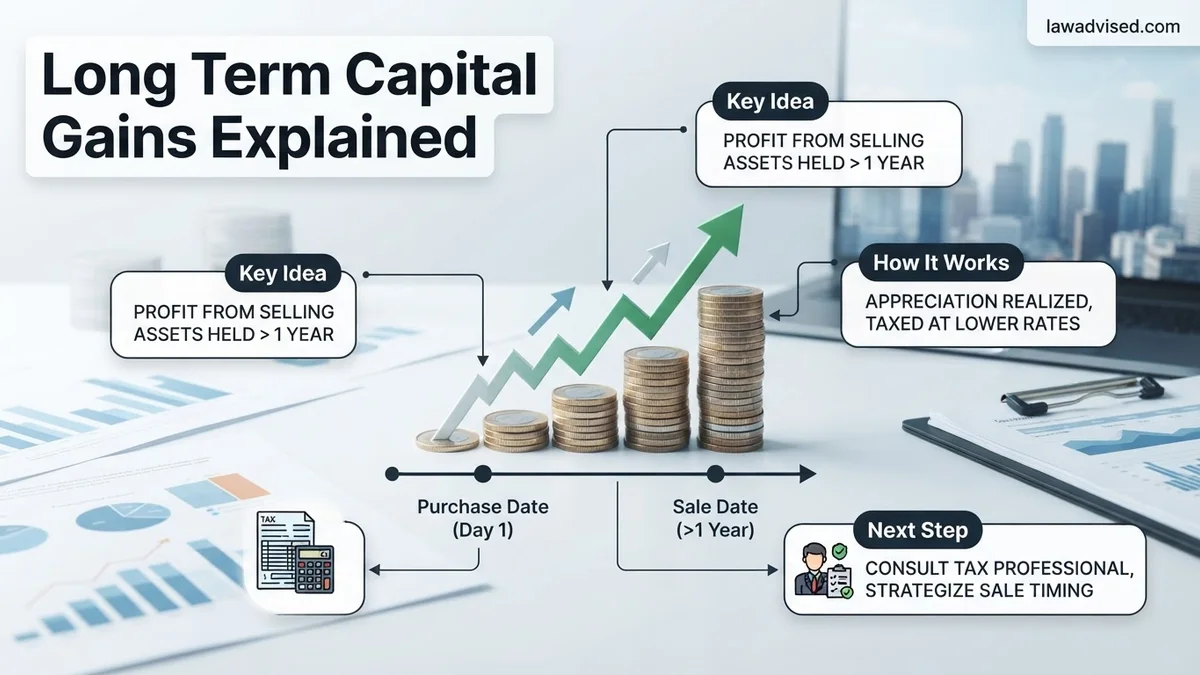
Long-term capital gains apply to profits made from selling an asset you have held for more than one year. These gains benefit from significantly lower tax rates compared to ordinary income or short-term gains, making strategic holding periods essential for tax efficiency.
Long-term capital gains are the profits you make from selling an asset you have owned for longer than one year, and they are taxed at much lower rates than ordinary income. If you sell that same asset within 365 days, your profits face short-term capital gains tax, which matches your standard income tax bracket.
Understanding this distinction is the single most important tax strategy for any investor eyeing 2026 financial planning. Waiting just a few extra days to sell an asset can slash your tax bill by half, directly protecting your net worth from unnecessary tax drag.
Key Takeaways
- Hold assets for over one year to qualify for preferential long-term tax rates.
- Long-term capital gains tax brackets for 2026 are 0%, 15%, and 20% based on income.
- Calculate your gain by subtracting your cost basis from the final sale price.
- Use tax-loss harvesting to offset realized capital gains against investment losses.
- Utilize tax-advantaged accounts like IRAs to defer or eliminate capital gains taxes.
What Causes High Capital Gains Tax Liabilities
Many investors trigger massive, avoidable tax bills simply because they do not track their holding periods or understand how the IRS categorizes investment profits. When you panic-sell or aggressively rebalance your portfolio without checking the calendar, you walk straight into the highest tax brackets.
The Trap of Short-Term Trading
Short-term capital gains are taxed as ordinary income. If you fall into the 32 percent or 37 percent federal income tax bracket, your investment profits face that exact same punishing rate. Day trading, swing trading, and quick crypto flips all generate short-term gains that erode your compounding returns.
- Profits are added directly to your W-2 or business income
- Rates can reach up to 37 percent at the federal level
- State taxes often apply on top of federal rates
Ignoring the Net Investment Income Tax (NIIT)
High-earning investors face an additional hurdle when generating capital gains. If your modified adjusted gross income crosses specific thresholds, the IRS tacks on the 3.8 percent Net Investment Income Tax.
- Threshold is $200,000 for single filers
- Threshold is $250,000 for married filing jointly
- Applies to both short-term and long-term gains once triggered
How to Fix Your Investment Strategy with Step-by-Step Holding Periods
Fixing your tax liability requires a deliberate shift in how you manage your portfolio timeline. By prioritizing the one-year threshold, you fundamentally change the math on your investment returns for 2026.
Step 1: Calculate the Exact 365-Day Window
The holding period starts the day after you purchase the asset and ends on the day you sell it. You must cross the one-year mark completely to qualify for long-term status.
- If you buy a stock on January 15, 2025, the earliest you can sell it for long-term treatment is January 16, 2026
- Leap years require careful calendar counting to avoid accidental short-term classification
- Always verify your brokerage account trade confirmation dates
Step 2: Align with 2026 Long-Term Tax Brackets
Once you cross that one-year threshold, your profits drop into the preferential long-term capital gains tax brackets of 0 percent, 15 percent, or 20 percent.
- 0 percent rate applies to single filers with taxable income up to $48,350 in 2026
- 15 percent rate covers incomes up to $533,400 for single filers
- 20 percent rate kicks in for income above those thresholds
Step-by-Step Guide to Calculating Your Taxable Capital Gains
Calculating your long-term capital gains for the 2026 tax year requires precise record-keeping and a methodical approach. According to guidance from the Internal Revenue Service (IRS), accuracy in this process directly prevents overpayment or underpayment penalties.
Step 1: Determine Your Cost Basis
Your cost basis is the original purchase price of the asset plus any associated fees, such as broker commissions or reinvested dividends. For inherited assets, the basis typically steps up to the fair market value on the date of the previous owner’s death.
Step 2: Calculate the Gross Proceeds
Subtract any selling expenses, like transaction fees or agent commissions, from the total amount you received when you disposed of the asset. This final figure represents your net proceeds from the sale.
Step 3: Subtract Basis from Proceeds
Subtract your total cost basis from your net proceeds to find your raw capital gain. If the proceeds exceed the basis, you have a taxable gain. If the reverse is true, you have a capital loss that can offset other gains.
- Gather all Form 1099-B documents provided by your brokerage firms for the 2026 tax year.
- Match the sale dates against your original purchase records to verify the holding period exceeds 365 days.
- Apply any eligible capital loss carryovers from previous tax years to reduce your net taxable amount.
What If Your Investments Still Trigger Heavy Taxes
Even with preferential long-term capital gains rates, high-value asset sales can push you into a higher tax bracket or trigger the 3.8% Net Investment Income Tax (NIIT). When standard holding strategies are not enough to mitigate significant tax liability, specific advanced mitigation steps are necessary.
Fallback Strategies for High-Tax Scenarios
- Utilize Tax-Loss Harvesting: Sell underperforming assets in your taxable portfolio at a loss to directly offset your capital gains realized earlier in the year.
- Donate Appreciated Assets: Transfer long-term appreciated stocks or property directly to a qualified 501(c)(3) charitable organization to eliminate capital gains taxes entirely while claiming a charitable deduction.
- Invest in Qualified Opportunity Zones (QOZ): Reinvest your capital gains into designated QOZs through a qualified opportunity fund to defer and potentially reduce your tax obligations under current 2026 federal guidelines.
- Consult a Certified Public Accountant (CPA): Engage a licensed tax professional or certified financial planner when portfolio transactions exceed six figures. According to industry data from the National Society of Accountants, professional tax advisory fees typically range from $300 to $1,000+ depending on the complexity of your investment portfolio.
Conclusion
Mastering long-term capital gains management is essential for preserving wealth and maximizing your investment returns through the 2026 tax season. By strategically holding assets for over a year and leveraging structural offsets like tax-loss harvesting, investors can significantly reduce their federal tax burden. According to verified research and financial planning experts from institutions like the CFA Institute, proactive portfolio structuring remains the single most effective defense against excessive taxation. Take your next actionable step today by auditing your current brokerage statements to identify potential long-term holding candidates and upcoming tax liabilities.
❓ Frequently Asked Questions
What are the exact income thresholds for the 2026 long-term capital gains tax brackets?
The 2026 tax brackets determine whether your long-term gains are taxed at 0%, 15%, or 20% based on thresholds tied to your total taxable income and filing status. IRS adjustments annually set these exact dollar limits.
How does the one-year holding period get calculated?
The holding period begins the day after you acquire the asset and ends on the day you dispose of it. To qualify for long-term status, you must sell the asset at least one year and one day after purchase.
Are there additional taxes that apply to high earners on capital gains?
High-income earners may also be subject to the 3.8% Net Investment Income Tax (NIIT) if their modified adjusted gross income exceeds specific statutory thresholds.
How does tax-loss harvesting work to minimize capital gains?
Tax-loss harvesting involves selling underperforming investments at a loss to offset the capital gains realized from winning investments. If your losses exceed your gains, you can deduct up to $3,000 of ordinary income per year.
Do inherited assets qualify for long-term capital gains treatment?
Assets received as an inheritance typically receive a ‘step-up’ in basis to the fair market value at the date of the original owner’s death, often eliminating previous capital gains entirely if sold immediately.
Does holding assets inside a retirement account trigger capital gains tax?
No, traditional and Roth IRAs, 401(k)s, and similar tax-advantaged accounts do not trigger capital gains taxes when you buy or sell assets within them, though withdrawals face different tax rules.

Ismail Hossain is the founder of Law Advised. He is an Divorce, Separation, marriage lawyer. Follow him.