Capital Loss Deduction Explained Step-by-Step Guide 2026
Bad investments don’t have to be a total loss come tax season. Capital loss deductions allow you to offset your taxable investment gains and lower your ordinary income by up to $3,000 per year. Understanding how to net these losses properly is the key to minimizing your tax bill.
You can lower your taxable income by up to 3,000 dollars per year using investment losses, and carry forward any excess to future tax returns. When your investments drop in value and you sell them, you create a capital loss that offsets your capital gains dollar-for-dollar.
Navigating the tax code for the 2026 tax year requires understanding how to net your wins and losses, apply the annual limits, and track your carryovers properly. This step-by-step guide walks you through the exact mechanics so you can keep more of your hard-earned money during tax season.
Key Takeaways
- Net capital losses first against capital gains of the same type (short-term or long-term).
- Deduct up to $3,000 of remaining net losses against your ordinary income annually.
- Carry forward any remaining unused losses indefinitely into future tax years.
- Holding periods determine whether a loss is classified as short-term or long-term.
- Maintain accurate records of purchase dates and cost bases to calculate losses correctly.
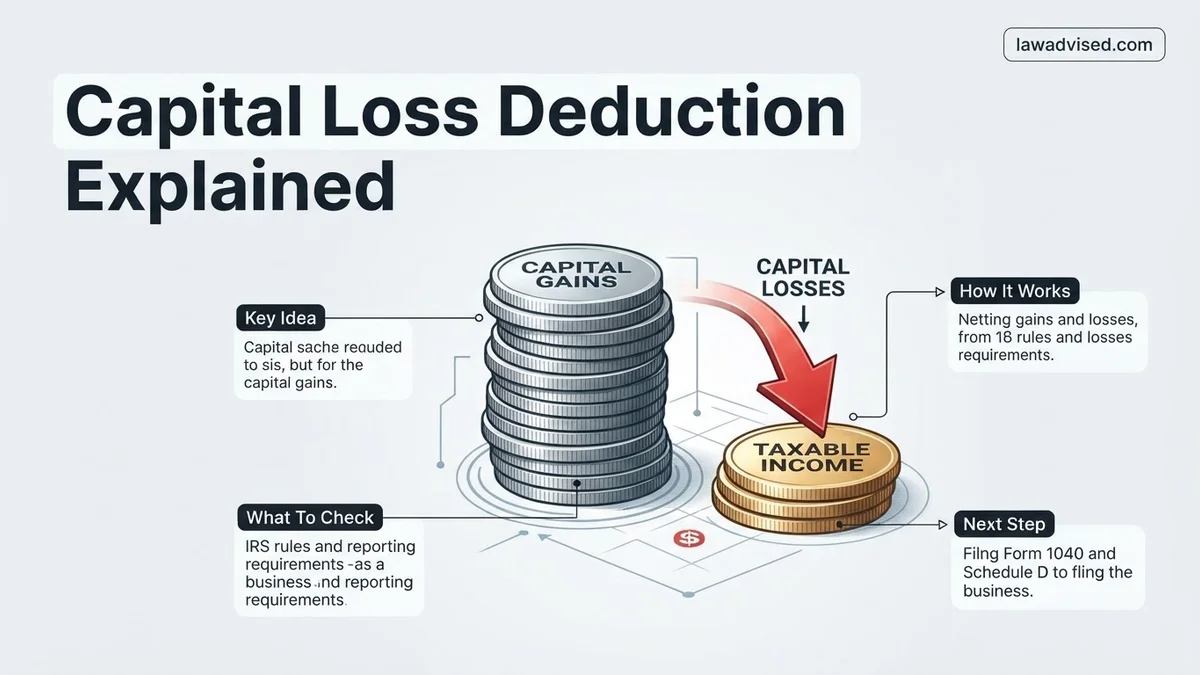
What Causes Capital Losses and How Netting Works
A capital loss only happens when you actually sell an asset—like stocks, crypto, or real estate—for less than you bought it. Paper losses on unsold assets do not count. To use these losses on your 2026 tax return, you must first categorize them by your holding period into short-term and long-term buckets.
Short-Term Versus Long-Term Losses
The IRS separates your investment activity based on how long you owned the asset before selling it.
- Short-term losses: Assets held for one year or less before selling.
- Long-term losses: Assets held for more than one year before selling.
The Step-by-Step Netting Process
You cannot just lump all your losses together right away. The tax code requires a specific netting order to match losses against the correct type of gains.
- Net your short-term capital gains against your short-term capital losses to find your net short-term result.
- Net your long-term capital gains against your long-term capital losses to find your net long-term result.
- If you have a net loss in one category and a net gain in the other, combine them to find your overall tax position for the year.
Example: Imagine you earned 5,000 dollars in long-term stock gains, but you also suffered 8,000 dollars in short-term crypto losses. You first offset your gains, leaving you with a net loss of 3,000 dollars to apply against your other income.
How to Calculate and Claim Your $3,000 Ordinary Income Deduction
Once you finish netting all your capital gains and losses for 2026, you might end up with a net capital loss overall. If your total losses exceed your total gains, the IRS lets you use that remaining loss to reduce your ordinary income, such as your W-2 salary or business earnings.
The Annual Ordinary Income Limit
There is a strict cap on how much ordinary income you can wipe out with investment losses in a single tax year.
- Single filers and Married Filing Jointly: You can deduct up to 3,000 dollars of net capital losses against ordinary income per year.
- Married Filing Separately: The annual limit drops to 1,500 dollars per spouse.
What Happens to Losses Exceeding the Limit?
If your net capital loss is 10,000 dollars, you can use 3,000 dollars of it to lower your taxable salary for 2026. What happens to the remaining 7,000 dollars? It does not disappear. You turn it into a capital loss carryover for the 2027 tax year, where the same netting and deduction rules apply until your balance reaches zero.
Step-by-Step Guide to Applying Short-Term Versus Long-Term Losses
Taxpayers must carefully categorize investment losses before filing their 2026 tax returns. The Internal Revenue Service maintains strict rules regarding how short-term and long-term capital losses offset corresponding capital gains.
Step 1: Net Your Short-Term Capital Transactions
First, aggregate all your short-term capital gains and losses from assets held for one year or less. Calculate the net total by subtracting total short-term losses from total short-term gains to determine your net short-term position.
Step 2: Net Your Long-Term Capital Transactions
Next, combine all long-term capital gains and losses from assets held for longer than one year. Subtract total long-term losses from total long-term gains to arrive at your net long-term capital position for the tax year.
Step 3: Combine Net Results and Apply Cross-Offsets
If you have a net loss in one category and a net gain in the other, combine them. According to IRS guidelines, a net loss of either type can offset a net gain of the opposite type. When losses exceed gains overall, the remaining deficit qualifies for the standard deduction limit.
What If Your Losses Exceed the Limit and You Need to Carry Forward
When total capital losses exceed the $3,000 annual ordinary income deduction limit ($1,500 if married filing separately), the remaining balance is not lost. Tax regulations allow investors to preserve excess losses for future tax years through the capital loss carryforward mechanism.
- Calculate the excess loss: Subtract the $3,000 deduction from your total remaining net capital loss after offsetting all current-year gains.
- Maintain detailed records: Retain all IRS Form 8949 and Schedule D documents from 2026 to accurately track the exact carryforward amount for your 2027 tax filing.
- Apply to future gains first: In subsequent tax years, your carried-forward losses will automatically offset future capital gains before any remaining amount applies against ordinary income up to the annual limit.
- Continue indefinitely: Capital loss carryforwards do not expire. You can continue rolling them over annually until the total balance is completely exhausted or until the taxpayer passes away.
What If It Still Doesn’t Work?
If complex asset sales, wash sale rules, or multi-brokerage reporting errors complicate your capital loss calculations for 2026, targeted troubleshooting steps can resolve discrepancies before filing.
- Reconcile Form 1099-B statements: Compare your brokerage statements directly against your trading logs to ensure cost basis reporting matches IRS data.
- Review historical wash sale flags: Check if identical securities were repurchased within the mandatory 30-day window, which permanently disallows the current loss deduction and adds it to the cost basis of the new stock.
- Consult a certified public accountant: If your portfolio involves complex partnership distributions, foreign assets, or crypto derivatives, professional intervention is necessary. According to industry data, hiring a CPA or tax attorney for advanced capital loss auditing typically ranges from $400 to $1,200 depending on return complexity.
- File an amended return: If you discovered missed capital losses from previous tax years, utilize IRS Form 1040-X to amend past filings within the standard three-year statute of limitations.
Conclusion
Navigating capital loss deductions requires precise categorization of short-term and long-term transactions to maximize tax efficiency and respect the $3,000 ordinary income limit. By properly offsetting gains and utilizing the indefinite carryforward rule, investors can significantly reduce their overall tax burden. According to verified research and tax experts, proactive portfolio harvesting and meticulous record-keeping are the most effective methods to protect investment capital against market downturns. Take the next step today by reviewing your 2026 brokerage statements and isolating eligible loss transactions before filing.
❓ Frequently Asked Questions
How do I report capital losses on my tax return?
You report capital gains and deductible losses on IRS Form 8949 and then summarize the totals on Schedule D of your Form 1040.
Can I use capital losses to offset my W-2 salary income?
Yes, after your losses offset any capital gains, up to $3,000 of the remaining loss can directly reduce ordinary income like wages, salaries, and interest.
What is the wash-sale rule and how does it affect deductions?
The wash-sale rule prevents you from claiming a capital loss if you buy a substantially identical investment within 30 days before or after the sale.
How are short-term and long-term losses matched against gains?
Short-term losses must first offset short-term gains, and long-term losses must first offset long-term gains. Any excess can then cross over to offset the other type of gain.
Are cryptocurrency losses eligible for the capital loss deduction?
Yes, the IRS treats cryptocurrency as property, meaning realized losses from crypto sales or exchanges qualify for capital loss deductions just like stocks.
What happens to unused capital loss carryovers if a taxpayer passes away?
Capital loss carryovers die with the taxpayer and cannot be transferred to heirs or reported on a final return beyond the year of death.

Ismail Hossain is the founder of Law Advised. He is an Divorce, Separation, marriage lawyer. Follow him.