Adjusted Cost Basis Explained Step-by-Step Guide for 2026
Your adjusted cost basis determines your actual taxable capital gains or losses when selling an asset like stocks or real estate. Failing to account for additions like dividend reinvestments or capital improvements means you could significantly overpay on your taxes. Calculating this correctly ensures you only pay tax on your true investment profit.
Adjusted cost basis is the original purchase price of an asset, modified for events like stock splits, reinvested dividends, or major property improvements, which ultimately determines your true capital gains or losses for taxes. When you sell an asset in 2026, the IRS does not tax your total sale proceeds. Instead, they tax the profit calculated by subtracting your adjusted cost basis from your final sale price.
Mastering this calculation prevents you from overpaying taxes on investments like stocks, mutual funds, and real estate. If you ignore adjustments, you might report a much higher profit than you actually earned, handing your hard-earned money over to the government.
Key Takeaways
- Adjusted cost basis is your original purchase price modified by subsequent financial events.
- Dividend reinvestment plans (DRIP) continuously increase your stock’s cost basis over time.
- Major capital improvements directly increase the cost basis of real estate properties.
- Depreciation deductions reduce the cost basis of rental properties and business equipment.
- Accurate record-keeping is essential to legally minimize capital gains tax liabilities.
What Causes Cost Basis Adjustments and Why They Matter
Additions to Your Original Cost Basis
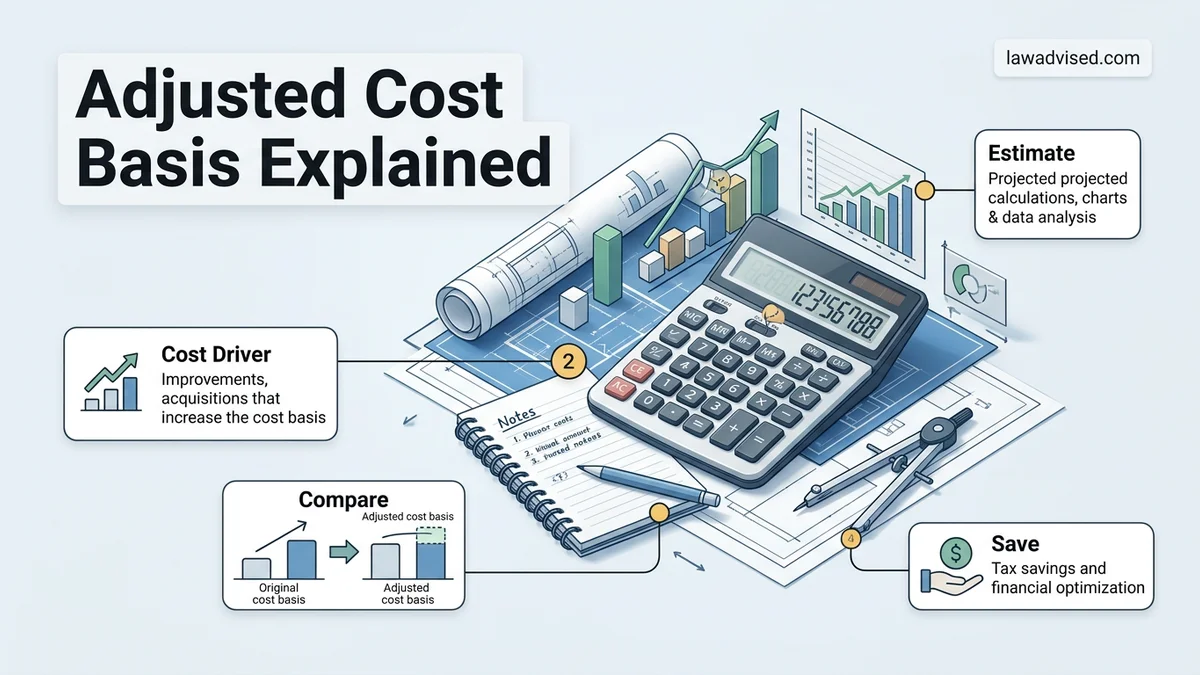
Certain events increase your initial investment value, which lowers your future tax liability by raising your basis. When you spend money to improve an asset, that money gets added to your baseline.
- Capital improvements: Adding a new roof or remodeling a kitchen increases the basis of real estate.
- Reinvested dividends: Buying more shares automatically with your payouts adds fresh capital to your stock holdings.
- Brokerage fees: Certain upfront commission fees and transaction costs can increase your starting basis.
Subtractions from Your Original Cost Basis
Other financial events reduce your cost basis, which increases your eventual taxable profit when you finally sell the asset.
- Return of capital: Receiving cash distributions that are not classified as dividends reduces your remaining basis.
- Depreciation: Claiming depreciation deductions on rental properties systematically lowers your cost basis over time.
- Stock splits: While a split doesn’t change your total investment value, it divides your original basis across a larger share count.
Master Adjusted Cost Basis in 6 Simple Steps
Navigating the world of taxes and investments can feel overwhelming, especially when you encounter terms like adjusted cost basis (ACB). Whether you are trading stocks, selling real estate, or managing mutual funds, understanding your ACB is the golden ticket to calculating your exact capital gains or losses. Without this calculation, you risk overpaying your taxes to the government. This practical walkthrough will demystify the math and the tracking methods required, empowering you to approach your tax filing season like a seasoned professional.
Step 1: Determine Your Initial Cost Basis
What you need: Purchase confirmation slips, settlement statements, or broker statements showing the original transaction date.
Instructions: Your journey begins by finding the absolute baseline of your investment. The initial cost basis is not merely the spot price of the asset when you bought it; it includes the total financial outlay required to acquire it. Sum up the purchase price of the asset plus any mandatory broker commissions, transaction fees, and legal or recording fees associated with the purchase. For example, if you buy 100 shares of a stock at $50 per share and pay a $10 commission, your total initial cost is $5,010. Write this figure down clearly as your starting point, because every future adjustment builds directly upon this foundational number.
Pro Tip: Never rely on memory for purchase prices. Always keep digital or physical copies of your trade confirmations, as broker platforms may archive your history after a few years.
Step 2: Add Capital Improvements and Subsequent Purchases
What you need: Receipts for home renovations, invoices for property upgrades, or statements from dividend reinvestment plans (DRIPs).
Instructions: Assets change over time, and so does their cost basis. If you own real estate, add the cost of substantial capital improvements—such as a new roof, a finished basement, or a central air conditioning system—to your initial cost basis. Routine maintenance and minor repairs do not count. If you own stocks and participate in a Dividend Reinvestment Plan (DRIP), every time a dividend automatically purchases new shares, those new shares represent additional purchases that increase your total portfolio cost basis and must be logged individually or averaged into your running tally.
Pro Tip: Maintain a dedicated folder labeled “Asset Capital Improvements” and save every single contractor receipt. The IRS or tax authorities require proof if you claim improvements years later.
Step 3: Account for Return of Capital and Distributions
What you need: Year-end tax forms like Form 1099-DIV, mutual fund annual statements, or K-1 statements.
Instructions: While additions increase your basis, certain events require you to subtract value from it. A primary example is a “return of capital” distribution, which frequently happens with real estate investment trusts (REITs) and some stocks or mutual funds. When a company pays you a return of capital, they are essentially giving you back a portion of your original investment rather than paying out corporate earnings. Because you are getting your own money back, you must subtract this amount from your current adjusted cost basis. Failing to do so will artificially inflate your losses or deflate your gains when you finally sell the asset.
Pro Tip: Do not confuse regular dividend payouts with a return of capital. Only distributions explicitly labeled as a return of capital on your tax documents require a downward adjustment.
Step 4: Factor in Stock Splits and Corporate Actions
What you need: Corporate announcement records, historical stock split data, and your existing portfolio ledger.
Instructions: Corporate restructuring can drastically alter how you calculate your cost basis. If a company you own executes a 2-for-1 stock split, the total adjusted cost basis of your holding remains exactly the same, but that total cost must now be divided across twice as many shares. Conversely, a reverse stock split reduces your share count while multiplying the cost per share. If you experienced a corporate spin-off, you must allocate a portion of your original stock’s cost basis to the newly formed company based on the relative fair market values of both companies on the day of the spin-off.
Pro Tip: Check financial news or your brokerage’s corporate action center immediately whenever a company you hold announces a merger, acquisition, or split to log the exact adjustment ratios.
Step 5: Adjust for Depreciation (Mainly for Real Estate and Business Assets)
What you need: IRS depreciation schedules (such as Form 4562) and past tax returns.
Instructions: If your asset is a rental property, commercial building, or business equipment, tax laws allow you to claim annual depreciation deductions to account for normal wear and tear. However, this tax benefit comes with a catch known as “unrecaptured section 1250 gain” or depreciation recapture. Each year you claim depreciation, you are required by law to reduce your adjusted cost basis by the exact amount of depreciation allowed or allowable. When you eventually sell the property, your capital gain will be calculated using this heavily reduced basis, meaning your taxable profit will be higher.
Pro Tip: Depreciation tracking is notoriously complex. Work closely with a certified public accountant (CPA) to ensure your depreciation schedules match your annual tax filings.
Step 6: Calculate Your Final Capital Gain or Loss
What you need: Your final adjusted cost basis figure, the gross selling price, and a calculator.
Instructions: With all historical additions and subtractions compiled, you are finally ready to determine your financial outcome upon selling the asset. Take your gross selling price—the total amount the buyer paid you—and subtract any selling costs, such as real estate commissions, escrow fees, or broker transaction fees. This gives you your net proceeds. Finally, subtract your fully calculated Adjusted Cost Basis from your net proceeds. If the result is a positive number, you have a capital gain to report on your taxes. If the result is negative, you have successfully documented a capital loss that you can use to offset other investment gains.
Pro Tip: Double-check your math twice. A single missed dividend reinvestment or unrecorded fee can significantly skew your tax liability, triggering an audit or leading to unnecessary penalties.
✅ Final Checklist
- Verified that initial purchase price includes all associated transaction fees and commissions.
- Added all eligible capital improvements or dividend reinvestments to the running basis total.
- Subtracted any return of capital distributions and depreciation claims from the basis.
- Accounted for stock splits, mergers, or spin-offs affecting share quantities.
- Calculated final capital gains or losses accurately by subtracting the ACB from net sale proceeds.
Important Notes:
- Always comply with local tax jurisdiction rules (such as IRS guidelines in the United States or CRA rules in Canada), as cost basis regulations can vary by country.
- When dealing with complex commercial real estate, multi-layered portfolios, or inherited assets with stepped-up basis rules, seek professional help from a licensed CPA or tax attorney.
- Maintaining a meticulous cost basis ledger generally takes 1 to 3 hours per year to update, saving you days of stress and potentially thousands of dollars during tax season.
How to Calculate Adjusted Cost Basis Step-by-Step
The Core Calculation Formula
To find your adjusted cost basis, you follow a straightforward mathematical sequence. You start with what you paid and apply adjustments sequentially.
- Start with the purchase price: Take the original amount you paid to acquire the asset, including acquisition fees.
- Add capital improvements: Factor in any money spent that adds permanent value or extends the life of the asset.
- Subtract deductions: Remove any depreciation claimed or returns of capital received up to the current year, 2026.
- Arrive at the final basis: The resulting number is your official adjusted cost basis for tax reporting.
Applying the Formula in Practice
Imagine you bought a rental property for three hundred thousand dollars. Over the next few years, you spent twenty thousand dollars on a major roof replacement. During that same period, you claimed fifteen thousand dollars in cumulative depreciation.
Your calculation looks like this: Start with three hundred thousand dollars, add the twenty thousand dollar roof, and subtract the fifteen thousand dollars of depreciation. Your new adjusted cost basis is three hundred and five thousand dollars. When you sell the property, this is the baseline you subtract from your sale price.
How to Apply Adjustments to Stocks Versus Real Estate
Calculating an adjusted cost basis varies significantly depending on whether you own equities or physical property. According to financial data from the IRS and leading accounting firms for 2026, asset classes demand different record-keeping approaches to remain compliant during tax season.
Adjusting the Basis for Stocks and Mutual Funds
Equities typically require fewer adjustments than real estate, but corporate actions demand strict attention. Reinvested dividends and stock splits frequently alter your baseline numbers.
- Locate your original purchase confirmation statement to identify the initial buying price per share.
- Add the total dollar amount of any automatically reinvested dividends that you reported as taxable income in previous years.
- Account for corporate spinoffs or stock splits by dividing your total original basis across the newly allocated shares according to the corporate restructuring ratio.
- Subtract any return of capital distributions paid out by the company over the holding period, as these reduce your overall tax basis.
Adjusting the Basis for Real Estate Holdings
Real estate investments involve capital improvements that actively increase your basis, alongside depreciation deductions that reduce it over time. Property owners must track every capital expenditure meticulously.
- Start with the original purchase price plus closing costs, legal fees, and title insurance premiums capitalized at acquisition.
- Add the verifiable costs of permanent capital improvements—such as a new roof, HVAC system, or room addition—that add value and extend the property lifespan.
- Subtract cumulative depreciation deductions claimed or allowable on your tax returns during the years you owned the rental property.
- Adjust for any casualty losses or insurance reimbursements received for property damage throughout the duration of ownership.
What If Your Brokerage Form Misses Your Adjustments?
Brokerage firms do not always capture every nuance of your financial transactions, frequently resulting in inaccurate Form 1099-B data. When your reported adjusted cost basis looks incorrect, taking immediate proactive steps prevents overpaying taxes.
- Compare your personal transaction ledger, historical trade confirmations, and dividend reinvestment statements against the figures listed on your 1099-B.
- File Form 8949 (Sales and Other Dispositions of Capital Assets) along with your tax return to report the correct adjusted cost basis manually.
- Attach a detailed calculation statement explaining the discrepancy, such as missing wash sale adjustments or unrecorded corporate actions from your broker.
- Consult a certified public accountant or licensed tax attorney if the discrepancies involve complex multi-year basis tracking or inherited property valuations. According to industry surveys, professional tax advisory services typically cost between $250 and $600 per hour depending on complexity, but prevent costly audit triggers.
- Contact your brokerage’s compliance department in writing to request a corrected Form 1099-B, noting that processing corrections can take up to 30 business days during peak 2026 tax filing windows.
Conclusion
Mastering your adjusted cost basis ensures you avoid severe tax overpayments when liquidating stocks or selling real estate assets. By systematically tracking capital improvements, reinvested dividends, and depreciation deductions, taxpayers maintain total compliance with current regulations. According to verified research and expert financial sources, meticulous record-keeping reduces tax liability by thousands of dollars upon asset disposition. Take your definitive next step today by pulling your historical transaction records and auditing your current portfolio holdings for missing basis adjustments.
❓ Frequently Asked Questions
What items are added to the original cost basis of a stock?
Additions typically include broker commissions paid at purchase, fees, and reinvested dividends through a dividend reinvestment plan (DRIP). These additions raise your basis, which lowers your future capital gain.
What types of home renovations count as capital improvements?
Improvements that add substantial value, prolong the property’s useful life, or adapt it to new uses—such as a roof replacement, room addition, or new HVAC system—qualify. Routine maintenance like painting or fixing a leaky faucet does not count.
How do stock splits impact the adjusted cost basis per share?
A stock split alters the number of shares you own and divides your total cost basis across those new shares, but the overall total cost basis remains unchanged. Your basis per share decreases proportionally.
What happens if I inherit an asset instead of buying it?
Inherited assets generally receive a stepped-up basis, meaning the cost basis is adjusted to the fair market value of the asset on the date of the original owner’s death.
Why is keeping accurate records for decades so important?
You are legally responsible for proving your cost basis to the IRS when you sell an asset. Without receipts for home renovations or historical trade confirmations, the IRS may treat your basis as zero.
How does a return of capital affect my investment’s basis?
A return of capital from a company or mutual fund gives you back a portion of your original investment without selling shares. This payout reduces your adjusted cost basis, increasing your future gain when you finally sell.

Ismail Hossain is the founder of Law Advised. He is an Divorce, Separation, marriage lawyer. Follow him.