Taxes on ETFs in Expert Guide to Capital Gains & 2026
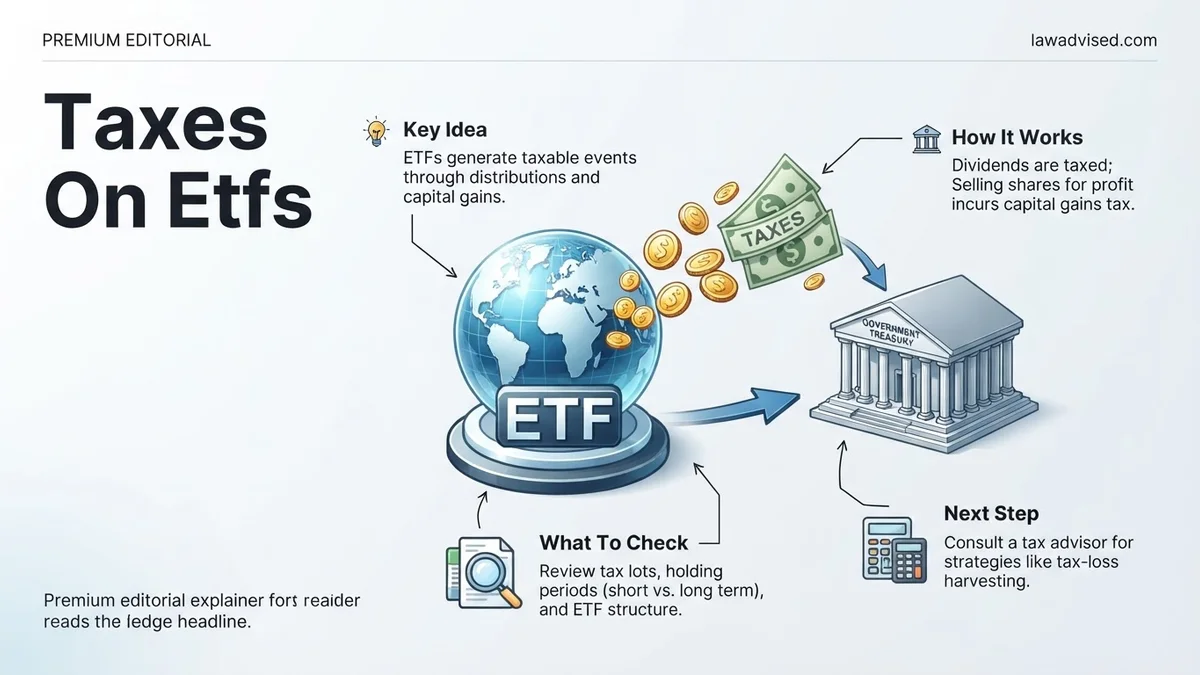
Understanding taxes on ETFs is essential for maximizing your after-tax investment returns in a taxable brokerage account. You generally face two main tax events: selling shares for a capital gain and receiving dividend distributions while holding the fund.
You owe taxes on your Exchange-Traded Funds in 2026 only when two specific events occur: you sell fund shares for a profit, or the fund distributes dividends and interest to your brokerage account. Unlike mutual funds, simply holding an ETF rarely triggers unexpected tax bills, thanks to a unique structural design that protects investors from internal portfolio trading.
Navigating these rules correctly prevents painful surprises during tax season. Let us break down exactly how ETF taxation works so you can keep more of your investment returns.
Key Takeaways
- You only trigger capital gains on ETFs when you sell shares for a profit in a taxable account.
- ETFs are more tax-efficient than mutual funds due to the unique in-kind creation and redemption mechanism.
- Holding ETF shares for more than one year qualifies your profits for lower long-term capital gains tax rates.
- Dividends distributed by ETFs are taxed as either qualified or ordinary income depending on holding periods and fund types.
- Investing in ETFs through tax-advantaged accounts like IRAs or 401(k)s defers or eliminates current-year tax obligations.
What Causes Tax Obligations When Investing in Exchange-Traded Funds
Capital Gains From Selling Your Shares
The first major tax trigger happens when you actively sell your ETF shares for a price higher than your original purchase price. If you buy an equity ETF at one hundred dollars and sell it later for one hundred fifty dollars, you have realized a capital gain. This transaction must be reported on your tax return, and the IRS will tax your profit based on how long you held the asset before selling.
- Short-term capital gains: Applies to ETFs you held for one year or less, taxed at your ordinary income tax bracket.
- Long-term capital gains: Applies to ETFs you held for more than one year, benefiting from preferential tax rates of 0%, 15%, or 20% depending on your 2026 taxable income.
Dividends and Interest Distributions
The second tax trigger occurs while you hold the ETF. Underlying companies inside the fund frequently pay dividends, or the fund holds interest-bearing bonds, and these payouts pass directly to you. Even if you automatically reinvest these dividends back into the ETF, the IRS considers them taxable income in the year they hit your account.
- Qualified dividends: Most standard stock ETF dividends qualify for lower long-term capital gains tax rates, provided you met the holding period requirement of owning the fund for more than 60 days around the ex-dividend date.
- Unqualified dividends and interest: Distributions from bond ETFs or real estate investment trusts are typically taxed at your higher ordinary income tax rate.
How to Calculate Capital Gains and Dividend Tax Liabilities Step-by-Step
Step 1: Determine Your Cost Basis and Holding Period
To calculate what you owe upon selling, you must first know your exact cost basis, which is the purchase price plus any broker commissions. Your brokerage firm uses specific identification or first-in, first-out accounting methods to track this.
- Subtract your cost basis from your final sale price to find your total gross capital gain.
- Check the exact purchase and sale dates to categorize the gain as either short-term or long-term.
- Factor in any capital losses from other investments in your 2026 portfolio to offset these gains.
Step 2: Calculate Your Total Tax Liability
Once you separate your short-term gains, long-term gains, and dividend income, apply the corresponding tax percentages based on your federal income bracket. For example, if you realize a one thousand dollar long-term gain and fall into the 15% long-term tax bracket for 2026, you will owe one hundred fifty dollars in federal taxes on that specific trade.
- Review your Form 1099-DIV and Form 1099-B provided by your broker at the beginning of the year to pull these exact numbers.
- Remember to account for potential state income taxes, which apply to both capital gains and dividend distributions in most jurisdictions.
What If Your ETF Distributions Still Trigger Unexpected Tax Bills
Even though exchange-traded funds maintain structural tax efficiency, certain events can still trigger capital gains distributions. This frequently catches investors off guard, particularly when holding actively managed funds or commodities. Understanding these exceptions ensures you can anticipate tax liabilities heading into the 2026 filing season.
Active Management Turnover
Actively managed ETFs buy and sell securities more frequently than passive index funds. According to Morningstar research, high portfolio turnover increases the likelihood that underlying assets are sold at a profit. When these trades generate realized gains within the fund, the portfolio manager must distribute those gains to shareholders at year-end.
Commodity and Futures Rebalancing
ETFs tracking physical commodities or utilizing futures contracts operate under different regulatory frameworks. Many grantor trusts or commodity pools pass through tax liabilities regardless of whether you sell shares. According to IRS tax guidance, these funds often issue Schedule K-1 forms, which can introduce complex reporting requirements and taxable events even without a cash distribution.
How to Fix Tax Inefficiencies Using Tax-Advantaged Accounts
The most effective strategy to shield your portfolio from capital gains taxes is structural placement. By shifting tax-inefficient assets into registered accounts, you eliminate the impact of annual distributions entirely.
Step-by-Step Account Optimization
- Audit current holdings: Review your portfolio to identify ETFs that generate high dividend yields or frequent capital gains distributions.
- Utilize retirement vehicles: Prioritize placing actively managed or commodity-based ETFs inside tax-deferred accounts like traditional IRAs or 401(k)s.
- Leverage tax-free growth: Direct high-growth equity ETFs into Roth accounts where qualified withdrawals are completely tax-free as of 2026.
- Reserve taxable accounts for core index funds: Keep broad-market, passive equity ETFs in standard brokerage accounts to maximize the benefit of in-kind creation and redemption mechanisms.
What If It Still Doesn’t Work?
If you have optimized your asset placement and still face unexpected tax friction, structural adjustments require a deeper intervention. Follow these escalation steps to mitigate ongoing tax exposure:
- Review your broker’s cost basis reporting to ensure wash sale rules or corporate actions were not miscalculated on Form 1099.
- Consider replacing actively managed sector ETFs with passive, multi-factor index funds that historically report zero capital gains distributions.
- Consult a certified public accountant (CPA) or a fee-only certified financial planner (CFP) to restructure your overall asset allocation. Professional advisory fees for tax-loss harvesting guidance generally range from $300 to $1,000 depending on portfolio complexity.
Conclusion
Navigating ETF taxation requires a deliberate approach to fund selection and account placement. By understanding how creation-redemption mechanics and active management interact with tax laws, you can minimize unnecessary liabilities. According to verified research and tax experts, aligning your portfolio structure with tax-advantaged accounts remains the single most effective way to preserve long-term returns. Take the next step today by auditing your current brokerage statements and relocating high-turnover funds before the next distribution cycle.
❓ Frequently Asked Questions
Do I owe taxes if my ETF increases in value but I do not sell?
No, unrealized gains inside a taxable brokerage account are never taxed. You only trigger a capital event when you officially sell shares or receive cash distributions.
How do authorized participants help lower ETF taxes?
Authorized participants exchange basket securities for ETF shares in-kind, which allows fund managers to purge low-cost-basis securities without triggering capital gains distributions for retail investors.
What happens if I sell my ETF at a loss?
Capital losses from selling ETFs can be used to offset capital gains realized from other investments, and up to $3,000 of excess losses can offset ordinary income per year.
Are international ETFs subject to foreign taxes?
Yes, international ETFs that hold foreign stocks may have foreign taxes withheld on dividends, though investors can often claim a foreign tax credit on their U.S. tax returns.
How can I track my ETF tax liability each year?
Your brokerage will issue a Form 1099-DIV early in the year detailing your exact dividend income, capital gain distributions, and proceeds from sales needed for tax filing.
Does dividend reinvestment (DRIP) exempt me from paying taxes?
No, automatically reinvesting your dividends into more ETF shares still counts as a taxable event in a standard brokerage account for the year the dividend was distributed.

Ismail Hossain is the founder of Law Advised. He is an Divorce, Separation, marriage lawyer. Follow him.