Stablecoin Taxes Explained 2026 A Step-by-Step Guide
Many taxpayers incorrectly assume that swapping volatile crypto for stablecoins is a tax-free event. In reality, crypto-to-stablecoin trades trigger capital gains or losses, and any yield earned from staking is immediately taxed as ordinary income.
Yes, you owe taxes when you trade, stake, or earn yield on stablecoins. Under current 2026 tax guidelines from the IRS and global financial authorities, stablecoins are treated as property, not currency. That means every time you swap a volatile crypto asset for a stablecoin like USDC or USDT, you trigger a taxable event.
Navigating stablecoin transactions requires strict record-keeping because the illusion of stable value often leads traders to falsely assume stablecoin trades are tax-free. Whether you are swapping Bitcoin for a stablecoin to lock in profits, moving between different stablecoins, or earning yield through DeFi protocols, you need to understand how capital gains and ordinary income rules apply to your portfolio in 2026.
Key Takeaways
- Swapping crypto for a stablecoin is a taxable disposal event.
- Holding stablecoins without selling or trading incurs no tax liability.
- Staking rewards and yield generate taxable ordinary income upon receipt.
- Stablecoin-to-fiat conversions require tracking cost basis and holding periods.
- Accurate record-keeping of every transaction is mandatory for IRS compliance.
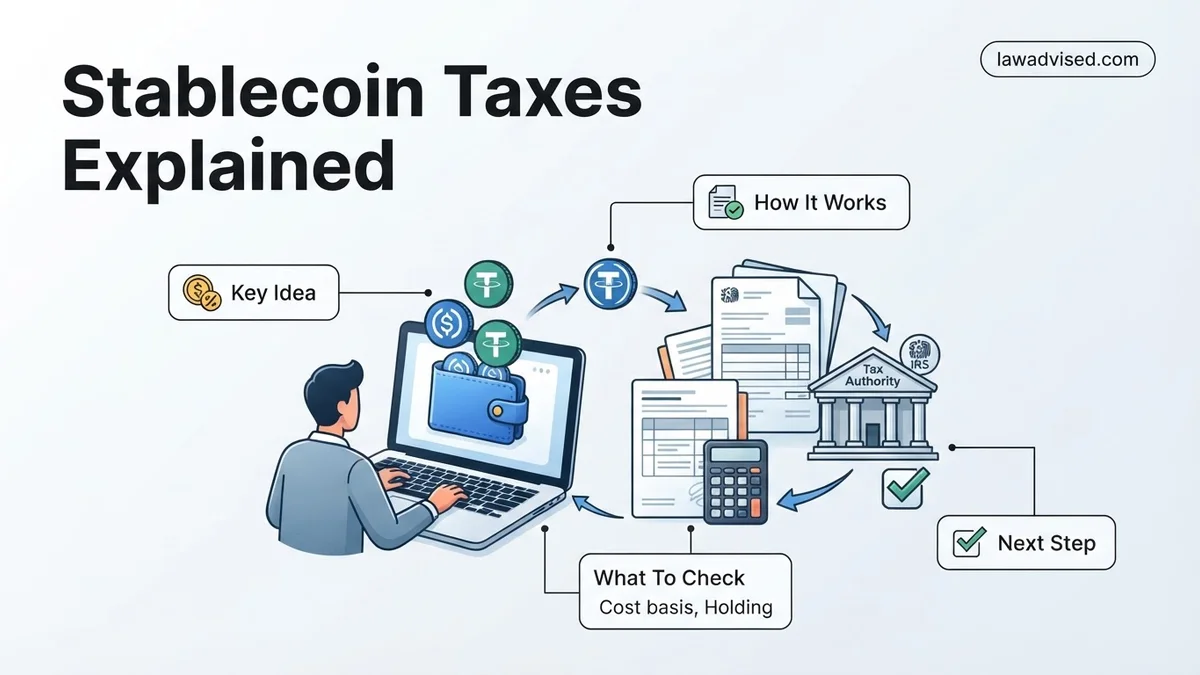
What Causes Tax Liabilities on Stablecoin Swaps and Yields
Crypto-to-Stablecoin and Stablecoin-to-Fiat Swaps
When you trade volatile cryptocurrencies like Ethereum for a stablecoin, the IRS views this as a disposal of property. If the value of Ethereum increased since you bought it, you have realized a capital gain that must be reported on your 2026 tax return. Converting your stablecoins back into fiat currency (like US Dollars) does not trigger a new capital gain on its own, because stablecoins are pegged to $1. However, using that stablecoin to buy another crypto asset or spending it on goods and services is another taxable disposal.
- Swapping volatile crypto for a stablecoin realizes capital gains or losses.
- Trading one stablecoin for another (such as USDT to USDC) can technically trigger a taxable trade, depending on exchange tracking.
- Cashing out stablecoins directly to your bank account via fiat does not create new gains, but it finalizes your transaction history.
Stablecoin-to-Stablecoin Exchanges
Many traders assume that moving funds between USDT, USDC, and DAI is tax-free because all three assets hold a steady $1 value. Unfortunately, tax authorities view these as property-to-property trades. If you acquire a stablecoin at one cost basis and trade it for a different stablecoin, you must calculate fractional gains or losses based on minute market fluctuations and platform fees.
How to Calculate Capital Gains and Income from Stablecoins
Calculating Capital Gains and Losses
To calculate the capital gain or loss on a stablecoin swap, you subtract your cost basis (the original purchase price of the asset you traded) from the fair market value of the stablecoin at the exact moment of the trade. Because stablecoins trade very close to $1.00, your capital gains on crypto-to-stablecoin trades will almost entirely depend on the price movement of the original crypto asset you sold.
- Cost Basis: What you originally paid for the crypto asset, including transaction fees.
- Proceeds: The fair market value of the stablecoin at the time of the swap.
- Holding Period: Short-term (held under one year) or long-term (held over one year) rates apply based on when you acquired the original asset.
Taxation of Stablecoin Yield and Staking Rewards
Earning interest, rewards, or yield through centralized platforms or decentralized finance (DeFi) protocols is treated differently than capital gains. In 2026, stablecoin staking rewards and liquidity pool yields are taxed as ordinary income at the fair market value on the day and time you actually receive them in your wallet. If you later sell those earned stablecoins, you establish a new cost basis and will face a capital gain or loss based on any price deviation from that receipt date.
Step-by-Step Process to File Your Stablecoin Tax Report
Filing your digital asset taxes requires a systematic approach, especially given the strict 2026 enforcement rules. According to guidelines from the IRS and leading digital asset compliance firms, following a structured workflow eliminates costly errors.
1. Aggregate Your Wallet and Exchange Data
Compile every transaction history across all decentralized wallets, centralized exchanges, and peer-to-peer platforms you used during the tax year. Export your complete transaction CSV files, ensuring you capture every transfer, trade, and yield-generation event.
2. Reconcile Cost Basis and Missing Inflow Data
Run your imported transaction data through a dedicated crypto tax software suite designed for the 2026 regulatory environment. Identify and manually fix missing cost basis errors, unassigned gas fees, or incomplete withdrawal records flagged by the software engine.
3. Calculate Capital Gains and Income
Generate your comprehensive Form 8949 and Schedule 1 reports automatically through your tax platform. Verify that all stablecoin-to-crypto trades, interest payments from DeFi lending protocols, and staking rewards are accurately categorized as either capital gains or ordinary income.
4. Export and Attach to Your Primary Tax Return
Export your finalized crypto tax summary files in a format compatible with professional tax preparation software like TurboTax, or hand the compiled PDFs directly to your Certified Public Accountant. Ensure your total stablecoin income matches the figures reported on any incoming 1099 forms from centralized exchanges.
What If You Missed Reporting Past Stablecoin Transactions
Failing to report past stablecoin transactions or omitting taxable yield events from previous years can trigger severe IRS audits, penalties, and back taxes. If you discover historical reporting errors, several remediation paths exist to bring your account into compliance for 2026.
- File an amended return (Form 1040-X): Submit corrected tax forms for each prior year where stablecoin trades or interest income were omitted, recalculating your tax liability and including appropriate interest charges.
- Utilize the IRS Voluntary Disclosure Practice: For significant historical non-compliance involving large digital asset holdings, formal voluntary disclosure programs can help mitigate criminal prosecution risks.
- Consult a specialized digital asset tax attorney: When historical omissions exceed tens of thousands of dollars in unreported gains, professional legal representation is critical. According to industry data, specialized tax lawyer fees typically range from $3,000 to $10,000+ depending on the complexity of the asset trail.
- Run a retroactive blockchain audit: Use specialized forensics software to reconstruct missing historical ledgers from decentralized exchanges and older wallets before speaking with a tax professional.
Conclusion
Navigating stablecoin taxes requires rigorous tracking of every trade, transfer, and yield-earning event to remain compliant with evolving regulatory standards. By leveraging specialized tax automation software and properly categorizing stablecoins as property rather than fiat currency, you can accurately report your financial activity and avoid severe IRS penalties. According to verified research and expert financial sources from leading compliance firms, proactive reporting and early data aggregation remain the most reliable methods for minimizing audit risk. Your immediate actionable next step is to export your complete transaction history from every exchange and wallet used over the past year into a reputable crypto tax calculation platform today.
❓ Frequently Asked Questions
How does the IRS view stablecoins compared to other cryptocurrencies?
The IRS treats all stablecoins as property, meaning standard cryptocurrency tax rules for capital gains, losses, and income apply identically.
What happens if I suffer a capital loss when trading stablecoins?
If you trade crypto for a stablecoin at a loss, you can use that capital loss to offset other capital gains and up to $3,000 of ordinary income.
How is cost basis determined for stablecoins acquired through swaps?
The cost basis of a stablecoin received in a swap is the fair market value of the cryptocurrency you traded away at the exact time of the transaction.
Does transferring stablecoins between my own wallets trigger a tax event?
No, moving stablecoins between your own self-custody wallets or accounts is a non-taxable transfer, though you should keep records to prove ownership.
How are liquidity pool rewards paid in stablecoins taxed?
Liquidity pool yields and trading fees earned in stablecoins are treated as ordinary income at the time they are received and claimed.
What software can help track stablecoin taxes automatically?
Crypto tax software tools connect via API to wallets and exchanges to automatically calculate cost basis, capital gains, and income from stablecoin activity.

Ismail Hossain is the founder of Law Advised. He is an Divorce, Separation, marriage lawyer. Follow him.