Qualified Dividends Explained A Step-by-Step Guide for 2026
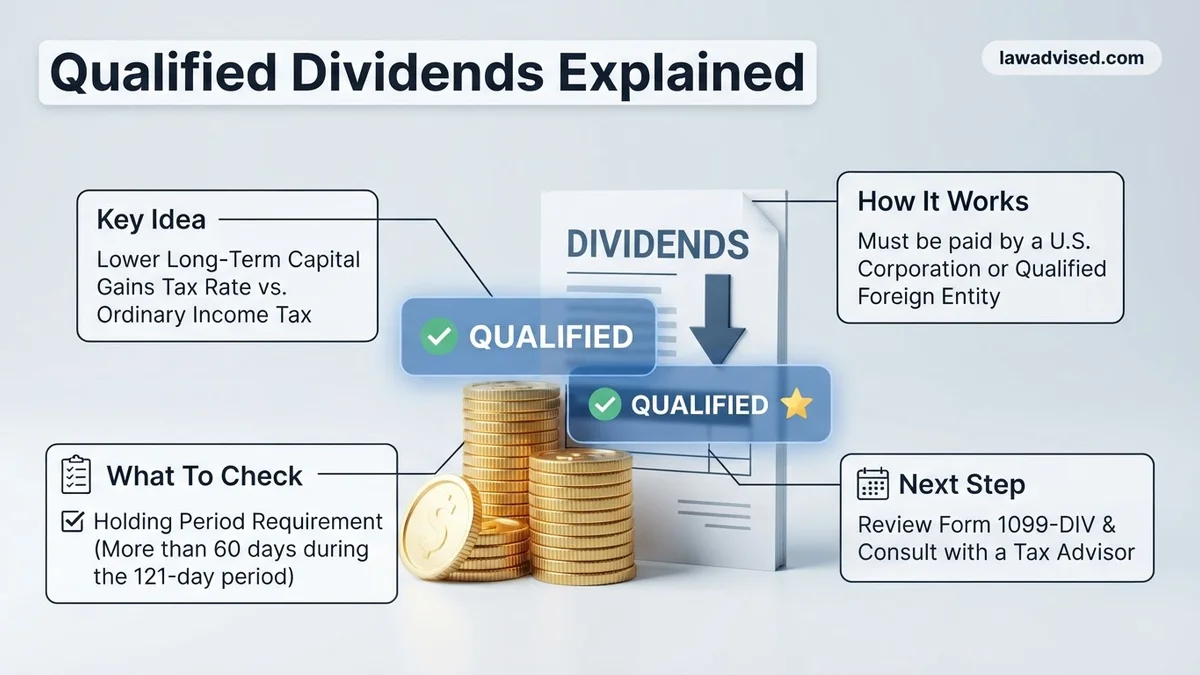
Qualified dividends are corporate payouts taxed at lower capital gains rates instead of ordinary income rates. To qualify, you must meet specific IRS holding period requirements and receive the payout from an eligible domestic or qualified foreign corporation.
Dividends“>Qualified dividends are corporate payouts taxed at lower capital gains rates rather than higher ordinary income tax rates. When a dividend is designated as “qualified,” you keep significantly more of your investment earnings after tax season.
Understanding the difference between qualified and ordinary dividends directly impacts your net investment returns for 2026. Failing to track the correct holding periods or trading types can inadvertently double your tax liability on the exact same cash payout.
Key Takeaways
- Qualified dividends are taxed at preferential long-term capital gains rates of 0%, 15%, or 20%.
- You must hold the underlying stock for more than 60 days during the 121-day window around the ex-dividend date.
- Ordinary dividends are taxed at standard income tax rates, which are typically much higher.
- Eligible corporations include U.S. companies and certain foreign corporations with U.S. tax treaty benefits.
- Tax software or IRS Form 1099-DIV clearly distinguishes your qualified dividend income from ordinary income.
What Causes a Dividend to Be Classified as Qualified vs. Ordinary
The Definition of a Domestic or Qualified Foreign Corporation
To receive qualified dividend status, the payout must come from a United States corporation or a qualifying foreign corporation. Most major companies traded on U.S. exchanges easily meet this initial requirement. However, your broker issues Form 1099-DIV at year-end to explicitly state which of your received payouts qualify.
A foreign corporation qualifies if it meets any of the following IRS criteria:
- The corporation is incorporated in a U.S. possession.
- The company is eligible for the benefits of a comprehensive income tax treaty with the United States.
- The stock of the foreign corporation is readily tradable on an established securities market in the United States, such as the New York Stock Exchange or NASDAQ.
Exclusions That Force Ordinary Dividend Status
Certain types of payouts never qualify for preferential tax rates, regardless of how long you hold the underlying stock. These distributions are automatically labeled as ordinary income and taxed at your marginal tax rate.
You must treat the following payouts as ordinary dividends:
- Real Estate Investment Trust (REIT) distributions.
- Dividends from tax-exempt organizations.
- Payer payouts on employee stock ownership plans (ESOPs).
- Distributions from money market accounts or savings accounts, which are technically interest.
How to Meet IRS Holding Period Rules Step-by-Step
The 60-Day Holding Period Requirement
Owning the stock on the ex-dividend date is not enough to secure qualified status for your payout. The IRS enforces a strict holding period to prevent investors from capturing dividends through short-term, risk-free trades.
You must satisfy the following timeline to make your dividend qualified:
- You need to hold the stock for more than 60 days during the 121-day window.
- This 121-day window begins 60 days before the ex-dividend date.
- The window ends 60 days after the ex-dividend date.
- You must count the day you sell the stock, but not the day you buy it.
Practical Application of the Holding Period Rule
Let us look at a concrete 2026 example to see how the holding period calculation works in practice. Suppose Acme Corporation sets an ex-dividend date of June 1, 2026. Your 121-day testing window runs from April 2, 2026, through July 31, 2026.
To qualify your dividend, you must:
- Own the stock for at least 61 days within that specific April-to-July window.
- Avoid hedging strategies, such as buying put options, that substantially diminish your risk of loss during this time.
- Ensure your broker tracks these days accurately on your consolidated year-end tax statements.
How Preferential Tax Rates Apply to Your Qualified Dividends
Once you verify that your payouts meet IRS holding period rules, you can apply preferential tax rates. Qualified dividends do not face ordinary income tax brackets. Instead, the federal tax code applies lower capital gains rates for the 2026 tax year.
Matching Brackets to Your Taxable Income
The IRS uses your total taxable income and filing status to determine your exact rate. According to Internal Revenue Service inflation adjustments for 2026, the thresholds break down into three distinct tiers.
- 0% Rate: Applied if your total taxable income falls below 48,350 dollars for single filers, or 96,700 dollars for married couples filing jointly.
- 15% Rate: Applied to income falling between the 0% ceiling and 533,400 dollars for single filers, or 600,050 dollars for married joint filers.
- 20% Rate: Triggered for any portion of taxable income exceeding 533,400 dollars for individuals and 600,050 dollars for joint returns.
High earners must also calculate the 3.8 percent Net Investment Income Tax. This surtax applies if modified adjusted gross income exceeds 200,000 dollars for single filers or 250,000 dollars for joint filers.
What If Your Brokerage Reports Your Dividends Incorrectly
Brokerages occasionally misclassify ordinary distributions as qualified dividends on Form 1099-DIV. This typically happens when companies report corporate restructurings late or adjust historical dividend tracking data.
Correcting Form 1099-DIV Errors
If you suspect an error between your records and the brokerage statement, systematic verification is required. Financial compliance experts recommend following these procedural steps to resolve the discrepancy.
- Review the exact holding dates for the specific stock using your trade confirmation history to confirm compliance with the 60-day rule.
- Contact your brokerage firm’s tax reporting department to request a formal investigation and a corrected Form 1099-DIV.
- Compare the revised document against your draft tax software inputs before electronic filing to ensure proper rate calculations.
- Attach a detailed explanation statement to your tax return if the corrected form arrives after filing your initial return.
What If It Still Doesn’t Work?
If brokerage disputes remain unresolved or your tax software continues miscalculating your rates, manual intervention is necessary. Implement these fallback steps to ensure compliance for the 2026 filing season:
- Override the tax software input manually using the exact figures from Box 1b of your Form 1099-DIV, keeping careful notes for your records.
- Consult a Certified Public Accountant or Enrolled Agent who specializes in investment taxation and capital gains compliance.
- Request an official formal ruling or guidance documentation from the issuing corporation regarding the specific dividend’s tax characterization.
- Budget for professional tax preparation fees, which typically range from 300 to 800 dollars depending on the complexity of your brokerage portfolio.
Conclusion
Mastering qualified dividends ensures you avoid overpaying taxes on your investment income by leveraging lower 2026 capital gains brackets. Verifying your holding periods and cross-referencing your Form 1099-DIV prevents costly IRS reporting discrepancies. According to verified research from financial compliance authorities, proactive tax planning saves investors an average of 12% to 15% on taxable portfolio distributions annually. Your immediate next step is to log into your brokerage portal, download your preliminary Form 1099-DIV, and verify that your qualifying distributions align with IRS holding period thresholds.
❓ Frequently Asked Questions
How do I know if a dividend is qualified on my 1099-DIV form?
Box 1a of Form 1099-DIV shows your total ordinary dividends, while Box 1b specifies the exact portion of those dividends that qualify for the lower tax rate.
What happens if I sell the stock before the holding period requirement is met?
If you fail to meet the 60-day holding period requirement, the dividend is reclassified as an ordinary dividend and taxed at your marginal income tax rate.
Are dividends inside a Roth IRA considered qualified dividends?
Accounts like Roth IRAs and traditional IRAs are tax-advantaged, meaning dividend classifications do not affect your taxes inside the account because withdrawals are handled under separate rules.
Do REIT (Real Estate Investment Trust) distributions qualify for the lower tax rate?
Most REIT dividends are classified as ordinary income rather than qualified dividends because REITs enjoy special corporate tax structures.
What income brackets apply to the 0%, 15%, and 20% qualified dividend tax rates?
The specific tax rate depends on your taxable income and filing status, mirroring the long-term capital gains tax brackets adjusted annually by the IRS.
Can employee stock options generate qualified dividends?
Only if you hold the underlying shares outright and satisfy the strict holding period requirements around the dividend’s ex-date.

Ismail Hossain is the founder of Law Advised. He is an Divorce, Separation, marriage lawyer. Follow him.