Ordinary Dividends Explained 2026 A Step-by-Step Guide
Ordinary dividends are payouts from a corporation to its shareholders that are taxed at standard ordinary income tax rates. Unlike qualified dividends, they do not qualify for lower long-term capital gains tax rates and typically come from short-term investments or specific types of distributions.
Ordinary dividends—also known as non-qualified dividends—are distributions of corporate earnings paid out to shareholders that are taxed at your standard marginal income tax rate. Unlike their lower-taxed counterparts, these payouts do not qualify for long-term capital gains tax rates, meaning you will pay a higher percentage to the IRS depending on your total taxable income for the 2026 tax year.
Understanding this distinction is critical for your tax planning and portfolio management. If you hold dividend-paying stocks, mutual funds, or exchange-traded funds (ETFs) in a standard taxable brokerage account, mistaking an ordinary dividend for a qualified one can lead to an unexpected tax bill. Knowing how these payouts are defined and taxed ensures you accurately report your investment income and avoid penalties.
Key Takeaways
- Ordinary dividends are taxed at standard income tax rates rather than lower capital gains rates.
- They are also commonly referred to as taxable dividends on financial documents.
- The holding period is the main factor separating ordinary dividends from qualified dividends.
- Box 1a on Form 1099-DIV reports your total ordinary dividend income for the tax year.
- REITs and MLPs frequently pay out ordinary dividends instead of qualified dividends.
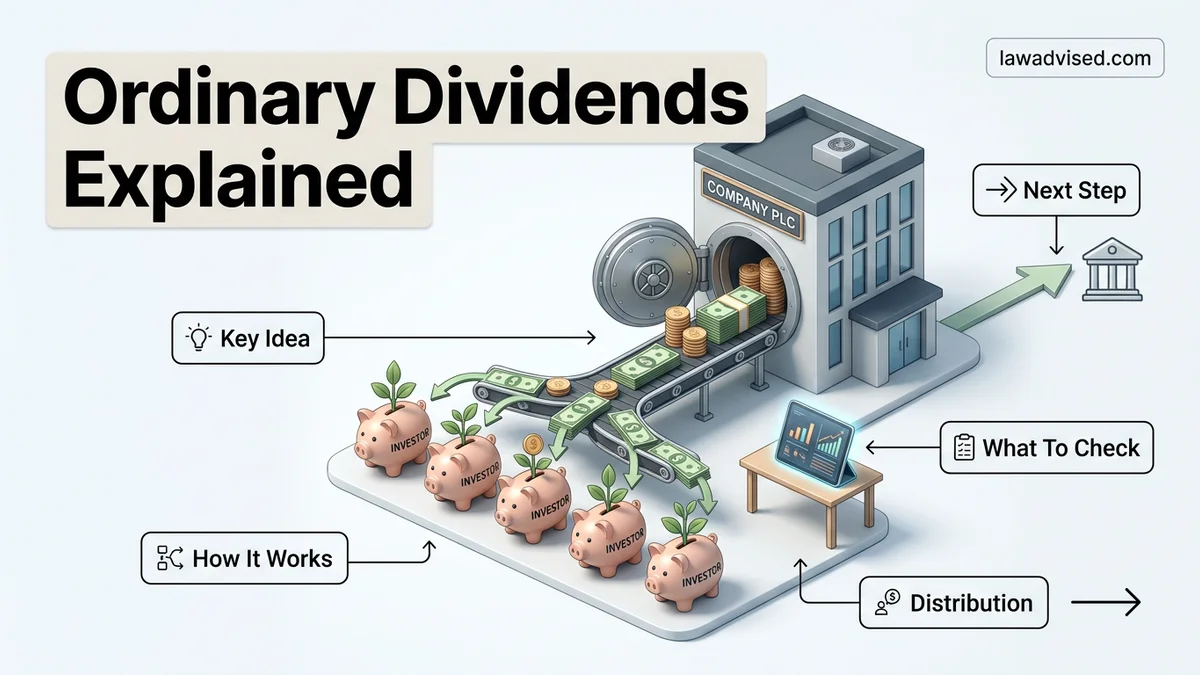
What Causes Ordinary Dividends to Occur and How They Are Defined
The Core Definition and Corporate Triggers
An ordinary dividend is simply the default classification for any cash or property payout a corporation gives to its shareholders. When a company generates profits, its board of directors can choose to retain those earnings or distribute them. When they distribute them, the IRS automatically categorizes them as ordinary income unless they meet specific criteria to become qualified.
Several common corporate actions trigger ordinary dividends in your portfolio:
- REIT Distributions: Real Estate Investment Trusts are legally required to distribute at least 90 percent of their taxable income to shareholders, and these payouts are almost always classified as ordinary dividends.
- Short-Term Holding Periods: If a company pays a dividend on a stock you bought just days before the ex-dividend date, the IRS views it as ordinary income.
- Special and One-Time Payouts: Companies issuing unexpected cash windfalls often structure them in ways that do not meet the strict holding period requirements for preferential tax rates.
Tax Treatment in the 2026 Tax Landscape
The defining characteristic of an ordinary dividend is its tax rate. For the 2026 tax year, ordinary dividends are taxed according to your individual federal income tax brackets, which range from 10 percent up to 37 percent.
Consider a practical example. If you fall into the 24 percent marginal tax bracket and receive one thousand dollars in ordinary dividends, you will owe two hundred and forty dollars in federal income taxes. If that exact same payout were qualified, you might pay only fifteen percent—or even zero percent—depending on your total income level. This makes tracking your asset types vital for keeping your tax burden low.
How to Identify Ordinary Dividends Versus Qualified Dividends
The Crucial Holding Period Requirement
The primary difference between an ordinary dividend and a qualified dividend comes down to how long you own the underlying stock. To qualify for the lower long-term capital gains tax rates, you must satisfy the IRS holding period rule.
You must own the stock for more than 60 days during the 121-day window that begins 60 days before the stock ex-dividend date. If you sell the stock before meeting this exact timeline, the dividend automatically defaults to being an ordinary dividend.
- Ordinary Dividends: Fail the holding period test, or come from asset classes like REITs and master limited partnerships that are excluded by law.
- Qualified Dividends: Meet the holding period requirement and are issued by domestic corporations or qualifying foreign companies.
- Form 1099-DIV: Your brokerage firm will officially sort this out for you at tax time, reporting ordinary dividends in Box 1a and the subset of qualified dividends in Box 1b.
Comparing the Financial Impact on Your Portfolio
The gap in taxation between ordinary and qualified dividends heavily influences where you should hold certain assets. Because ordinary dividends face higher tax rates, savvy investors often place high-yield ordinary dividend assets—like REITs—inside tax-advantaged accounts like a Traditional IRA or Roth IRA.
By sheltering ordinary dividends in a retirement account, you eliminate the immediate tax sting of the standard income tax brackets. Meanwhile, you can keep stocks that consistently issue qualified dividends in your standard taxable brokerage account, taking full advantage of the lower 0 percent, 15 percent, or 20 percent capital gains rates.
Step-by-Step Guide to Calculating Taxes on Ordinary Dividends
Calculating the exact tax you owe on ordinary dividends requires knowing your total taxable income and current 2026 federal tax brackets. Because ordinary dividends do not qualify for the preferential 0%, 15%, or 20% rates, they are taxed as earned income at your marginal income tax rate.
Step 1: Locate Your Total Taxable Income
First, add your ordinary dividends reported on Form 1099-DIV (Box 1a) to your other sources of income, such as W-2 wages, business income, and interest. Subtract your standard deduction or itemized deductions to arrive at your final taxable income.
Step 2: Determine Your 2026 Marginal Tax Bracket
Match your final taxable income against the Internal Revenue Service marginal tax brackets for the 2026 tax year. Ordinary dividends are stacked on top of your other ordinary income, meaning they are taxed at the highest bracket your income reaches.
- Identify your filing status (Single, Married Filing Jointly, Head of Household).
- Locate the specific marginal tax bracket that encompasses your total taxable income.
- Multiply the total amount of your ordinary dividends by that specific marginal tax rate percentage to find your estimated tax liability.
What If Your Brokerage Reports Your Dividends Incorrectly
Receiving an inaccurate Form 1099-DIV from your brokerage is a frustrating error that can delay your tax filing and trigger IRS notices. Brokerages occasionally misclassify qualified dividends as ordinary dividends, or vice versa, based on holding period errors.
Submitting a Correction Request
If you spot a discrepancy between your year-end brokerage statements and your official Form 1099-DIV, take immediate action to protect your tax return accuracy.
- Contact your brokerage firm’s customer support or tax reporting department via secure message or phone.
- Provide specific transaction confirmation numbers and monthly account statements proving the correct dividend classification and holding periods.
- Request an official corrected Form 1099-DIV (often designated as a “Corrected” check-box form).
- Wait for the corrected document to process, which typically takes between 3 to 10 business days during peak tax season.
What If It Still Doesn’t Work?
If your brokerage refuses to issue a corrected Form 1099-DIV before your filing deadline, or if complex foreign tax credits and phantom distributions complicate your return, alternative fallback steps are necessary.
- File for a standard six-month tax extension using IRS Form 4868 by the April 2026 deadline to give your brokerage time to issue correct documents.
- Report the accurate dividend figures on your tax return based on your own verified records, attaching a detailed explanatory statement if required by your tax software.
- Consult a certified public accountant (CPA) or a federally authorized tax practitioner to handle complex multi-brokerage reporting errors. Professional tax advisory services typically cost between $300 and $800 depending on the complexity of your investment portfolio.
- Contact the IRS taxpayer assistance line or utilize a registered volunteer income tax assistance program if you encounter persistent reporting disputes with financial institutions.
Conclusion
Navigating ordinary dividends in 2026 requires understanding how these distributions are taxed at your ordinary marginal income rate rather than preferential capital gains rates. According to verified research and tax experts from the American Institute of Certified Public Accountants (AICPA), proactive tax planning and careful review of Form 1099-DIV documents prevent costly filing errors. Your actionable next step is to cross-reference your year-end brokerage statements with your 1099-DIV Box 1a total before submitting your tax return.
❓ Frequently Asked Questions
What exactly makes a dividend ordinary instead of qualified?
A dividend is classified as ordinary if the investor does not hold the underlying stock for more than 60 days during the 121-day window surrounding the ex-dividend date. Certain types of entities, like Real Estate Investment Trusts, also automatically distribute ordinary dividends.
How are ordinary dividends taxed at tax time?
Ordinary dividends are added to your earned income and taxed according to your marginal income tax bracket, which can range from 10% up to 37% depending on your total taxable income.
Where do I look on my 1099-DIV to find ordinary dividends?
Box 1a on Form 1099-DIV lists your total ordinary dividends. Box 1b shows the subset of those dividends that qualify for lower tax rates.
Do ordinary dividends apply to retirement accounts like traditional IRAs?
Dividends received inside tax-advantaged accounts like traditional IRAs or 401(k)s are not taxed when distributed by the company, meaning ordinary dividend rules only apply to taxable brokerage accounts.
Can mutual funds and ETFs distribute ordinary dividends?
Yes, mutual funds and exchange-traded funds pass ordinary dividends through to investors if the fund itself holds the underlying securities for short durations.
Are foreign dividends classified as ordinary dividends?
Many foreign corporation dividends are treated as ordinary dividends unless the company is located in a country with a comprehensive tax treaty with the U.S. and meets holding period tests.

Ismail Hossain is the founder of Law Advised. He is an Divorce, Separation, marriage lawyer. Follow him.