401k Withdrawals and Taxes Expert 2026 Guide
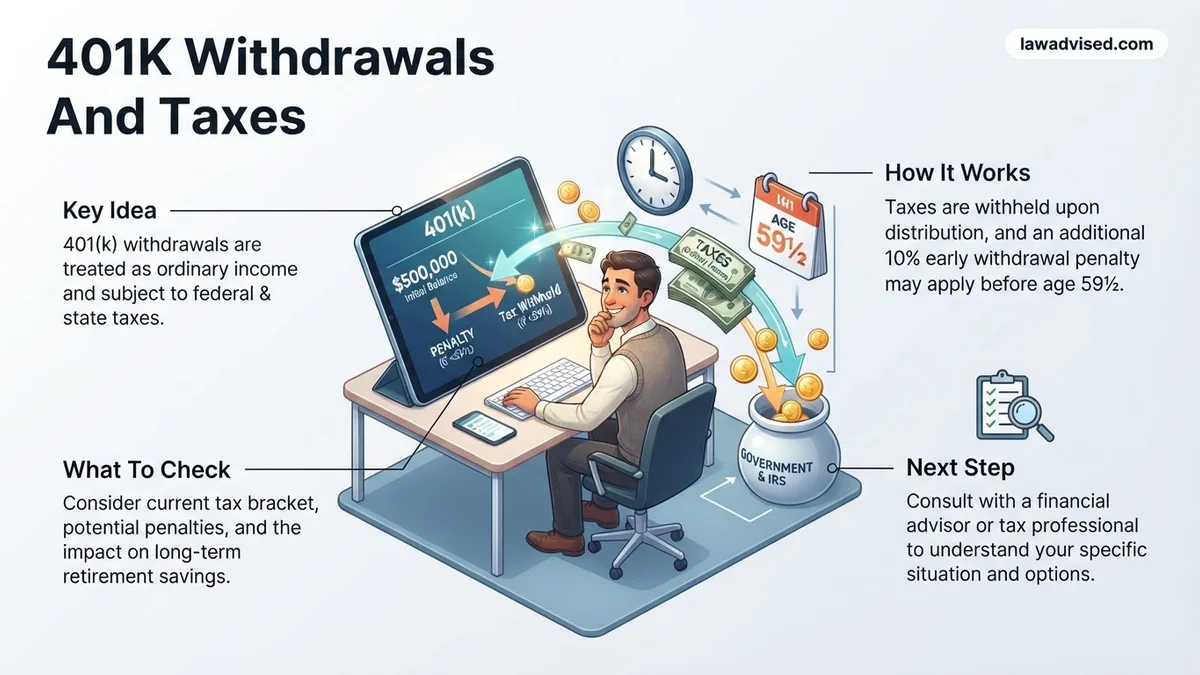
Navigating 401k withdrawals and taxes requires understanding the strict rules governing traditional and Roth accounts. Taking money out incorrectly triggers ordinary income taxes and steep 10% early withdrawal penalties before age 59½.
When you pull money from a traditional 401(k) in 2026, every single dollar counts as ordinary income and faces federal income tax at your current marginal bracket. Roth 401(k) withdrawals, by contrast, come out completely tax-free if you meet the five-year holding rule and are at least 59½. If you tap either account before age 59½ without qualifying for an IRS exception, you will also trigger a punishing 10% early withdrawal penalty on top of ordinary income taxes.
Managing these distributions requires precision because a large lump-sum withdrawal can easily push you into a much higher tax bracket. By understanding mandatory withholding rates, strategic pacing, and age-based rules, you can prevent unnecessary tax drainage and keep more of your retirement savings.
Key Takeaways
- Traditional 401(k) withdrawals are taxed as ordinary income at your current marginal rate.
- Qualified Roth 401(k) withdrawals are completely tax-free if rules are met.
- Distributions before age 59½ generally incur a 10% penalty plus regular income tax.
- The Rule of 55 allows penalty-free withdrawals if you leave your job at 55 or older.
- Required Minimum Distributions (RMDs) force taxable withdrawals starting at age 73.
What Causes High Tax Bills on 401k Withdrawals
Mandatory Withholding and Bracket Creep
When you request a distribution from a traditional 401(k), plan administrators are legally required to withhold 20% for federal income taxes right off the top. This automatic withholding is rarely your actual tax liability. If your total income in 2026 places you in a higher marginal bracket, you will owe even more when you file your tax return. Conversely, if you fall into a lower bracket, you will wait for a refund. Pulling a large sum to buy a car or pay off debt causes bracket creep, instantly elevating your taxable income and exposing your gains to higher marginal rates.
State Taxes and Traditional vs. Roth Surprises
Ignoring state income taxes is another fast track to an unexpected tax bill. While states like Florida or Texas levy zero state income tax, others tax retirement distributions at rates exceeding 10%. Furthermore, confusing traditional and Roth tax rules leads to costly errors. Traditional 401(k) withdrawals are fully taxable, whereas Roth 401(k) withdrawals are tax-free. However, if you withdraw earnings from a Roth 401(k) prematurely, those earnings face both ordinary income taxes and the 10% early withdrawal penalty.
- Federal Withholding: Fixed at 20% for standard traditional 401(k) distributions.
- State Impact: Varies wildly; check your specific state laws for retirement income exemptions in 2026.
- Roth Earnings: Subject to tax and penalties if taken before age 59½ and the five-year rule is unmet.
How to Fix Your Withdrawal Strategy Step-by-Step
Staging Distributions Across Tax Years
To avoid severe tax spikes, you must stop taking lump-sum distributions. Instead, stage your withdrawals across multiple calendar years to stay within a predictable tax bracket. Calculate your expected 2026 income from Social Security, pensions, and part-time work first. Then, fill the remaining space in your current tax bracket with traditional 401(k) withdrawals. Spreading the income prevents you from unnecessarily vaulting into the 32%, 35%, or 37% federal tax brackets.
Using Strategic Conversions and Timing
You can also lower lifetime tax obligations by executing strategic Roth conversions during lower-income years before taking required minimum distributions (RMDs). If you retired early in 2026, you likely have a low-income window. Convert traditional 401(k) funds up to the top of the 12% or 22% tax bracket. This moves money into a tax-free growth environment without paying peak marginal rates later in life.
- Audit Income: Add up all guaranteed 2026 income sources to find your baseline tax bracket.
- Calculate Room: Determine how much traditional 401(k) money you can withdraw without crossing into the next tax bracket.
- Execute Payouts: Request smaller, scheduled periodic payments rather than one large annual distribution.
How to Avoid the 10% Early Withdrawal Penalty Legally
Accessing your retirement funds before age 59½ typically triggers a steep 10% early withdrawal penalty in addition to ordinary income tax. However, Internal Revenue Service regulations provide several legal avenues to bypass this extra fee. Understanding these exemptions can save you thousands of dollars when facing unexpected financial pressure in 2026.
Utilizing IRS Rule 72(t) for Substantially Equal Periodic Payments
Internal Revenue Service Code Section 72(t) allows individuals of any age to take penalty-free distributions from a 401k plan. To qualify, you must calculate a series of substantially equal periodic payments based on your life expectancy. Financial planners emphasize that this strategy requires strict adherence to withdrawal formulas for at least five years or until you reach age 59½, whichever is longer. Modifying the payment schedule prematurely results in retroactive penalties plus substantial interest charges on all prior distributions.
Qualifying Exemptions Under Federal Guidelines
Federal tax code outlines specific life events that excuse account holders from the 10% early withdrawal penalty. According to data from the Internal Revenue Service and tax policy researchers, common penalty-exempt scenarios include:
- Total and permanent disability that prevents you from engaging in any substantial gainful activity.
- Distributions taken to cover unreimbursed medical expenses that exceed 7.5 percent of your adjusted gross income.
- Corrective distributions of excess deferrals made before the annual tax filing deadline.
- Distributions to qualified military reservists called to active duty for a period exceeding 179 days.
What If RMD Rules and Special Circumstances Still Apply
Navigating required minimum distributions and unexpected life events demands careful attention to shifting federal thresholds. The SECURE 2.0 Act continues to reshape retirement account mandates through 2026. Account holders must evaluate how these evolving federal guidelines impact their annual tax liability and overall withdrawal strategy.
Navigating Updated Required Minimum Distribution Thresholds
Federal regulations mandate that retirement account owners begin taking required minimum distributions once they reach the designated statutory age. According to 2026 Internal Revenue Service guidelines, missing a required minimum distribution deadline incurs a severe excise tax penalty of 25 percent on the amount that should have been withdrawn, though this can be reduced to 10 percent if corrected promptly. Tax specialists recommend setting up automatic annual distributions through your plan administrator to prevent costly administrative oversights.
Managing Beneficiary Rules and Special Circumstances
Inherited accounts and unexpected life developments introduce complex tax liabilities that require targeted planning. Financial compliance experts note that non-spouse beneficiaries generally must deplete an inherited 401k balance within a ten-year window. Furthermore, special provisions permit penalty-free withdrawals for qualified domestic relations orders following a divorce decree. Reviewing these specialized rules ensures compliance with federal tax statutes.
What If It Still Doesn’t Work?
If standard penalty exemptions and basic distribution strategies fail to resolve your 2026 tax dilemmas, more intensive corrective measures are necessary. When self-service retirement planning hits a roadblock, consider the following fallback steps:
- Contact your 401k plan administrator immediately to halt or reverse pending transactions before the settlement date closes.
- Consult a Certified Public Accountant or a Certified Financial Planner to review your specific tax bracket and withholding elections. Professional advisory fees typically range from $200 to $500 per hour or a flat project fee of $1,500 to $3,000 for comprehensive retirement tax planning.
- File for an extension on your federal tax return if you need additional time to calculate complex 72(t) payment schedules or reconcile 1099-R forms.
- Submit a formal private letter ruling request to the Internal Revenue Service if your distribution scenario involves ambiguous or highly complex regulatory interpretations.
Conclusion
Managing 401k withdrawals and the associated tax burdens requires a strategic approach to avoid heavy penalties and maximize your retirement savings. By understanding marginal tax brackets, utilizing legal exemptions like Rule 72(t), and navigating required minimum distributions carefully, you can protect your long-term wealth. According to verified research and expert sources from the Internal Revenue Service and leading financial planning associations, proactive tax diversification remains the most effective defense against unexpected retirement liabilities. Take your next actionable step today by requesting a comprehensive distribution audit from your plan custodian to evaluate your current withholding status.
❓ Frequently Asked Questions
How does mandatory tax withholding work when taking a 401(k) distribution?
Plan administrators typically withhold a mandatory 20% for federal taxes on lump-sum traditional 401(k) distributions. Depending on your actual tax bracket, you may owe more when filing your annual return or receive a refund.
What qualifies as an exception to the 10% early withdrawal penalty?
Exceptions include total and permanent disability, certain medical expenses exceeding a percentage of your adjusted gross income, higher education costs, and substantially equal periodic payments under Rule 72(t).
How do 72(t) distributions work for early retirees?
Rule 72(t) allows you to take a series of substantially equal periodic payments based on your life expectancy from your 401(k) before age 59½ without paying the 10% penalty, though ordinary income taxes still apply.
What is the difference between a direct rollover and an indirect rollover?
A direct rollover moves funds straight from your old 401(k) to a new account without tax consequences. An indirect rollover gives you the cash temporarily, requiring you to deposit the full amount into a new retirement account within 60 days to avoid taxes and penalties.
How are employer matches taxed upon withdrawal?
Employer matching contributions are always pre-tax in traditional accounts. Therefore, when withdrawn, 100% of the match amount plus earnings is taxed as ordinary income.
Can I take a loan from my 401(k) instead of a taxable withdrawal?
Many plans allow you to borrow up to 50% of your vested balance or $50,000, whichever is less. Loans are not immediately taxed if repaid on schedule, but failing to repay usually turns the balance into a taxable distribution subject to penalties.

Ismail Hossain is the founder of Law Advised. He is an Divorce, Separation, marriage lawyer. Follow him.