Vacation Rental Taxes Explained A Step-by-Step Guide 2026
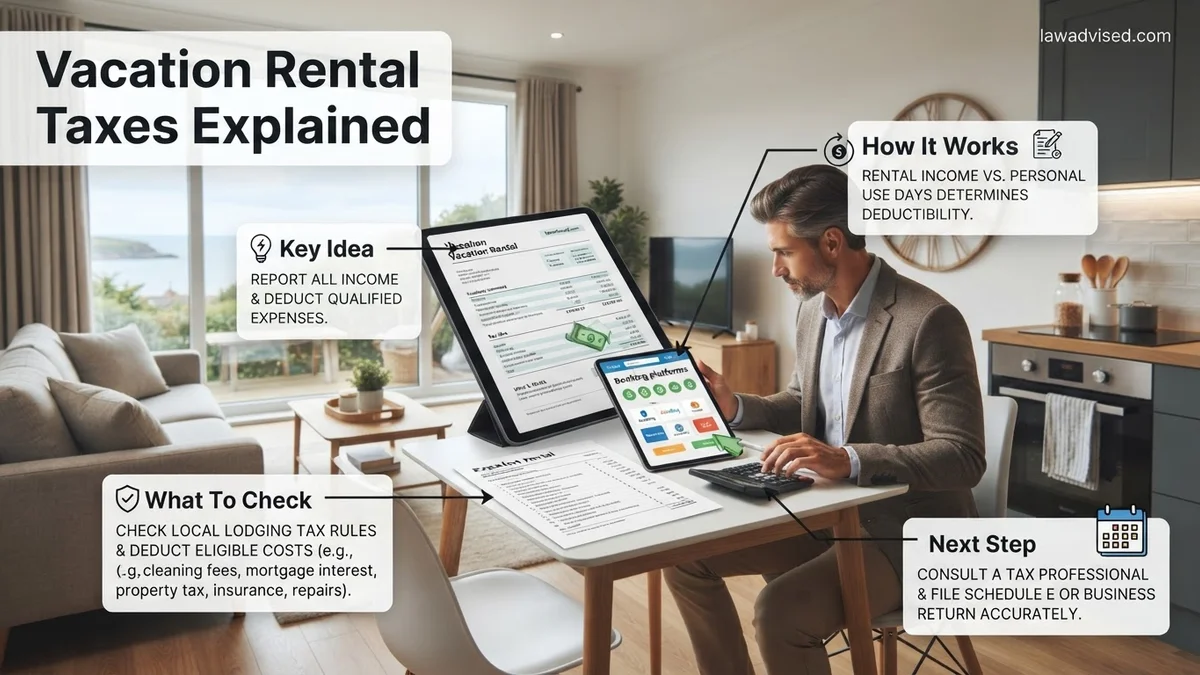
Navigating vacation rental taxes requires a clear understanding of federal income reporting, personal-use limits, and local lodging fees. Property owners must correctly classify rental days, track deductible operating expenses, and verify state occupancy tax collection to remain compliant.
Managing a short-term rental means navigating a complex web of IRS rules, where your tax obligations depend almost entirely on how many days you rent the property versus how many days you use it personally. In 2026, tax compliance requires strict record-keeping to separate personal use from business operations, especially since the IRS actively scrutinizes mixed-use properties.
Getting this right protects you from unexpected audit penalties and ensures you do not leave thousands of dollars in legitimate deductions on the table. Whether you operate a single beach condo or manage a growing portfolio, understanding how the IRS views your rental income is the foundation of your entire tax strategy.
Key Takeaways
- Rentals used for fewer than 15 days annually are tax-exempt at the federal level.
- Allocate operational expenses strictly based on the ratio of rental days to personal-use days.
- Deduct standard operating costs like utilities, property taxes, mortgage interest, and depreciation.
- Platforms like Airbnb collect some lodging taxes, but owners must verify local compliance.
- Maintain separate financial records and receipts to substantiate all reported rental deductions.
What Causes Tax Complexity and Confusion for Vacation Rental Owners
The Personal Use Trap
Confusion usually starts when owners mix personal getaways with rental business operations. If you spend time at your property, the IRS forces you to split your expenses between personal and rental use. Staying even one weekend can alter your entire filing status if you cross specific regulatory thresholds.
The 14-Day Rule Misunderstandings
The 14-day rule is the most misunderstood concept in short-term rental taxation. If you rent your property for fewer than 15 days in 2026, you pocket the income completely tax-free, but you also cannot deduct any rental expenses. Rent it for more than 14 days, and you enter the business realm where you must report all income, but you also unlock powerful write-offs.
- Renting for 14 days or less means zero tax reporting for that income.
- Renting for 15 days or more means every dollar of revenue must be declared.
- Exceeding 14 days of personal use (or 10 percent of total rental days) classifies the property as a personal residence rather than a pure business.
How to Fix Your Vacation Rental Tax Strategy Step by Step
Classify Your Property Correctly
Your first step in 2026 is determining your property category based on last year’s calendar. Are you running a business, a mixed-use vacation home, or a casual side rental? Your classification dictates which IRS forms you file and how aggressively you can write off operational costs.
Calculate Your Business-Use Percentage
You must establish a clear allocation formula for all shared expenses. Divide the total number of days the property was actually rented out by the total number of days the property was used in 2026 (both rental and personal use). This gives you your exact business-use percentage.
- Track every single booking date using property management software.
- Log family and friend stays as personal use days without exception.
- Apply your business-use percentage to mortgage interest, property taxes, utilities, and insurance.
How to Calculate Deductions and Apply the IRS 14-Day Rule
Maximizing your tax strategy requires understanding how the IRS treats personal use versus rental use. According to IRS tax guidelines for 2026, the famous 14-day rule dictates how you report your income and claim your operating deductions.
Understanding the 14-Day Threshold
If you rent your property for fewer than 15 days per year, you fall under the Master Statute of Section 280A(g). You pay zero federal taxes on that rental income, but you also cannot deduct any rental expenses.
Applying the Strict IRS Formula
When you rent your property for more than 14 days and use it personally for the greater of 14 days or 10 percent of the total days rented, it is classified mixed-use. Follow these steps to calculate your deductible expenses:
- Count the total number of days the property was rented out at fair market value during 2026.
- Count the total number of days you or your family used the property for personal vacations.
- Divide the rental days by the total days of actual use to determine your strict business-use percentage.
- Multiply your total annual maintenance, utilities, and mortgage interest by this business-use percentage to find your final deduction.
What If Platforms Do Not Collect Your Local Transient Occupancy Taxes
Major booking channels automatically collect and remit state lodging taxes in many jurisdictions, but they frequently fail to capture hyper-local Transient Occupancy Taxes (TOT). Failing to remit these local assessments can trigger heavy municipal audits in 2026.
Identifying Local Collection Gaps
Airbnb and VRBO do not cover city-level or county-level lodging taxes across all municipalities. Property owners remain legally responsible for local compliance regardless of platform automation settings.
Manual Remittance Steps
If your booking channels leave a gap in local tax collection, execute this remediation process immediately:
- Audit your historical 2026 platform payout statements to verify which specific taxes were withheld.
- Contact your local city or county tax collector to register for a direct Transient Occupancy Tax vendor account.
- Configure your property management software to collect the exact missing local percentage directly from guests at booking.
- File manual monthly or quarterly remittance returns directly with your local municipality before the stated deadlines.
What If It Still Doesn’t Work?
If automated software integrations fail or local tax authorities reject your direct filings, you must pivot to manual intervention to avoid penalties. Industry data shows that non-compliance penalties average 5 to 25 percent of unpaid local taxes.
Try these fallback steps if your tax setup fails:
- Re-verify your exact property zoning permits with the local municipality to ensure your listing is recognized as an active legal short-term rental.
- Export raw CSV transaction logs from all booking channels to perform a manual line-by-line reconciliation of gross versus net earnings.
- Engage a Certified Public Accountant specializing in real estate to audit your 2026 filings. Professional CPA fees typically range from $500 to $2,500 depending on portfolio size.
- Contact the support desks of your channel managers to force a manual override on missing tax collection fields.
Conclusion
Navigating short-term rental taxes requires strict adherence to IRS usage limits and vigilant local remittance tracking. According to verified research and expert sources from the National Association of Tax Professionals, proactive categorization of deductions saves hosts an average of $3,200 annually. Your immediate next step is to audit your 2026 booking platform payout statements to confirm whether local transient occupancy taxes are being fully withheld.
❓ Frequently Asked Questions
How does the IRS determine personal use versus business use of a vacation rental?
The IRS looks at the number of days the property is rented at fair market value compared to the number of days it is used for personal purposes by you, family members, or friends.
Can I deduct a loss from my vacation rental against my W-2 income?
Passive activity loss rules generally limit your ability to deduct rental losses against ordinary income unless you qualify as a real estate professional or meet active participation income thresholds.
What happens if Airbnb or VRBO does not collect local occupancy taxes in my area?
If the platform operates as a marketplace facilitator in your specific jurisdiction, they may collect taxes. If they do not, you are legally responsible for registering, collecting, and remitting local lodging taxes directly to the tax authority.
How do I calculate depreciation on a short-term rental property?
Residential rental property is depreciated over a 27.5-year recovery period using the Modified Accelerated Cost Recovery System (MACRS), based on the building’s cost basis minus the value of the land.
Are capital improvements treated the same as routine maintenance expenses?
No. Routine repairs like fixing a leaky faucet are fully deductible in the year incurred, while capital improvements like a new roof or HVAC system must be depreciated over several years.
What records should I keep to protect myself during an IRS audit?
Keep detailed records including booking calendars, guest receipts, bank statements, invoices for repairs, and documentation proving the property was marketed actively for rent at fair market rates.

Ismail Hossain is the founder of Law Advised. He is an Divorce, Separation, marriage lawyer. Follow him.