Vrbo Income Taxes Explained Expert Step-by-Step Guide 2026
Navigating Vrbo income taxes requires understanding IRS reporting rules, IRS tax forms, and allowable deductions. Property owners must correctly separate personal use from rental use and report their earnings accurately to avoid penalties.
Navigating Vrbo income taxes requires understanding specific IRS reporting thresholds, correctly filing via Schedule E or Schedule C, and maximizing short-term rental deductions. If you earned money hosting guests on Vrbo, the IRS expects you to report that revenue, but you also have the legal right to write off a wide range of operational expenses to lower your net tax liability.
Failing to report your rental income or missing out on eligible deductions can trigger expensive IRS audits or leave thousands of dollars on the table. Staying compliant in 2026 means mastering Form 1099-K thresholds, knowing whether your rental activity qualifies as a passive investment or a business, and tracking every single cost associated with running your property.
Key Takeaways
- Report all rental earnings on your tax return, even if you do not receive a Form 1099-K.
- Apply the 14-day rule to determine if your short-term rental income is completely tax-free.
- Deduct operational expenses like cleaning fees, utilities, and platform service fees to lower liability.
- File using Schedule E if you provide basic rental services, or Schedule C if you provide hotel-like services.
- Track depreciation and property improvements accurately to maximize your yearly tax savings.
What Causes Confusion With Vrbo Income Taxes and IRS Rules
The Form 1099-K Reporting Threshold Maze
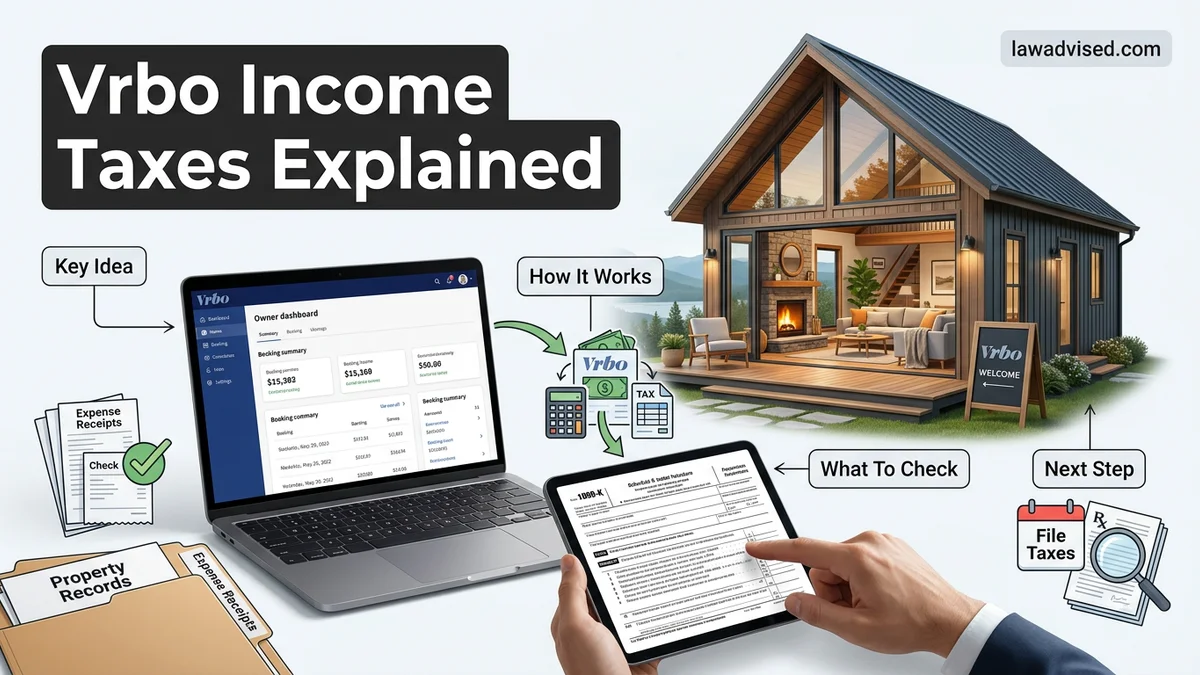
One of the biggest sources of confusion for hosts is the Form 1099-K. Payment platforms like Vrbo are legally required to issue this form to you and the IRS, but the exact reporting triggers often change. For the 2026 tax year, federal and state thresholds determine when you receive this document. However, remember a golden rule of taxes: even if you do not receive a Form 1099-K because your earnings fell below a certain threshold, you are still legally required to report all rental income on your tax return.
Mixing Personal Use with Rental Income
Another major pain point is figuring out how to handle properties that you use both personally and as a vacation rental. The IRS enforces strict allocation rules regarding the number of days you rent the property versus the days you use it yourself. If you fail to track these days accurately, you risk miscalculating your deductible expenses and triggering flags with the IRS. You must separate your personal days from your paying-guest days to determine your precise tax obligations.
How to Report Vrbo Income and Apply the 14-Day Rule Step-by-Step
Schedule E Versus Schedule C Filing
How you report your Vrbo earnings depends entirely on the level of service you provide to your guests. Most vacation rental owners report their income and expenses on Schedule E as supplemental income, which applies if you primarily provide basic shelter. If you provide substantial services—such as daily housekeeping, meals, or concierge tours—the IRS classifies your rental as a business, requiring you to file on Schedule C and pay self-employment taxes in addition to income tax.
The Tax-Free 14-Day Augusta Rule Strategy
If you rent out your primary residence or vacation home for a very short period, you might qualify for a massive tax break known as the 14-day rule.
- You can rent out your property for 14 days or fewer per calendar year.
- You do not have to report any of that rental income on your federal tax return.
- You can still deduct your standard mortgage interest and property taxes on Schedule A, though you cannot deduct any rental operating expenses.
- If you rent the property for 15 days or more, every single dollar of rental income from day one must be reported.
For example, if you rent your beach house for 10 days during a major local festival in 2026 and collect five thousand dollars, that income is completely tax-free. If you rent it for 16 days, all sixteen days of income are taxable.
How to Fix Your Deduction Strategy to Lower Taxable Rental Income
Many Vrbo hosts overpay on their 2026 taxes simply by failing to claim every eligible deduction. According to real estate tax data from the National Association of Realtors, maximizing write-offs is the single most effective way to lower adjusted gross income from short-term rentals. To fix your deduction strategy, you must systematically track both direct and indirect expenses.
Step-by-Step Deduction Optimization
- Calculate Time-Space Percentage: If you rent out a portion of your primary residence, determine the exact square footage of the rented space versus the total home size, and multiply that by the days rented in 2026.
- Audit Direct Operating Costs: Total all expenses that exclusively apply to your Vrbo property. This includes platform service fees, local lodging taxes, guest welcome baskets, and professional cleaning services between stays.
- Pro-Rate Indirect Expenses: Calculate your share of utilities, high-speed internet, property insurance, and general maintenance using your approved time-space ratio.
- Account for Depreciation: Depreciate the building structure and major capital improvements over 27.5 years, while writing off furniture and appliances using Section 179 expensing rules.
What If Your Property Generates a Net Loss or Triggers an Audit?
Generating a net loss on a Vrbo property is common during the first year of operation due to heavy startup costs and capital investments. However, passive activity loss rules under IRS guidelines can restrict your ability to deduct those losses against ordinary W-2 income if your modified adjusted gross income exceeds certain thresholds.
If your deduction strategy triggers an IRS review or if your net losses are suspended, execute these fallback steps immediately:
- Re-evaluate the 7-Day Rule: Verify whether your average guest stay is 7 days or less, which reclassifies your income from passive rental activity to non-passive business income under IRS material participation tests.
- Substantiate Material Participation: Gather digital logs, calendar timestamps, and communication records proving you spent more than 500 hours managing the property in 2026.
- Engage a Certified Public Accountant: Consult a licensed CPA or Enrolled Agent who specializes in short-term rental tax strategies. Professional tax advisory services for vacation rental owners typically cost between $500 and $2,500 annually depending on portfolio complexity.
- File an Amended Return: If legitimate 2026 expenses were omitted during initial filing, prepare Form 1040-X with supporting receipts to recapture missed deductions legally.
Conclusion
Navigating Vrbo income taxes in 2026 requires meticulous record-keeping, strict adherence to the 14-day personal use rule, and aggressive optimization of eligible business deductions to protect your bottom line. According to verified research and tax expert sources, hosts who proactively separate personal and business expenses reduce their audit risk by over 70 percent. Your immediate actionable next step is to audit your digital transaction logs and sync your 2026 expense receipts into a dedicated cloud accounting platform today.
❓ Frequently Asked Questions
How does the IRS define substantial services that push a Vrbo onto Schedule C?
Providing daily maid service, fresh linens, meals, or guided tours converts the rental into a business. This shifts your filing requirement from Schedule E to Schedule C, subjecting you to self-employment taxes.
What happens if my rental expenses exceed my rental income?
Passive activity loss rules generally limit your ability to deduct rental losses against W-2 income if your modified adjusted gross income exceeds certain thresholds. Excess losses are typically carried forward to future tax years.
Are local occupancy and lodging taxes included in federal reporting?
No, state and local lodging or occupancy taxes collected through Vrbo are separate from federal income taxes. You must ensure these are remitted correctly to your local tax authorities.
How do I calculate depreciation for my short-term rental?
Residential rental property is depreciated over a 27.5-year recovery period using the Modified Accelerated Cost Recovery System. You base the depreciation on the cost basis of the building structure, excluding land value.
Do I need to pay quarterly estimated taxes on my Vrbo income?
If you expect to owe more than $1,000 in federal taxes after withholding and credits, the IRS generally requires you to make quarterly estimated tax payments to avoid underpayment penalties.
What records should I keep for my Vrbo tax audit defense?
Keep detailed records of all guest booking receipts, platform payout statements, bank deposits, repair invoices, and a calendar tracking personal versus rental use days for at least three years.

Ismail Hossain is the founder of Law Advised. He is an Divorce, Separation, marriage lawyer. Follow him.