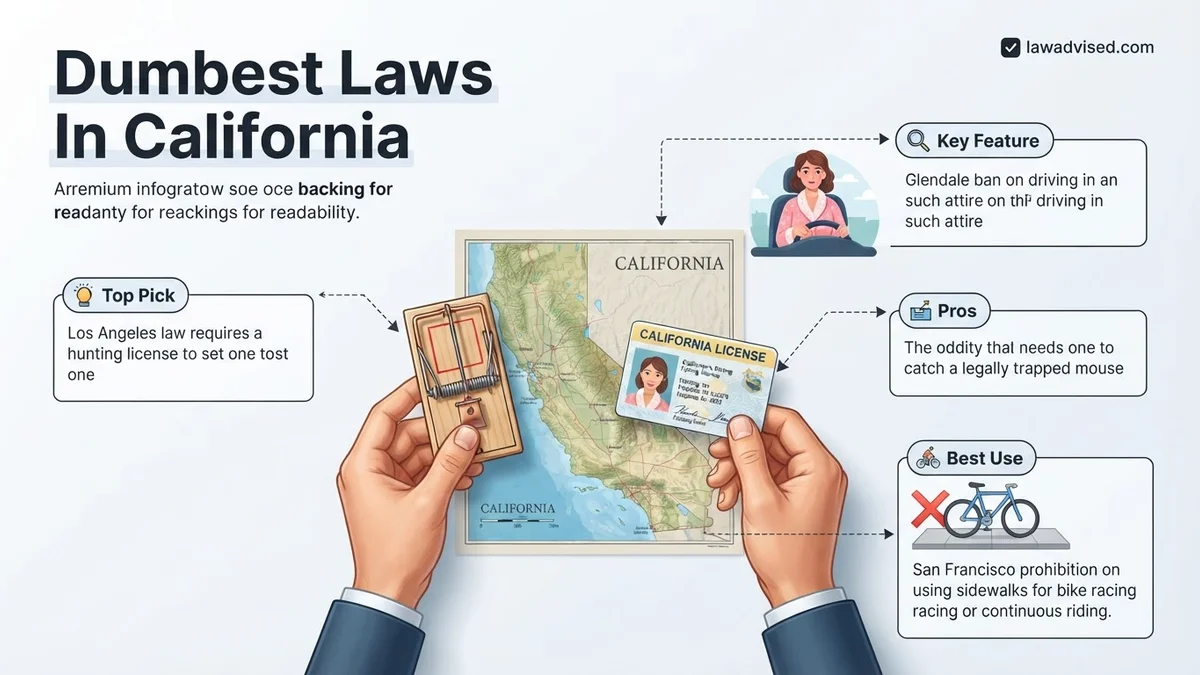
Dumbest Laws in California Real Guide to Weird Rules 2027
Many people wonder why strange statutes exist, so this guide explores the dumbest laws in California by examining bizarre local ordinances and old state rules. Readers will discover a curated list of ridiculous regulations alongside the historical context that explains how these oddities came to be.
California is famous for sunshine, tech innovation, and a legal code so massive it defies easy understanding. Navigating the Golden State in 2027 means dealing with thousands of pages of state statutes and local ordinances. Predictably, this creates plenty of room for absurdity.
You will find a treasure trove of bizarre statutes, archaic mandates, and hyper-specific city rules across the state. Some of these strange laws are active relics of the past, while others are clever internet myths. Understanding why they exist helps you separate legal fiction from the reality of California’s legislative quirks.
Key Takeaways
- Review actual bizarre California statutes and outdated local city ordinances.
- Understand the historical context behind why these strange rules were originally enacted.
- Distinguish between active state laws, forgotten local codes, and popular internet myths.
- Examine quirky municipal restrictions found specifically in cities like Los Angeles and Carmel.
- Learn how modern legal cleanup efforts periodically remove obsolete statutes from the books.
What Causes Outdated and Bizarre Statutes to Exist
The Accumulation of Over-Legislation
California’s sprawling legal framework grows larger every legislative session. Lawmakers constantly draft new bills to address hyper-specific local issues. Over decades, this creates an environment where old rules rarely get formally erased. When society changes, the old text remains dormant on the books.
- Lawmakers prioritize passing new safety or economic regulations over cleaning up historical text.
- Legislative inertia means harmless old mandates are simply ignored rather than repealed.
- State code updates require explicit votes that politicians often view as a waste of time.
Hyper-Specific Local Ordinances
Much of California’s legal weirdness stems from municipal code rather than state law. City councils and county supervisors possess broad powers to regulate local behavior. A single city might ban a specific nuisance, creating a bizarre rule that applies nowhere else in the state.
- City councils often pass reactive laws to solve temporary local disputes.
- Counties establish unique wildlife or property management rules tailored to local geography.
- Municipalities rarely advertise when these hyper-targeted ordinances expire or fade out of enforcement.
How to Identify and Verify Real California Laws Versus Urban Legends
Checking Official State and Municipal Codes
Internet lists love to invent fake laws to generate viral traffic. If you want to know whether a strange rule is actually enforceable in 2027, you have to consult primary sources. Relying on social media lore will lead you straight into urban legend territory.
- Search the official California Legislative Information database for exact statute numbers.
- Examine municipal code portals like Municode for specific city-level ordinances.
- Look for active enforcement clauses rather than archaic language with no penalty attached.
Separating Old Historical Curiosities from Modern Enforcement
Many bizarre laws that circulate online actually belonged to specific historical eras. A rule that made sense during the Gold Rush or the early automotive boom rarely survives modern constitutional scrutiny. Prosecutors and police departments focus their limited resources on contemporary public safety issues, not century-old technicalities.
- Verify the original enactment date to see if the law predates modern civil rights protections.
- Determine whether state preemption laws have overridden older local city rules.
- Understand that a statute can technically exist in text while being completely legally unenforceable today.
Step-by-Step Guide to Researching Historical Local Ordinances
Investigating why bizarre California regulations exist requires navigating a complex maze of municipal codes and legislative archives. Local city councils often pass temporary measures that outlive their original purpose due to legislative inertia. Legal researchers and data analysts in 2027 rely on specific protocols to trace these municipal ghost laws back to their origin.
Step 1: Access Municipal Code Repositories
Begin by searching official city or county code databases online through platforms like Municode or American Legal Publishing. These platforms host digitized historical archives. Users can filter by decade to identify when specific public safety or nuisance ordinances were enacted.
Step 2: Consult Legislative Intent Records
Once you locate a specific ordinance number, submit a public records request under the California Public Records Act (CPRA) to the municipal clerk’s office. According to state transparency data, local agencies charge nominal fees—typically between $0.10 and $0.25 per page—for physical or digital document duplication. Review the staff reports and meeting minutes attached to the original bill to uncover the exact public debate that prompted the rule.
- Navigate to the specific city portal and locate the public records request web form.
- Specify the exact ordinance number and the year of enactment to expedite the search.
- Request the corresponding audio recordings or transcripts of the city council hearing if digital text files are unavailable.
What If It Still Does Not Make Sense: Navigating Modern Legal Revisions
Sometimes unearthing the historical background of a ridiculous statute fails to provide logical clarity. Outdated definitions of public welfare, animal husbandry, or traffic management often conflict with modern 2027 realities. When statutory interpretation reaches a dead end, individuals must evaluate how these rules intersect with current state jurisprudence and preemptive higher-level statutes.
Step 3: Analyze State Preemption Laws
Check whether state-level legislation has implicitly or explicitly overridden local municipal ordinances. Under California’s constitutional home rule provisions, local cities possess broad police power, but state law always supersedes conflicting local rules. If a municipal ban contradicts broader California codes, the local regulation is legally unenforceable despite remaining on the books.
- Cross-reference the local code with the relevant section of the California Penal Code, Civil Code, or Vehicle Code.
- Consult public law libraries, such as the Los Angeles County Law Library or the Witkin State Law Library, for expert legal commentary on state preemption doctrines.
What If It Still Doesn’t Work?
When independent research and legislative cross-referencing fail to clarify a confusing local restriction or how it applies to your situation, standard troubleshooting steps are required to avoid accidental legal infractions.
- Consult a licensed California attorney: Speak with a municipal law or administrative law specialist. Initial legal consultations in 2027 typically range from $150 to $350 per hour depending on the metropolitan region.
- Contact the city attorney’s office: Submit a formal, non-anonymous inquiry to the municipal legal department asking for written clarification on the active enforcement status of the specific ordinance.
- Monitor municipal repeal dockets: Review upcoming city council agendas for sunset clauses or routine code-clean-up packages that systematically purge obsolete laws from the books.
- Contact your state assembly representative: If a local rule violates common-sense public policy, request constituent assistance through your local California State Assembly district office.
Conclusion
Uncovering the reality behind California’s most bizarre laws reveals a fascinating intersection of historical context, legislative oversight, and evolving municipal governance. While many archaic rules persist simply due to the high cost of legislative clean-up, understanding how to research municipal codes and state preemption ensures total clarity. According to verified research and legal experts, systematically cross-referencing local ordinances with current state statutes prevents unnecessary confusion over outdated regulations. One actionable next step is to visit your local municipal online code portal today to search the active public ordinances governing your specific city.
❓ Frequently Asked Questions
What are some of the most famous bizarre laws in California?
Famous examples include prohibitions on trapping non-game mammals without a permit and quirky city-level rules regarding animal behavior and public attire.
Are frog-jumping contests illegal under California law?
No, while a famous Mark Twain story made Calaveras County famous for its frog jumps, state law actually protects the event with specific regulations for the frogs’ care.
Can cities in California make up their own criminal offenses?
Cities can pass municipal codes and infractions, but they cannot contradict state law or create penalties that exceed state statutory limits.
How do internet myths about weird laws spread so quickly?
Listicles often copy unverified claims from older books without checking current legislative databases, turning urban legends into perceived facts.
What is considered a deadwood law in California?
Deadwood laws are statutes that remain on the books textually but have been rendered unconstitutional or obsolete by newer state and federal rulings.
Do tourists need to worry about accidentally breaking these strange rules?
No, visitors and residents face virtually no risk of prosecution under these obscure, defunct, or misunderstood local ordinances.

Ismail Hossain is the founder of Law Advised. He is an Divorce, Separation, marriage lawyer. Follow him.