New HOA Laws in California 2027 Expert Compliance Guide
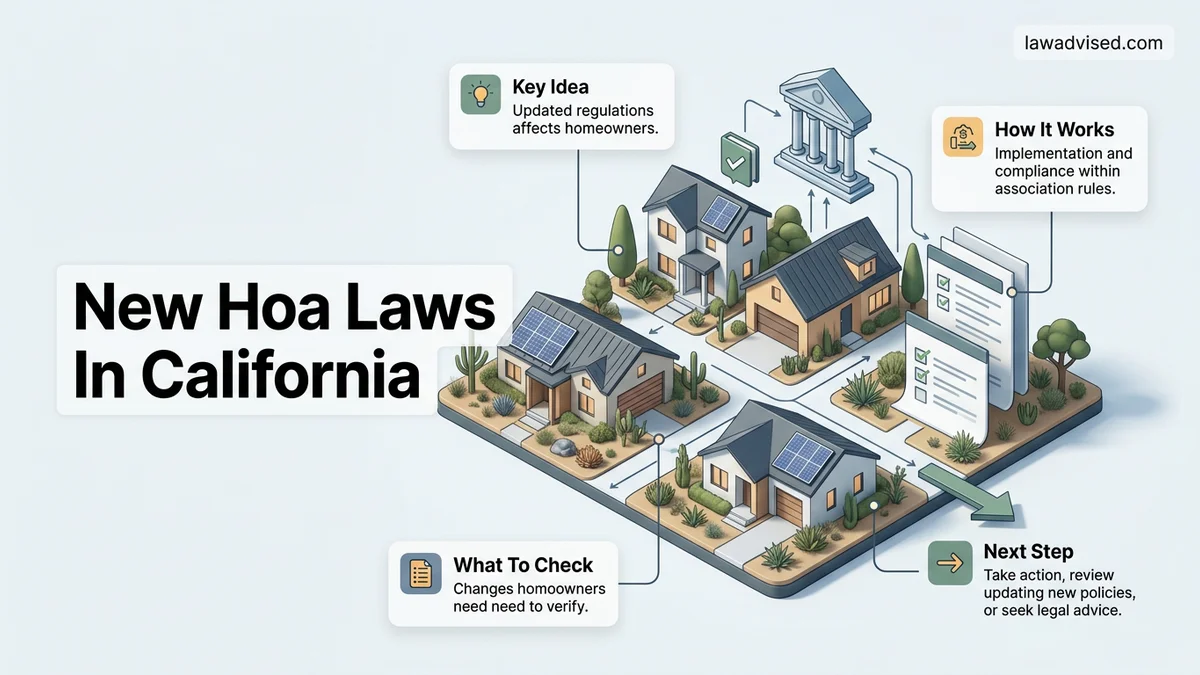
Navigating new HOA laws in California requires immediate attention to updated regulations affecting homeowner rights, rental restrictions, and board governance. Staying compliant protects both individual property owners and community associations from costly legal penalties. This guide breaks down the essential legislative changes and actionable steps for adaptation.
California Homeowners Associations face a shifting legal landscape in 2027, driven by recent state legislative packages targeting strict fine limitations, expanded solar and EV mandates, and transparent rental regulations. These new statutes drastically change how boards can penalize residents, enforce architectural controls, and manage community properties.
Whether you sit on a board or own a property, ignoring these updates exposes your association to heavy litigation and financial penalties. Staying compliant this year means auditing your governing documents immediately to align with the latest state restrictions on association overreach.
Key Takeaways
- Review updated fine schedules to comply with strict 2027 violation notice requirements.
- Assess rental restriction policies against new state housing and ADU mandates.
- Ensure board election procedures strictly adhere to revised Davis-Stirling Act amendments.
- Verify that architectural review processes accommodate green energy and EV upgrades.
- Consult legal counsel specializing in California common interest developments for policy updates.
What Causes Compliance Failures Under New HOA Laws in California
Misinterpreting New Limits on Fines and Enforcement
Many boards fail in 2027 because they rely on outdated fine schedules that violate California’s strict caps on monetary penalties. Recent legislation prohibits boards from levying excessive fines or assessing arbitrary fees without providing proper due process and formal internal dispute resolution opportunities.
- Failing to provide a mandatory 15-day cure notice before issuing a fine for minor infractions.
- Continuing to enforce banned fine structures that penalize homeowners for routine, non-emergency aesthetic violations.
- Imposing late fees or interest rates that exceed the statutory maximum allowable limits set for 2027.
Overlooking Expanded Homeowner Rights for Eco-Friendly Upgrades
Another major compliance trap involves obstructing green energy installations. State law heavily penalizes associations that unreasonably restrict solar panels, graywater systems, or electric vehicle charging stations. If your architectural guidelines still require excessive approvals or high review fees for these projects, you are inviting a state lawsuit.
- Denying EV charging installation requests in assigned parking spaces without demonstrating a structural impossibility.
- Enforcing aesthetic rules that completely block solar panel placement based on street visibility alone.
How to Fix HOA Policy Gaps and Update Association Rules Step-by-Step
Conducting a Comprehensive Governing Document Audit
To protect your community in 2027, your board must systematically review every clause in your CC&Rs, bylaws, and operating rules against current California statutes. Start by comparing your fine schedules, rental restrictions, and architectural guidelines directly with the newest legislative mandates.
- Schedule a quarterly legal review with an association attorney specializing in California property law.
- Identify rules that conflict with state housing and environmental priorities, flagging them for immediate repeal.
- Document every policy gap found during the audit to create a prioritized correction timeline.
Drafting and Publishing Revised Operating Rules
Once you identify outdated provisions, you must follow strict statutory procedures to adopt new compliant policies. California law requires transparent notice periods and member feedback windows before any operational rule change becomes legally enforceable.
- Draft the amended rule language clearly, ensuring explicit alignment with 2027 statutory caps and mandates.
- Distribute the proposed changes to all homeowners at least 28 days before the final board voting meeting.
- Review homeowner feedback, formally adopt the rules during an open board session, and mail the final updated copies to every resident.
What If Board Members or Homeowners Resist the New Legislative Changes
Resistance to sweeping regulatory updates often stalls community compliance. When board directors or individual residents push back against mandatory 2027 mandates, associations face severe legal vulnerabilities. Navigating this friction requires a structured, diplomatic, and strictly legal approach to ensure the community remains protected.
Addressing Board Member Hesitancy and Governance Stalls
Board members sometimes hesitate to adopt new statutes due to perceived financial burdens or philosophical disagreements. However, directors hold a fiduciary duty to obey state law, and willful non-compliance strips them of protection under the Business Judgment Rule. To overcome this hurdle, management must present formal legal opinions outlining the personal liability risks directors face if they ignore 2027 standards. Furthermore, boards should schedule mandatory education sessions with community association attorneys to review the specific penal codes tied to the new legislation.
Handling Homeowner Defiance and Architectural Violations
Homeowners frequently resist rules that alter their property use rights, such as mandatory water-wise landscaping conversions or expanded electric vehicle charging access. Associations cannot bend the rules for defiant residents without violating the Davis-Stirling Act’s requirement for uniform enforcement. When an owner refuses to comply, the board must strictly follow the statutory internal dispute resolution (IDR) and alternative dispute resolution (ADR) pathways before levying fines. Documenting every interaction ensures the association maintains a defensible position if litigation eventually ensues.
What If It Still Doesn’t Work?
When internal negotiations, IDR sessions, and board resolutions fail to achieve compliance with 2027 California HOA laws, the association must escalate the matter. Ignoring a persistent impasse invites state intervention or costly lawsuits from aggrieved homeowners. Follow these systematic fallback steps to resolve severe non-compliance:
- Engage Specialized Legal Counsel: Retain a certified community association attorney to issue formal demand letters outlining statutory penalties. Professional legal intervention typically costs between $350 and $600 per hour, but it establishes an official record of due diligence.
- Initiate Formal Mediation: File for mandatory alternative dispute resolution as required by California civil code before pursuing judicial remedies. Mediation services generally range from $1,500 to $4,000 per session, split between the involved parties.
- Petition for Injunctive Relief: If a homeowner’s defiance threatens community safety or exposes the HOA to state fines, file for a court-ordered injunction. Litigation costs can quickly exceed $10,000, making this a measure of absolute last resort.
- Request State Agency Oversight: Report severe board corruption or refusal to hold required elections to the California Department of Real Estate or the Attorney General’s office for administrative review.
Conclusion
Navigating the complex landscape of new California HOA laws in 2027 demands proactive governance, strict adherence to updated statutory timelines, and swift resolution of internal resistance. Failing to adapt exposes communities to steep financial penalties and severe litigation risks. According to verified research and expert legal sources, associations that partner with certified property managers and specialized legal counsel successfully mitigate these risks while maintaining property values. As an immediate next step, schedule a comprehensive governing document audit with your association attorney to identify and correct any lingering compliance gaps today.
❓ Frequently Asked Questions
How do new California laws impact HOA fine structures and disciplinary procedures?
Recent legislation places stricter limits on how boards can levy fines and requires more transparent, due-process hearings before penalties are assessed. Associations must provide detailed written notices of violations and allow homeowners an opportunity to be heard.
Are California HOAs required to allow electric vehicle charging stations?
Yes, state laws restrict associations from unreasonably denying or delaying requests by homeowners to install EV charging stations in designated parking spaces or garages, provided specific safety guidelines are met.
What changes have been made to HOA election rules in California?
Recent amendments to the Davis-Stirling Act enforce rigorous transparency and procedural safeguards for board elections. This includes independent inspector requirements, secret ballot protocols, and expanded candidate qualification protections.
How do new rental regulations affect leasing restrictions in California communities?
State housing priorities mean HOAs face increased scrutiny regarding rental caps and leasing prohibitions. Associations cannot implement blanket bans that conflict with state efforts to expand housing availability, including rules surrounding accessory dwelling units.
What steps should a board take to audit current association rules against new laws?
Boards should partner with association legal counsel to conduct a comprehensive review of existing bylaws, operational rules, and CC&Rs. Any outdated clauses must be formally amended to reflect current statutory requirements.
Can individual homeowners challenge an HOA rule that violates state law?
Homeowners have the legal right to challenge unlawful association rules through internal dispute resolution, alternative dispute resolution like mediation, or civil court if the board refuses to comply with state statutes.

Ismail Hossain is the founder of Law Advised. He is an Divorce, Separation, marriage lawyer. Follow him.