Pool Fence Laws in Arizona Expert Legal 2026
Navigating pool fence laws in Arizona requires strict adherence to state and local statutes regarding barrier dimensions, gap limits, and gate mechanics. Property owners must ensure enclosures are at least 60 inches high with self-closing and self-latching gates to prevent unauthorized access and legal liability.
Arizona pool fence laws require every residential swimming pool to be completely enclosed by a barrier at least 5otch feet (60 inches) high, featuring self-closing and self-latching gates that open outward. Navigating these statutes in 2026 demands strict adherence to state standards and local municipal amendments, which often incorporate the Association of Pool & Spa Professionals (APSP) guidelines.
Failing to meet these exact legal specifications exposes you to severe liability risks, municipal code violations, and potential fines. Whether you are buying a home, renting out a property, or updating an existing backyard layout, understanding the precise dimensions and compliance triggers protects both your neighborhood children and your legal standing.
Key Takeaways
- Arizona law mandates pool fences be at least 60 inches tall from exterior ground level.
- Gates must open outward away from the pool area and feature self-closing mechanisms.
- The maximum allowable ground clearance beneath the fence is precisely 4 inches.
- Horizontal slats must be spaced at least 45 inches apart to prevent children from climbing.
- Alternative compliance methods include approved pool covers, door alarms, and self-latching home exits.
What Causes Non-Compliance With Arizona Pool Fence Laws
Most backyard pool owners unknowingly breach state statutes due to minor structural shifts or outdated hardware. Arizona Revised Statutes mandate rigid dimensional tolerances, and even a fraction of an inch outside these bounds triggers a violation.
Height and Ground Clearance Failures
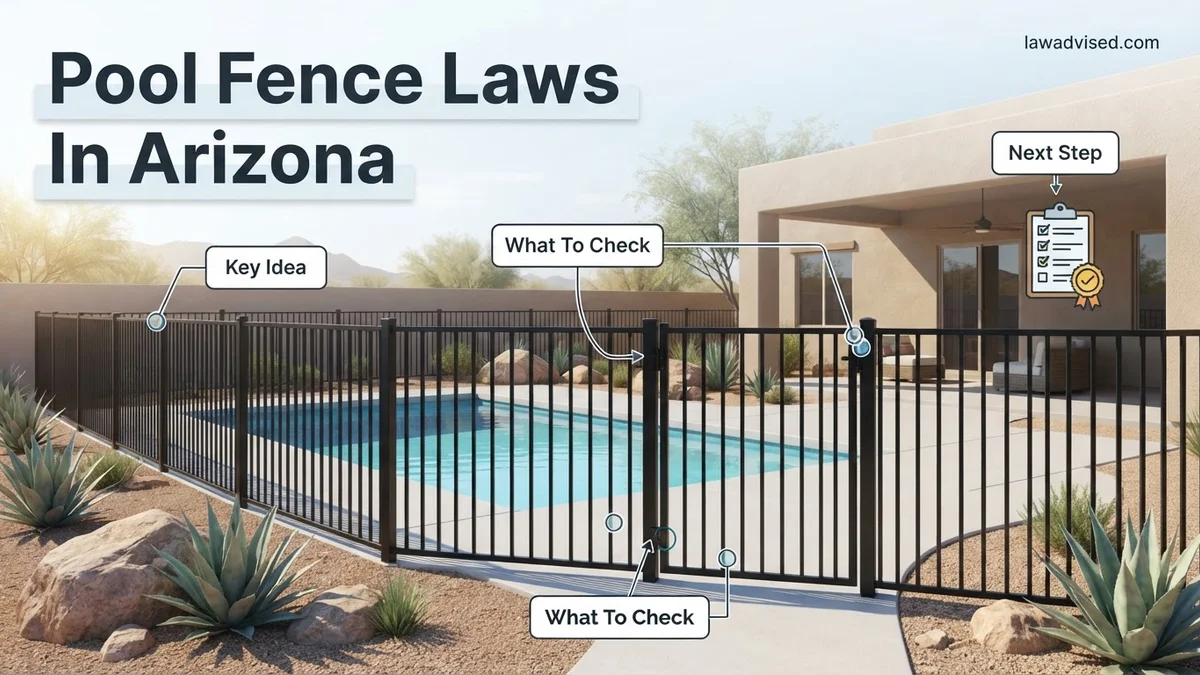
- Fence Height Deficiencies: The barrier must measure a minimum of 60 inches from the exterior grade level to the top of the fence. Many older wrought iron or chain-link fences sit at 48 inches, failing current legal thresholds.
- Excessive Bottom Gap: The maximum allowable clearance between the bottom of the fence and the ground is 2 inches on hard surfaces, or 4 inches on unpaved ground like dirt or gravel. Anything larger allows a small child to crawl underneath.
Gate and Latch Malfunctions
- Inward-Opening Gates: Arizona law dictates that all pool gates must swing outward, away from the pool area, preventing a child from pushing the gate open.
- Improper Latch Placement: The release mechanism for a self-latching gate must sit at least 54 inches from the bottom, or be shielded on the pool side at least 3 inches below the top of the gate to prevent small hands from reaching over.
How to Fix Barrier Deficiencies Step-by-Step
Bringing a non-compliant pool enclosure up to 2026 Arizona standards requires systematic measuring and targeted hardware upgrades. You can resolve most physical deficiencies without a complete teardown of your existing perimeter.
Correcting Dimensional and Structural Gaps
- Measure the Grade Clearance: Use a tape measure around the entire perimeter. If gaps exceed 2 inches on concrete or 4 inches on soil, add extension mesh, lower the footing, or backfill with gravel.
- Address Vertical Slats: If you use vertical bar fencing, ensure the space between slats does not exceed 4 inches. Widen or narrow bars if a 4-inch sphere can pass through any opening.
- Eliminate Climbable Footholds: Remove horizontal rungs or decorative elements within 45 inches of each other on the exterior side, ensuring children cannot use them as a ladder.
Upgrading Gate Mechanics
- Install Heavy-Duty Hinges: Replace worn hinges with spring-loaded, self-closing models that actively pull the gate shut from any position.
- Retrofit the Latch Mechanism: Mount a magnetic or gravity-drop latch that automatically engages every time the gate swings shut. Verify that the latch release sits above the legally required 54-inch mark.
- Test the Action: Manually open the gate to various angles and let go to ensure it latches securely without human assistance.
How to Correct Gate and Latch Failures
Gate and latch failures represent the most common code violations cited during Arizona home inspections. Municipal building codes require that all pool gates open outward, away from the water. Furthermore, the latch release mechanism must sit at least 54 inches above the ground or be shielded inside the gate structure. Ensuring compliance protects children and satisfies local municipal ordinances for the year 2026.
Step-by-Step Gate Realignment
- Inspect the hinge tension and adjust the self-closing springs using the manufacturer-provided adjustment tool.
- Check the vertical alignment of the gate post using a professional spirit level to ensure the latch engages without manual lifting.
- Lubricate the internal latch components with a silicone-based spray to prevent sticking during extreme desert heat cycles.
- Test the self-latching mechanism from a distance of six inches to verify it engages securely every single time.
What If Alternative Safety Measures Still Don’t Meet Legal Standards
Arizona Revised Statutes mandate strict enclosure standards that alternative measures like pool covers alone often fail to satisfy. When inspections reveal that a property falls short of statutory requirements, homeowners must take immediate corrective action to avoid severe civil liabilities and municipal fines.
Fallback Steps for Non-Compliant Enclosures
- Install an emergency pool alarm certified to ASTM F2208 standards as an immediate supplementary defense layer.
- Consult a licensed pool barrier contractor to evaluate the property and redesign non-compliant perimeter layouts.
- Review the estimated cost range for professional fence and gate remediation, which typically spans from $1,500 to $4,000 depending on linear footage and material choices.
- Schedule a re-inspection with local code enforcement officers immediately after completing all necessary structural modifications to secure official compliance documentation.
Conclusion
Navigating pool fence laws in Arizona requires strict adherence to statutory height minimums, self-latching gate mandates, and municipal barrier specifications. Failure to maintain these critical safety features exposes families to catastrophic risks and legal penalties. According to verified research and expert safety sources, proactive barrier maintenance remains the single most effective deterrent against childhood submersion incidents. Take action today by scheduling a comprehensive professional inspection of your pool enclosure to verify complete 2026 compliance.
❓ Frequently Asked Questions
What are the exact statutory requirements for pool fence slats in Arizona?
For vertical slats, the maximum allowable gap between them is 1.75 inches. If the fence has horizontal and vertical members combined, horizontal slats must be at least 45 inches apart vertically to prevent them from acting as a ladder for climbing children.
Where must the self-latching mechanism be placed on a pool gate?
The release mechanism of the self-latching device must be positioned at least 54 inches above the bottom of the gate, or on the pool side of the gate at least 3 inches below the top, ensuring small children cannot reach it.
Do municipal pool fence codes override Arizona state laws?
Local cities and counties like Phoenix, Tucson, or Maricopa County can enforce stricter ordinances than the state baseline, meaning property owners must comply with the most restrictive rule applicable to their location.
What types of door alarms are legally accepted if the house forms part of the barrier?
Approved door alarms must be UL-listed, produce a continuous audible warning when the door is opened, and include a manual deactivation switch located at least 54 inches above the floor.
What are the legal liabilities for failing to maintain a compliant pool fence in Arizona?
Property owners face severe civil liability, potential misdemeanor charges, and insurance claim denials if a drowning or injury occurs on a non-compliant property due to negligence of statutory safety laws.
Are automatic pool covers considered a standalone legal substitute for a fence?
Yes, ASTM-compliant safety pool covers that can support a specific weight and lock in place are recognized as valid alternatives, provided they meet local building department approvals.

Ismail Hossain is the founder of Law Advised. He is an Divorce, Separation, marriage lawyer. Follow him.