Bike Riding Laws in California 2027 Expert Safety Guide
Understanding bike riding laws in california is essential for avoiding fines and staying safe on the road. This guide covers mandatory equipment, road positioning, right-of-way rules, and the California safety stop law.
California bicycle laws treat your two-wheeler essentially as a motor vehicle, granting you the same rights and responsibilities on public roads. Navigating state statutes requires knowing where to position yourself, when you must yield, and how local ordinances have evolved by 2027 to protect cyclists in dense urban corridors and rural highways alike.
Understanding these regulations shields you from steep municipal citations and prevents dangerous collisions. Whether you commute daily through Los Angeles or weekend-tour along the Pacific Coast Highway, compliance with the California Vehicle Code (CVC) keeps you legally protected and physically safe.
Key Takeaways
- Cyclists must generally ride on the right side of the road with traffic.
- Helmets are legally required only for riders under 18 years old in California.
- The bicycle safety stop law permits cyclists to treat certain stop signs as yield signs.
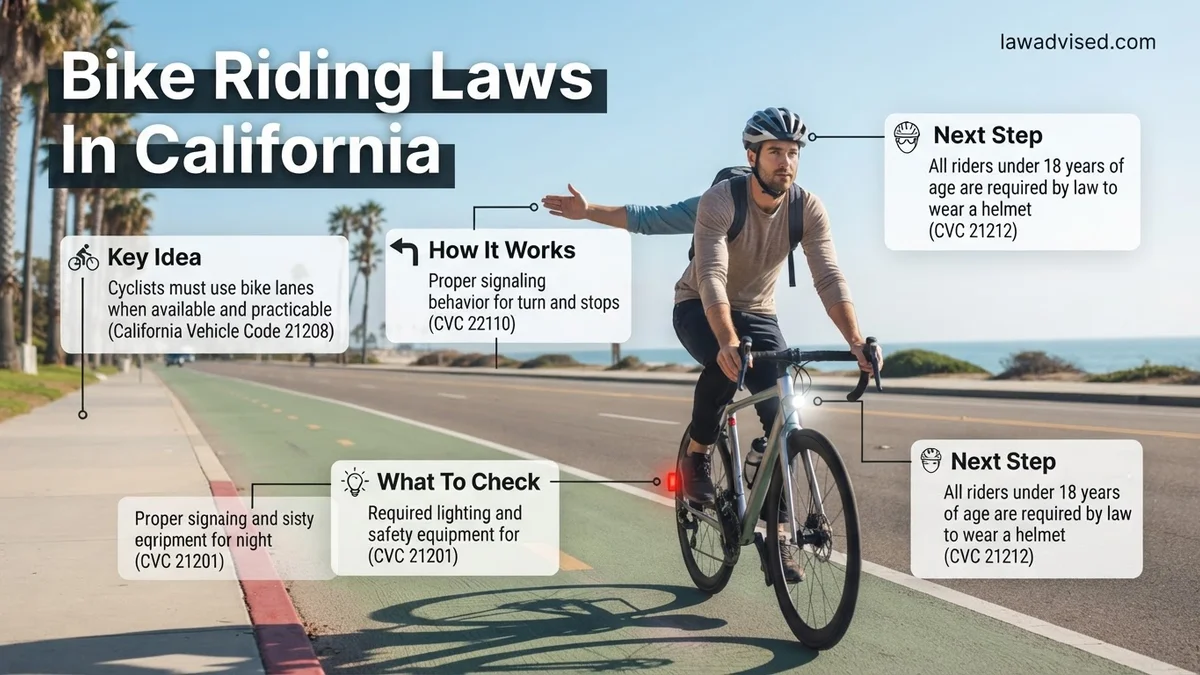
- Bicycles ridden at night require a front white light and rear red reflector or light.
- Local cities and counties may enforce their own specific sidewalk riding regulations.
What Causes Confusion With California Bicycle Traffic Laws
The Evolution of the Idaho Stop in California
Cyclists often misunderstand how they can legally interact with stop signs and traffic signals across the state. Under the historic “bicycle safety stop” law (CVC 21450.5), riders can treat certain stop signs as yield signs under specific conditions. You must still slow down, assess the intersection, and yield the right-of-way to any pedestrians or oncoming vehicles already legally occupying the intersection. However, this does not grant you blanket permission to blast through red lights unless local municipal trial programs explicitly permit a specific intersection behavior.
Right-of-Way and Intersection Dynamics
Another major point of confusion involves turning movements and multi-lane roadways. Many riders incorrectly assume they can filter past turning traffic on the right side blindly. California law mandates that if you are preparing for a right turn, you must hug the right-hand curb or edge of the roadway as much as practicable. Conversely, left turns can be executed either by merging into the leftmost turning lane like a car or by performing a “box turn” at the far-side crosswalk of the intersection. Knowing these nuances prevents costly traffic tickets and dangerous blind-spot collisions.
How to Fix Your Road Positioning and Follow Traffic Signals
Mastering Lane Positioning and the “Practicable” Rule
Under CVC 21202, you must ride as close as practicable to the right-hand curb or edge of the roadway. However, “practicable” does not mean you must hug the gutter where debris, glass, and car doors create severe hazards. You are legally permitted to take the lane—moving away from the right edge—under several clear conditions:
- When overtaking and passing another bicycle or vehicle going in the same direction.
- When preparing for a left turn at an intersection or into a private driveway.
- When reasonably necessary to avoid hazards, including fixed or moving objects, vehicles, pedestrians, animals, or substandard-width lanes.
- When approaching a place where a right turn is authorized.
Strict Adherence to Traffic Control Devices
You must obey all official traffic control signals, signs, and directional arrows just like motorists. Running a red light or ignoring a red arrow on a bicycle carries the same fine as doing so in a sedan. If a traffic signal fails to detect the metallic mass of your bicycle, California law generally permits you to proceed through a red light after exercising due care, provided you have waited for a reasonable amount of time (typically one full cycle) and the intersection is completely clear of conflicting traffic.
Step-by-Step Guide to Complying With Safety and Equipment Mandates
Meeting California equipment standards requires a systematic approach to hardware and lighting. Cyclists must ensure their gear satisfies the California Vehicle Code to avoid citations.
Step 1: Install Mandatory Lighting
- Attach a white front light emitting visible illumination from at least 300 feet away, compliant with 2027 visibility standards.
- Mount a red rear reflector or a solid/flashing red rear light visible from 500 feet.
Step 2: Equip Pedal and Wheel Reflectors
- Affix white or yellow reflectors on each pedal, or use reflective shoes visible from the front and rear.
- Ensure side-reflectors are present on the wheels if riding during darkness, unless the tires feature built-in reflective sidewalls.
Step 3: Verify Brakes and Helmet Status
- Test your braking system on dry pavement to ensure the bike can execute a one-braked-wheel skid on a clean, level surface.
- Check that any riders under the age of 18 wear an ANSI- or CPSC-certified bicycle helmet securely strapped to the head.
What If Local Ordinances Differ on Sidewalk and Bike Lane Rules
California state law provides a baseline, but local municipalities retain the authority to enact stricter ordinances regarding sidewalk riding and bike lane usage.
Sidewalk Riding Restrictions by City
State law leaves sidewalk prohibition up to individual cities and counties. Los Angeles generally bans adult sidewalk riding, while certain mountain towns permit it. Cyclists must check municipal codes before navigating pedestrian walkways.
Bike Lane Mandates and Exceptions
Under CVC 21208, cyclists traveling slower than traffic must use established bike lanes. However, exceptions apply. Riders may legally leave the bike lane to prepare for a left turn, pass a pedestrian or hazard, or avoid merging traffic conflicts.
What If It Still Doesn’t Work?
If compliance efforts stall or legal disputes arise regarding a traffic citation or infrastructure hazard, riders should take structured fallback actions.
- Consult a certified cycling instructor or local bike coalition to audit your equipment setup for strict state compliance.
- Visit a local professional bike shop to inspect non-compliant braking or lighting systems, with safety tune-ups typically ranging from $75 to $200.
- File a formal maintenance ticket with your municipal public works department if poorly designed bike lanes or missing signage caused a safety hazard.
- Retain a personal injury or traffic attorney specializing in California cycling law if you are contesting an unfair citation, with legal consultation fees varying widely by firm.
Conclusion
Navigating bike riding laws in California requires strict adherence to lighting mandates, helmet rules, and evolving local ordinances. Securing proper equipment ensures both legal compliance and personal safety on the road. According to verified research and expert safety sources from the California Highway Patrol, proactive maintenance significantly reduces urban collision rates. Take the next step today by auditing your bicycle’s lighting and braking systems to meet all updated standards.
❓ Frequently Asked Questions
What is the California bicycle safety stop law?
The safety stop law allows bicyclists to treat a stop sign as a yield sign, permitting them to proceed through safely without coming to a complete stop if there is no immediate hazard, provided they slow down and yield right-of-way to pedestrians and cross traffic.
Are bicycles legally classified as vehicles in California?
Yes, under California Vehicle Code Section 21200, a person riding a bicycle on a public street has all the rights and is subject to all the duties applicable to the driver of a vehicle.
Is it legal to ride a bicycle on the sidewalk in California?
State law does not explicitly ban sidewalk riding, but it grants local cities and counties the authority to regulate or prohibit sidewalk riding, especially in business districts.
What equipment is legally required on a California bicycle?
Bicycles must be equipped with a brake that allows the operator to make a one-braked wheel skid on dry, level pavement, along with proper handlebars, pedals, and required night lighting equipment.
Can I receive a DUI for riding a bicycle while intoxicated in California?
Yes, California Vehicle Code Section 21200.5 makes it illegal to ride a bicycle on a highway while under the influence of alcohol or drugs, carrying similar fines and legal penalties.
What are the rules regarding hand signals for California bicyclists?
Cyclists must use hand signals to indicate turns or stopping when practical, signaling left turns with the left arm extended horizontally, and right turns with the left arm bent upward or the right arm extended horizontally.

Ismail Hossain is the founder of Law Advised. He is an Divorce, Separation, marriage lawyer. Follow him.