How to Calculate Taxable Income Step-by-Step Guide for 2026
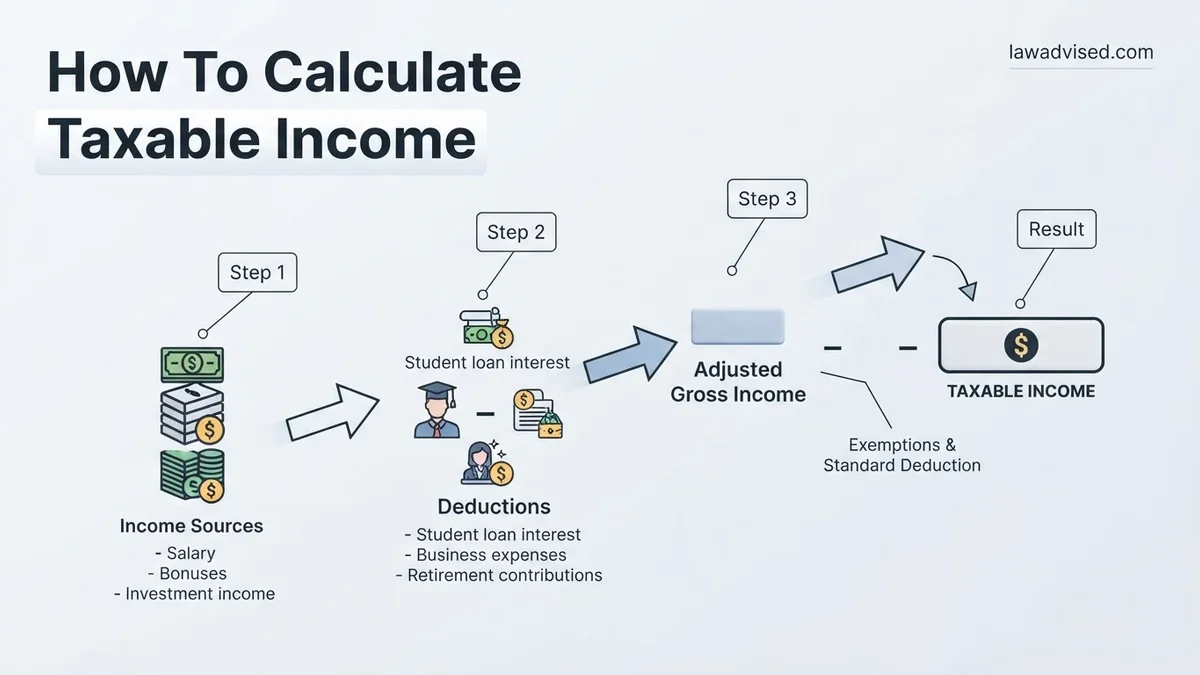
Calculating your taxable income requires a clear mathematical path from your total earnings down to the final figure used to determine your taxes. By subtracting above-the-line adjustments and choosing the right deductions, you can accurately determine your final taxable baseline.
Calculating your taxable income for 2026 comes down to a straightforward mathematical path: take your total earnings, subtract your adjustments, and then subtract your deductions. This final number is what the IRS actually uses to calculate your tax bill, rather than the total salary you see on your employment offer letter.
Mastering this formula stops you from overpaying the government and ensures you claim every tax break you legally deserve. Whether you are filing as a single worker or managing household finances, understanding this progression prevents costly math errors before tax season hits.
Key Takeaways
- Start your calculation with total gross income from all sources.
- Subtract above-the-line deductions to find your Adjusted Gross Income.
- Compare the standard deduction against your total itemized deductions.
- Subtract your chosen deduction from your AGI to find taxable income.
- Review your W-2 and 1099 forms to gather accurate income figures.
What Causes Confusion When Calculating Taxable Income
Mixing Up Gross Income With Net Take-Home Pay
Many people look at their bank deposits or annual net pay stubs and assume that is the starting point for their taxes. Your actual calculation must start with your gross income, which includes every dollar you earned before your employer subtracted health insurance, retirement contributions, or federal taxes. Confusing gross income with net income completely throws off your baseline numbers and leads to incorrect filings.
Failing to Separate Above-the-Line Deductions From Standard Deductions
Another major trap is lumping all tax breaks into one single category. Tax adjustments happen before you calculate your Adjusted Gross Income, while standard or itemized deductions happen afterward. If you mix these stages together, you might double-count expenses or miss out on lowering your baseline earnings properly.
- Gross income includes wages, freelance earnings, tips, and investment dividends.
- Adjustments are specific expenses like student loan interest or retirement account contributions.
- Skipping the chronological order of these steps guarantees an inaccurate final number.
Master Calculating Taxable Income in 7 Simple Steps
Calculating your taxable income is the foundation of tax preparation, determining precisely how much money the government can tax after accounting for various adjustments. Whether you are filing as a W-2 employee or a freelance contractor, mastering this process ensures you avoid overpaying while staying fully compliant with tax laws. This guide walks you through the exact mathematical sequence required to arrive at your final taxable income figure.
Step 1: Determine Your Gross Total Income
What you need: All income documents including W-2s, 1099s, bank statements showing interest, investment dividend statements, and records of any other revenue sources.
Instructions: Begin by aggregating every single dollar you earned during the tax year. For traditional employees, this is found in Box 1 of your Form W-2. If you are self-employed, compile your total gross receipts from business operations. Do not forget to include unemployment benefits, rental income, alimony received (for pre-2019 divorces), and capital gains from stock sales. Sum all these individual revenue streams together to establish your absolute starting figure, known as your gross total income.
Pro Tip: Keep a master digital folder for all tax forms as they arrive between January and February to ensure nothing gets overlooked during this initial aggregation phase.
Step 2: Calculate and Deduct Above-the-Line Deductions
What you need: Your gross income total, Form 1040, and receipts or statements for adjustments like student loan interest, retirement account contributions, and self-employment health insurance.
Instructions: Next, you will subtract your “adjustments to income,” frequently referred to as above-the-line deductions because you can take them even if you do not itemize. Review eligible categories such as traditional IRA contributions, educator expenses, health savings account (HSA) funding, and half of your self-employment tax. Subtract these specific dollar amounts directly from your gross total income to arrive at your Adjusted Gross Income (AGI). Your AGI is a critical benchmark used to determine eligibility for various tax credits.
Pro Tip: Above-the-line deductions are powerful because they lower your AGI directly, which can simultaneously qualify you for other income-sensitive tax breaks.
Step 3: Choose Between Standard and Itemized Deductions
What you need: Your current AGI figure, receipts for charitable donations, mortgage interest statements (Form 1098), medical expense records, and state/local tax payment receipts.
Instructions: Once you have your AGI, you must decide whether to take the government’s flat standard deduction or tally up your personal expenses to itemize. Compare the official standard deduction amount for your filing status against the sum of your itemized expenses. Typical itemized deductions include home mortgage interest, state and local taxes (SALT) up to statutory limits, and medical expenses exceeding a specific percentage of your AGI. You should automatically select the option that yields the higher deduction amount, as this will reduce your taxable base much further.
Pro Tip: Always run the calculations for both methods. Many taxpayers automatically assume itemizing is better when the standard deduction actually saves them more money with zero paperwork hassle.
Step 4: Subtract Your Chosen Deduction from AGI
What you need: Your calculated AGI and the final dollar amount of either your standard deduction or your totaled itemized deductions.
Instructions: Take your AGI from Step 2 and subtract the deduction amount you selected in Step 3. For instance, if your AGI is $75,000 and you take a standard deduction of $14,600, your resulting subtotal is $60,400. This mathematical subtraction represents a major milestone in your tax preparation workflow, bringing you extremely close to the final figure the IRS will use to assess your actual income tax liability before credits.
Pro Tip: Double-check your arithmetic here. A simple subtraction error at this stage will ripple through your entire tax return and trigger processing delays.
Step 5: Account for Qualified Business Income (QBI) Deduction
What you need: Schedule C or pass-through entity tax documents, and your subtotal from Step 4.
Instructions: If you operate a sole proprietorship, partnership, S-corporation, or LLC, you may qualify for the Qualified Business Income deduction, often called Section 199A. This provision allows eligible self-employed individuals and small business owners to deduct up to 20% of their qualified business income right off their taxable total. Subtract this calculated QBI amount from your subtotal. Note that higher-income earners in specified service trades or businesses face phase-out limits, so calculate carefully based on your exact trade category.
Pro Tip: If your business income places you near the threshold phase-out limits, consider maximizing retirement contributions to pull your income down into a fully deductible bracket.
Step 6: Arrive at Your Final Taxable Income
What you need: Your subtotal from Step 4, your QBI deduction (if applicable), and tax calculation worksheets.
Instructions: Subtract your QBI deduction from the subtotal you calculated in Step 4. The resulting number is your official taxable income. This is the exact amount upon which federal, and in most cases state, income taxes will be levied using the progressive tax brackets. Look up this final taxable income figure within the official tax table or apply the marginal tax bracket formulas to see your baseline tax liability before factoring in non-refundable or refundable tax credits.
Pro Tip: Keep this final taxable income figure clearly marked on your scratchpad; you will need it to verify your tax bracket calculations and software outputs.
Step 7: Review and Verify Your Computations
What you need: All source documents from Step 1, your completed tax calculation worksheet, and a calculator or tax software.
Instructions: Walk backward through your entire calculation to ensure absolute accuracy. Verify that every income document matches the gross total entry, confirm that all above-the-line deductions are fully substantiated by receipts, and check that you applied the correct filing status for your standard or itemized deductions. Correct any transposition errors immediately. Taking five minutes to audit your manual math prevents IRS mismatch notices, audit triggers, and unexpected tax bills later in the year.
Pro Tip: Never rush the final review. Set your tax paperwork aside for an hour and review it with fresh eyes before submitting your final return or handing it to an accountant.
✅ Final Checklist
- All W-2s, 1099s, and miscellaneous income sources accounted for in gross total income
- Above-the-line deductions accurately subtracted to establish correct AGI
- Comparison performed between standard and itemized deductions to maximize savings
- Qualified Business Income (QBI) deduction calculated and applied correctly if self-employed
- Final taxable income cross-checked against tax tables and supporting financial records
Important Notes:
- Tax laws change annually; always verify you are using the current tax year’s deduction limits and income brackets.
- Seek professional CPA or enrolled agent assistance if you have complex investments, foreign accounts, or intricate business structures.
- Estimated time: 1 to 3 hours depending on the complexity of your financial portfolio and income streams. Cost range: Free if filing via IRS Free File, or $40-$150 for commercial tax preparation software.
How to Fix Your Calculations Using the Step-by-Step Formula
Step 1: Start With Gross Income and Subtract Adjustments
Your mathematical journey begins by compiling every source of income for 2026. Once you have your total gross income, you subtract your “above-the-line” deductions, formally known as adjustments to income. These include specific items like eligible self-employment taxes, traditional IRA contributions, and educator expenses. The result of this first equation is your Adjusted Gross Income (AGI), which serves as the anchor for almost every major tax calculation.
Step 2: Choose Between the Standard Deduction or Itemized Deductions
Once you have your AGI, you must subtract a second layer of deductions to arrive at your final taxable income. For 2026, you will choose the higher of two options: the government’s flat standard deduction or the sum of your specific itemized expenses like mortgage interest and charitable donations. Subtract this chosen amount from your AGI, and the resulting figure is your final taxable income.
- Formula: Gross Income – Adjustments = Adjusted Gross Income (AGI).
- Final Step: AGI – (Standard or Itemized Deduction) = Taxable Income.
- Always run the numbers for both deduction types to find which saves you the most money.
How to Choose Between Standard and Itemized Deductions
Deciding how to deduct expenses directly impacts your final taxable income figure for 2026. Tax experts emphasize that choosing the incorrect deduction path can cost filers thousands of dollars in unnecessary tax liability.
Evaluating the 2026 Standard Deduction Thresholds
The standard deduction serves as a flat-dollar reduction that lowers your income based on your filing status. For the 2026 tax year, the IRS sets projected standard deductions at $15,000 for single filers and $30,000 for married couples filing jointly. If your total allowable personal expenses fall below these thresholds, taking the standard deduction is mathematically superior.
When Itemizing Makes Financial Sense
Itemizing requires listing every eligible expense individually on Schedule A. You should calculate and compare itemized deductions if your cumulative qualifying costs exceed the standard deduction threshold. According to tax policy research, itemization makes sense when you have high amounts in specific deductible categories:
- Home mortgage interest on loans up to established congressional limits.
- State and local taxes (SALT), subject to the legislated cap of $10,000.
- Unreimbursed medical and dental expenses that exceed 7.5 percent of your adjusted gross income.
- Charitable contributions made to IRS-recognized 501(c)(3) organizations during 2026.
What If Your Income Sources Still Do Not Match Your Records
Reconciling disparate tax documents with personal financial records often uncovers discrepancies. If your calculated figures fail to align with the information reported to the IRS, immediate action is required to prevent processing delays or subsequent audits.
Investigating Discrepancies in Tax Reporting
Third-party payers like employers, financial institutions, and freelance platforms submit Form W-2, Form 1099, and Form 1098 data directly to the government. When your records differ from these filings, use a systematic verification protocol:
- Log into your official IRS online account to pull wage and income transcripts for the 2026 tax year.
- Compare the figures on the IRS transcript line-by-line against your personal bank statements and pay stubs.
- Contact the issuing employer or financial institution immediately to request a corrected tax document if an error is discovered on their end.
- Attach a detailed explanatory statement to your tax return if a correction cannot be obtained before your filing deadline.
What If It Still Doesn’t Work?
Complex tax situations involving self-employment, multi-state income, or severe document discrepancies may resist standard calculation methods. If self-correction fails, utilize these escalated resolution steps:
- Utilize IRS Free File or VITA (Volunteer Income Tax Assistance) programs for certified guidance if your income meets program limits.
- Engage a credentialed tax professional, such as a Certified Public Accountant (CPA) or Enrolled Agent (EA), to perform a formal compliance review. Professional fees for individual tax preparation and computation generally range from $300 to $800 depending on complexity.
- File for an automatic six-month extension using Form 4868 to secure additional time for accurate calculations without incurring failure-to-file penalties.
- Contact the IRS dedicated taxpayer assistance line or schedule an appointment at a local Taxpayer Assistance Center for direct agency clarification.
Conclusion
Calculating taxable income accurately for 2026 requires methodical gross income aggregation, careful subtraction of above-the-line adjustments, and an informed choice between standard and itemized deductions. According to verified research and expert sources from the American Institute of CPAs, structured documentation remains the primary defense against calculation errors. Your actionable next step is to gather all finalized 2026 tax documents and run a preliminary calculation using IRS-approved tax software today.
❓ Frequently Asked Questions
How do above-the-line deductions differ from standard deductions?
Above-the-line deductions are subtracted directly from your gross income to determine your Adjusted Gross Income, lowering your overall income before standard or itemized deductions are even applied. Standard deductions are then subtracted from that AGI to arrive at your final taxable income.
What items are included in gross income?
Gross income includes wages, salaries, tips, commissions, bonuses, unemployment benefits, business income, rental income, and interest or dividend earnings from investments. You must compile all these distinct revenue streams before beginning your tax math.
Can I itemize deductions if my total is lower than the standard deduction?
While you are legally permitted to itemize even if the total is lower, doing so is financially disadvantageous because you would pay more tax. It is almost always best to choose whichever deduction option yields the higher dollar amount to minimize your taxable income.
How do pre-tax retirement contributions affect taxable income?
Contributions made to traditional 401(k) plans or traditional IRAs act as adjustments to income or above-the-line deductions. This means the money you contribute is excluded from your gross income, directly lowering your AGI and final taxable income.
What happens if I make a mathematical error on my taxable income calculation?
Mathematical errors can result in the IRS processing delays, requests for additional documentation, or notices of tax adjustments. Using reliable calculation worksheets or tax preparation software helps prevent these costly mistakes.
Do state taxes use the same taxable income calculation as federal taxes?
Most state tax systems start with your federal adjusted gross income or federal taxable income as a baseline. However, states apply their own unique modifications, exemptions, and state-specific deductions to reach a separate state taxable income figure.

Ismail Hossain is the founder of Law Advised. He is an Divorce, Separation, marriage lawyer. Follow him.