Tax Brackets for Head of Household 2026 Expert Guide
Filing as head of household offers lower tax rates and a higher standard deduction than single filers. Knowing the 2026 income thresholds helps you estimate your liability and plan your withholding accurately.
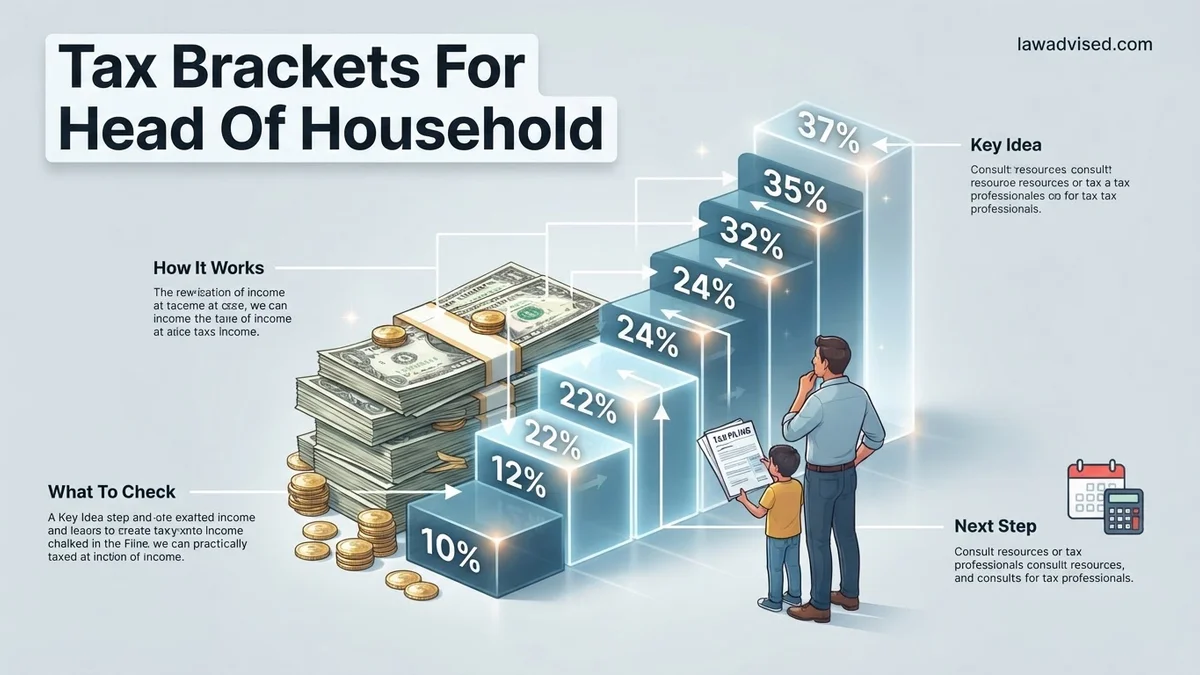
For the 2026 tax year, the Head of Household federal income tax brackets feature seven marginal rates ranging from 10% up to 37%, applied across significantly higher income thresholds compared to single filers. The 10% bracket applies to taxable income up to $16,550, the 12% bracket covers income from $16,551 to $63,100, the 22% bracket spans from $63,101 to $99,700, the 24% rate hits income between $99,701 and $190,150, the 32% rate applies from $190,151 to $221,700, the 35% rate covers $221,701 to $553,500, and the top 37% rate applies to any taxable income exceeding $553,500.
Filing as Head of Household offers a much larger standard deduction—projected at $22,050 for 2026—and wider tax brackets than filing as single, directly lowering your overall tax liability. Knowing exactly where your income lands within these 2026 brackets allows you to optimize your deductions, avoid unexpected tax bills, and strategically time capital gains or retirement account distributions before the year closes.
Key Takeaways
- Head of household status provides higher standard deductions than single filing.
- Tax brackets range from 10% to 37% based on taxable income.
- Qualifying dependents must live with you for more than half the year.
- Paying more than half of household upkeep is mandatory.
- Marginal rates only apply to income within specific brackets.
What Causes Tax Bracket Miscalculations for Head of Household Filers
Strict Qualification Rules and Changing Dependents
The most frequent cause of tax bracket miscalculations is failing to meet the strict IRS tests for Head of Household status, which instantly reclassifies you into the much less favorable Single or Married Filing Separately brackets. You must pay more than half the cost of maintaining your home for a qualifying dependent, such as a qualifying child who lived with you for more than half the year. If your child turns 19 (or 24 if a full-time student) or moves out for college, losing that dependent in 2026 can abruptly disqualify your filing status and push your taxable income into much higher tax brackets.
Fluctuating Income and Supplemental Earnings
Marginal tax brackets apply progressively, meaning only the money within a specific bracket is taxed at that rate. However, filers often miscalculate their bracket when experiencing sudden income changes:
- Receiving unexpected bonuses, commissions, or freelance income that pushes you into the next marginal rate (e.g., crossing from the 22% bracket into the 24% bracket at $99,701).
- Failing to account for pre-tax deductions like traditional 401(k) or IRA contributions, which lower your adjusted gross income and can drop you into a lower bracket.
- Misjudging the impact of investment income, capital gains, or taxable social security benefits on your overall taxable income.
How to Fix Your Withholding and Determine Your 2026 Tax Bracket
Calculating Your Projected Taxable Income for 2026
To accurately determine your 2026 tax bracket, you must calculate your expected Adjusted Gross Income (AGI) and subtract the 2026 Head of Household standard deduction of $22,050. Start by compiling all expected streams of income for the year, including wages, self-employment earnings, and investment yields. Subtract above-the-line deductions such as student loan interest, health savings account contributions, and traditional retirement account deposits to arrive at your estimated AGI. Once you subtract the standard deduction from that figure, match the resulting taxable income against the 2026 federal brackets to see your exact marginal tax rate.
Adjusting Your Paycheck Withholding with the IRS Estimator
Once you know your projected 2026 tax bracket, you need to align your employer withholdings to prevent underpayment penalties or a surprisingly small refund. Use the official IRS Tax Withholding Estimator online tool, making sure to input your correct Head of Household filing status and expected 2026 dependent details. If your withholdings are too low:
- Submit a new Form W-4 to your employer payroll department immediately.
- Use Step 4(a) on the Form W-4 to account for other income, or Step 4(c) to request an explicit extra dollar amount withheld from each paycheck.
- Review your pay stubs after the first updated paycheck to verify that the correct federal tax amount is being deducted.
Step-by-Step Guide to Filing Under Head of Household Status
Filing your 2026 federal income tax return under the head of household designation requires strict adherence to IRS procedural guidelines to avoid processing delays or audits. Tax software and professional preparers rely on a methodical approach to establish your eligibility and calculate your correct tax liability.
1. Verify Your Marital Status and Qualifying Person
Confirm that you were considered unmarried on the final day of the 2026 tax year. Next, cross-reference your household roster against IRS Publication 501 guidelines to ensure your dependent or qualifying relative meets all residency and relationship tests.
2. Calculate Household Support Costs
Gather all financial records for the 2026 calendar year, including rent or mortgage statements, utility bills, grocery receipts, and property taxes. Calculate the total cost of keeping up your home and verify that you paid more than fifty percent of these expenses.
3. Input Data into Tax Preparation Software
Select your filing status as head of household when prompted by your tax software or when providing details to your CPA. Enter the social security numbers and accurate relationship codes for your qualifying dependents to lock in the proper standard deduction and tax bracket thresholds for 2026.
What If Your Qualifying Status Changes During the Tax Year
Life events frequently alter household structures, creating complex scenarios for taxpayers filing for the 2026 tax year. If a qualifying dependent moves out, or if your marital status shifts due to a final divorce decree entered before December 31, 2026, your filing status may be impacted.
Mid-Year Loss of a Qualifying Person
If your qualifying dependent lived with you for more than half of 2026 but passed away or moved out near the end of the year, you may still qualify for head of household status. The critical test remains whether the individual was a qualifying person for the required portion of the year while you paid more than half the household upkeep costs.
Status Changes and Temporary Absences
Temporary absences by a qualifying person for education, medical care, or military service do not disqualify you from head of household status. According to IRS guidelines, the home must be viewed as the main seasonal or permanent residence of the qualifying person throughout the temporary absence.
What If It Still Doesn’t Work?
If your tax preparation software rejects your head of household designation or complex family dynamics make your 2026 filing status ambiguous, do not guess. Implement these targeted fallback steps to resolve the issue:
- Consult IRS Publication 501: Review the specific rules regarding abandoned spouses and qualifying dependents to catch overlooked residency tests.
- Run a Secondary Tax Simulation: Input your data into an alternative, verified tax software platform to check for software-specific logic errors.
- Engage a Certified Public Accountant (CPA): Hire a licensed tax professional specializing in individual returns. Professional consultation fees typically range from $300 to $600 depending on complexity.
- Request a Private Letter Ruling: For highly unusual multi-family living arrangements, your tax professional can petition the IRS directly, though this incurs higher administrative costs.
Conclusion
Navigating the 2026 tax brackets for head of household status demands precision, from proving financial support percentages to tracking dependent residency rules. Securing this status significantly lowers your tax liability compared to single or married filing separately categories. According to verified research and expert tax sources, proactive documentation is the single most effective safeguard against IRS audits and processing errors. Your immediate actionable next step is to compile your 2026 household expense receipts and verify your qualifying person’s residency timeline before initiating your tax return.
❓ Frequently Asked Questions
What exact income thresholds define each 2026 head of household tax bracket?
The thresholds outline the specific taxable income caps for the 10%, 12%, 22%, 24%, 32%, 35%, and 37% marginal rates, adjusted annually for inflation by the IRS.
Can a married person ever file as head of household?
Yes, married individuals considered unmarried can qualify if they lived apart from their spouse for the last six months of the tax year and meet household maintenance tests.
What qualifies as maintaining a home for head of household status?
You must pay more than half of the total expenses of keeping up the home, including rent, mortgage interest, utilities, property taxes, and groceries.
How does the standard deduction for head of household compare to single status?
The head of household standard deduction is substantially higher than the single filer amount, reducing your overall taxable income before brackets are applied.
What happens if my dependent moves out mid-year?
The dependent must generally live with you for more than half the year, though temporary absences for school or medical care are permitted under specific IRS rules.
Are child tax credits available for head of household filers?
Yes, filers meeting income limits can claim the child tax credit and additional child tax credits alongside their head of household status.

Ismail Hossain is the founder of Law Advised. He is an Divorce, Separation, marriage lawyer. Follow him.