How Itemized Deductions Work A Step-by-Step Guide for 2026
Many taxpayers miss out on tax savings because they don’t understand how itemized deductions work compared to the standard deduction. By tallying eligible expenses like mortgage interest, charitable donations, and medical bills on Schedule A, you can reduce your taxable income if your total exceeds the standard threshold. This guide breaks down the mechanics, thresholds, and math required to choose the right strategy for your tax return.
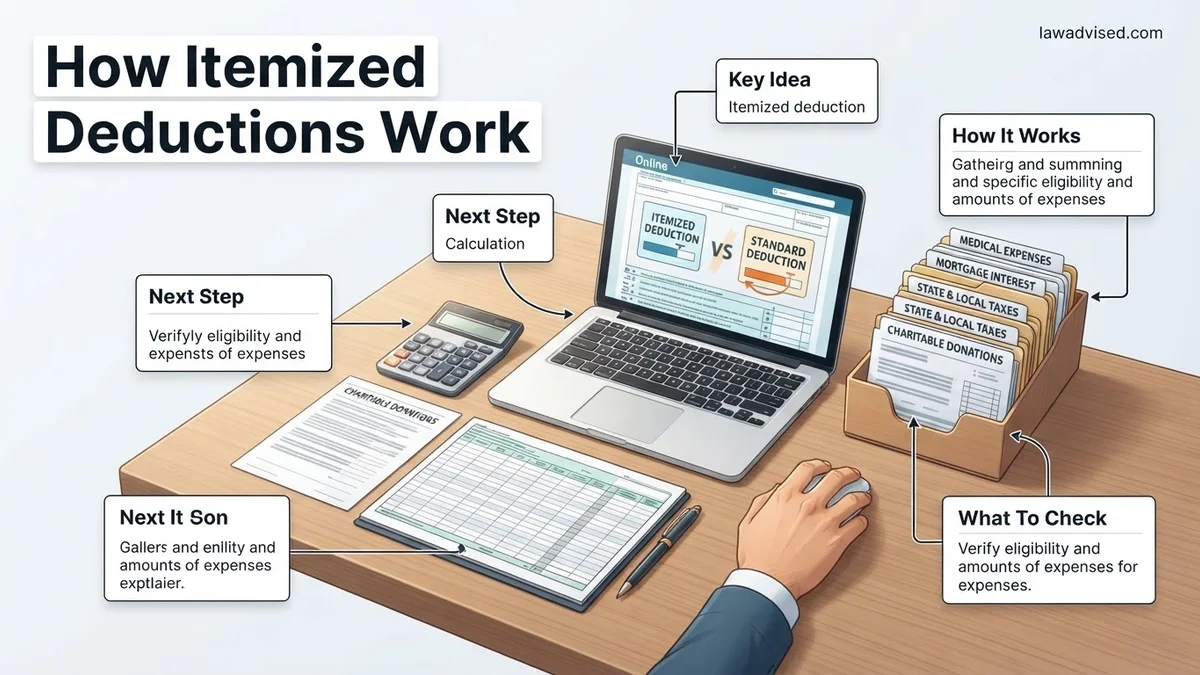
Itemized deductions are specific, qualified expenses you subtract from your Adjusted Gross Income (AGI) to lower your taxable income, thereby reducing the federal income tax you owe. Instead of taking a flat, one-size-fits-all standard deduction, you tally up eligible costs like mortgage interest, state and local taxes, and medical bills on Schedule A of Form 1040.
Choosing to itemize only makes financial sense if your total eligible expenses exceed the federal standard deduction threshold for 2026. Understanding this math directly impacts how much money stays in your bank account versus going to the IRS.
Key Takeaways
- Itemizing allows you to deduct specific qualified personal expenses to lower your taxable income.
- Compare your total itemized expenses against the standard deduction and choose the higher amount.
- Medical and dental expenses must exceed a strict percentage of your Adjusted Gross Income to qualify.
- Use Schedule A on Form 1040 to report and total your eligible itemized deductions.
- Keep thorough receipts and documentation for every single expense you claim on your return.
What Causes Taxpayers to Misunderstand How Itemized Deductions Work
Many filers leave money on the table or make costly tax-filing errors because they misunderstand the fundamental mechanics of Schedule A. Itemizing is not about getting a dollar-for-dollar refund on everything you spend; it is about lowering the baseline income upon which your tax bracket is calculated.
The Myth of Dollar-for-Dollar Reimbursements
A common misconception is that spending $1,000 on a deductible expense reduces your final tax bill by $1,000. In reality, deductions reduce your taxable income, not your tax liability directly. If you are in the 22% tax bracket, a $1,000 deduction saves you roughly $220 in actual taxes. You must spend significant sums out of pocket before itemizing yields a meaningful financial benefit.
Ignoring AGI Percentage Floors and Caps
Another frequent mistake is assuming every dollar of a qualified expense counts toward your total. Tax law imposes strict limits and percentage floors on certain categories:
- Medical and Dental Expenses: You can only deduct the portion of your unreimbursed medical costs that exceeds 7.5% of your 2026 Adjusted Gross Income.
- State and Local Taxes (SALT): The total deduction for state income, sales, and property taxes remains capped at $10,000 per year for most filers.
- Charitable Contributions: Cash donations are generally limited to 60% of your AGI, with lower limits applying to property and appreciated assets.
How to Calculate and Compare Your Deductions Step-by-Step
To determine whether you should itemize for the 2026 tax year, you need to run a side-by-side comparison. The IRS allows you to choose whichever method results in the lower tax burden, so you are never locked into itemizing if the standard deduction is higher.
Step 1: Tally Your Qualified Schedule A Expenses
Gather your receipts, Form 1098 mortgage statements, and charitable donation records throughout the year. Add up every category that qualifies for itemization:
- Home mortgage interest on up to $750,000 of indebtedness.
- State and local property and income taxes (up to the $10,000 cap).
- Out-of-pocket medical expenses that surpass the 7.5% AGI floor.
- Qualified charitable donations to IRS-recognized 501(c)(3) organizations.
Step 2: Compare Your Total Against the 2026 Standard Deduction
Once you have your grand total, compare it directly against the baseline standard deduction for your filing status in 2026. If your itemized total is $16,000 and the single filer standard deduction is $15,000, you should itemize to capture that extra $1,000 in deductions. If your total falls short of the standard threshold, take the standard deduction to save time and maximize your tax savings effortlessly.
How to Fix Common Errors When Claiming Schedule A Expenses
Filing Schedule A requires absolute precision to avoid Internal Revenue Service processing delays or painful post-filing audits. Minor calculation errors or missing documentation can trigger automated matching notices from tax authorities, freezing expected refunds for months.
Step 1: Re-verify Adjusted Gross Income Thresholds
Many taxpayers miscalculate percentage-based floors for medical expenses and casualty losses. For the 2026 tax year, medical and dental expenses must exceed 7.5 percent of your adjusted gross income before any deduction applies. Always subtract this exact percentage from your total qualified medical spending before entering the final figure on Schedule A.
Step 2: Consolidate and Audit Supporting Records
Incomplete receipts or missing 1098 forms frequently cause disallowed deductions. Gather all bank statements, digital receipts, and official tax forms into a single digital folder. Ensure every charitable donation over 250 dollars has a contemporaneous written acknowledgment from the qualified organization before submission.
Step 3: Correct Electronic Filing Transmission Errors
Modern tax preparation software often flags mismatched employer identification numbers or unverified mortgage interest reporting. If your return is rejected due to a Schedule A discrepancy, review the specific error code provided by your software. Update the corresponding field with data directly from your physical tax documents, re-run the diagnostic check, and securely resubmit your electronic return.
What If Your Itemized Expenses Still Don’t Beat the Standard Deduction
If your total qualified expenses fall short of the 2026 standard deduction threshold, itemizing provides zero tax advantage. Strategic financial planning can bridge this gap in future tax cycles. Consider the following fallback steps:
- Bunch Your Charitable Contributions: Combine multiple years of charitable giving into a single calendar year to clear the itemization hurdle. Alternatively, utilize a donor-advised fund to immediately claim the full deduction while distributing grants to charities over several years.
- Prepay Qualified Medical Procedures: Schedule elective medical procedures, dental work, or optical purchases within the same calendar year to maximize your medical expense percentage.
- Harvest Investment Losses: Offset capital gains by selling underperforming assets strategically to free up cash for deductible expenses.
- Consult a Licensed Certified Public Accountant: For complex portfolios involving multi-state property taxes or intricate business-personal expense allocations, engage a tax professional. Hiring a certified public accountant typically costs between 300 dollars and 1,000 dollars depending on return complexity, but their strategic advice often uncovers overlooked deductions.
Conclusion
Navigating Schedule A requires careful record-keeping and precise mathematical thresholds to ensure your itemized deductions surpass the standard deduction limits. When your total expenses fall short, strategic bunching methods can successfully rescue your tax savings strategy. According to verified research and expert sources from the American Institute of Certified Public Accountants, proactive year-round tax planning consistently yields better outcomes than last-minute filing adjustments. Your immediate actionable next step is to log into your tax software or review your year-to-date financial ledger to calculate your current itemized totals before the end of the 2026 filing window.
❓ Frequently Asked Questions
What are the most common types of itemized deductions?
The most common itemized deductions include state and local taxes (SALT) up to statutory limits, home mortgage interest, charitable contributions, and medical expenses that exceed specific AGI floors.
How do medical expense deductions work on Schedule A?
You can deduct qualified, unreimbursed medical expenses that exceed a certain percentage of your Adjusted Gross Income. Only the amount above that percentage floor can be included in your itemized total.
Is there a limit on how much I can deduct for charitable donations?
Yes, charitable contributions are generally limited to a certain percentage of your Adjusted Gross Income, depending on the type of organization and property donated.
What documentation do I need to keep if I itemize my deductions?
You must retain receipts, canceled checks, bank statements, and official tax forms like Form 1098 for mortgage interest to substantiate every deduction claimed in case of an IRS audit.
How has the standard deduction impacted the choice to itemize?
Higher standard deduction thresholds implemented in recent years mean that fewer taxpayers find it beneficial to itemize, as the standard deduction is often higher than their total itemized expenses.
Can married couples filing separately choose different deduction methods?
If a married couple files separate returns, both spouses must use the same method. If one itemizes, the other must also itemize, even if their individual expenses are very low.

Ismail Hossain is the founder of Law Advised. He is an Divorce, Separation, marriage lawyer. Follow him.