Earned Income Tax Credit Explained 2026 A Step-by-Step Guide
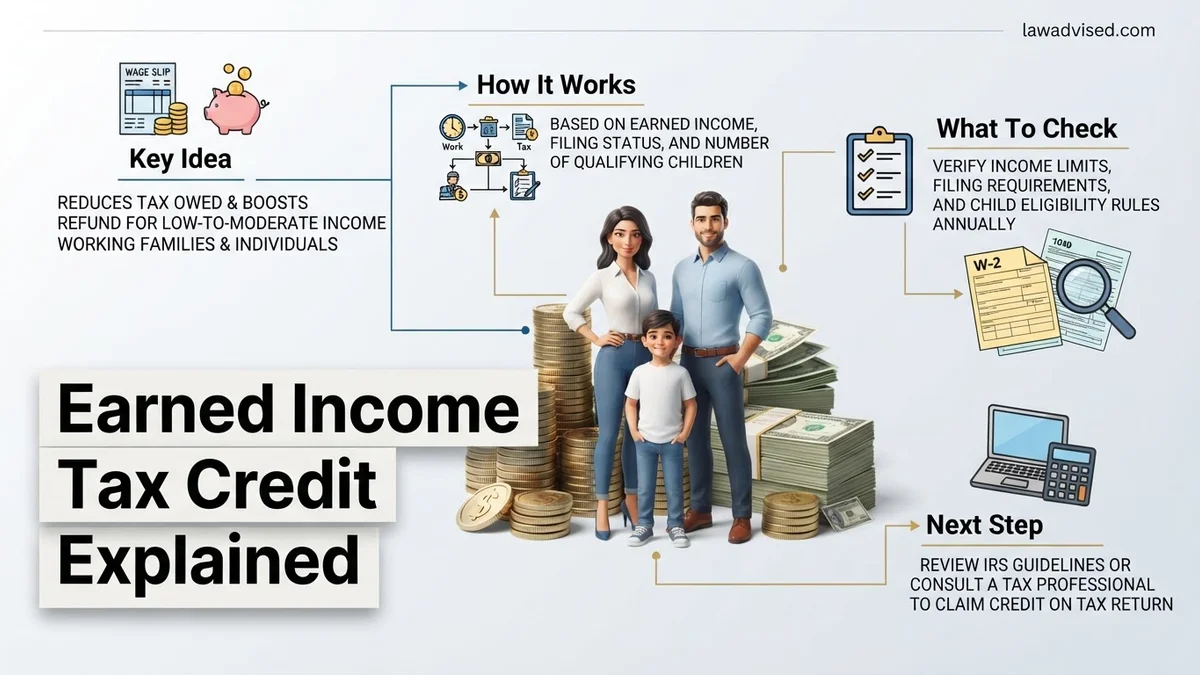
The Earned Income Tax Credit (EITC) is a valuable federal tax benefit designed to help low-to-moderate-income workers keep more of their hard-earned money. Because it is fully refundable, you can receive a cash refund even if you owe zero federal income tax.
The Earned Income Tax Credit (EITC) is a valuable federal tax benefit designed to help low- to moderate-income workers and working families keep more of what they earn. If you qualify for the EITC in 2026, you can significantly lower your federal tax liability—and because the credit is fully refundable, you can receive a direct cash payout from the IRS even if you owe zero income tax.
Filing for this credit is one of the most practical ways to boost your annual finances, but thousands of eligible workers miss out every year simply because they do not understand the rules. This guide breaks down the core definitions, qualification rules, and payout expectations you need to navigate your 2026 tax return successfully.
Key Takeaways
- The EITC provides a refundable cash payout even if you owe no federal income tax.
- You must have earned income from a job, self-employment, or gig work to qualify.
- Investment income must stay below the annual federal threshold to remain eligible.
- Filing a federal tax return is mandatory, even if you are not otherwise required to file.
- Claiming the credit correctly requires a valid Social Security Number for everyone on the return.
What Is the Earned Income Tax Credit and Why It Matters
The Definition and Purpose of the EITC
The EITC is a financial incentive for individuals who work and earn wages below a specific threshold. Created to offset the burden of federal taxes and supplement low wages, the credit scales dynamically. As you work more, your credit typically grows up to a certain point before phasing out gradually as your income rises. For the 2026 tax year, the program remains a vital economic lifeline for millions of single filers and married couples alike.
Why Being “Refundable” Changes Everything
Most tax credits are non-refundable, meaning they can only reduce your tax bill down to zero. Once your liability hits zero, any leftover credit vanishes. The EITC works differently because it is a refundable tax credit. If your calculated EITC exceeds the amount of federal income tax you owe, the IRS will send you the remaining balance as a direct tax refund. This distinction makes the EITC a powerful tool for generating tangible, pocketable cash during tax season.
How to Determine If You Qualify for the EITC
Earned Income and Investment Limits for 2026
To qualify for the EITC, you must have earned income from a job, self-employment, or union strike benefits. Passive income streams like dividends, pensions, or social security do not count toward your earned income total. Furthermore, the IRS strictly enforces an investment income cap. For the 2026 tax year, your total investment income—such as capital gains, interest, and dividends—must not exceed inflation-adjusted limits (historically hovering around the $11,000 threshold).
Core Eligibility Checklist
Meeting the financial caps is only part of the equation. To successfully claim the federal EITC in 2026, you must meet the following criteria:
- You and anyone claimed on your return must possess a valid Social Security Number issued on or before the due date of the 2026 tax return.
- Your filing status cannot be “Married Filing Separately” in most standard scenarios.
- You must be a U.S. citizen or a resident alien for the entire tax year.
- You cannot be claimed as a qualifying child on someone else’s tax return.
Step-by-Step Instructions to Claim Your EITC Refund
Claiming the Earned Income Tax Credit requires careful attention to detail. Filing accurately ensures you receive your maximum financial benefit without unnecessary processing delays.
Gather Required Documentation
You must assemble all income and identification records before starting your tax return. Accurate paperwork prevents calculation errors that trigger IRS audits.
- Collect all Form W-2 statements from employers and Form 1099 documents for independent contracting work.
- Locate valid Social Security numbers for yourself, your spouse, and any qualifying children claimed on the return.
- Keep track of investment income records, interest statements, and any untaxed income documentation for the 2026 tax year.
File Using Tax Software or Professional Assistance
Modern tax preparation platforms automatically check eligibility criteria and calculate the precise credit amount. Utilizing approved software significantly reduces mathematical errors.
- Select an IRS Free File provider if your adjusted gross income falls below the annual program threshold for 2026.
- Input your earned income data carefully, ensuring all dependent information matches Social Security Administration records.
- Complete Schedule EIC if you are claiming qualifying children and attach it directly to your Form 1040 submission.
What If Your EITC Claim Is Rejected or Delayed
IRS processing protocols often delay refunds containing the Earned Income Tax Credit to verify income authenticity. Understanding rejection notices helps you resolve issues quickly.
Respond to IRS Notices Promptly
If the agency requests additional documentation, you must reply within the specified timeframe. Ignoring these requests permanently forfeits the credit amount for the tax year.
- Review the specific IRS letter code to identify why the return was flagged for review.
- Gather requested proof, such as school records or lease agreements, proving your child lived with you for more than half of 2026.
- Submit photocopies of the documentation through the online portal or mail address provided in the official notice.
What If It Still Doesn’t Work?
Complex tax situations or persistent IRS rejections require advanced intervention. Follow these fallback steps to secure your legitimate refund:
- Review your transcripts directly through your online IRS account to check for processing hold codes.
- Contact a Low Income Taxpayer Clinic for free legal assistance if you face an unresolved audit or severe IRS dispute.
- Hire a Certified Public Accountant or Enrolled Agent to amend an incorrect return. Professional tax preparation fees typically range from $150 to $450 depending on return complexity.
- Contact your local congressional representative’s office to request constituent casework assistance for chronically delayed refunds.
Conclusion
Claiming the Earned Income Tax Credit provides vital financial relief for eligible workers navigating rising living costs. Following precise filing steps and responding quickly to IRS notices ensures you receive your full funds. According to verified research and expert sources from the IRS and the Center on Budget and Policy Priorities, filing electronically with direct deposit remains the fastest way to access your credit. Take the next step today by gathering your 2026 income documents and utilizing a trusted tax software program to file an accurate return.
❓ Frequently Asked Questions
What are the basic income limits to qualify for the EITC in 2026?
Income limits change annually based on inflation and family size. Generally, single filers with no children must earn below specific thresholds, while families with three or more children have significantly higher phase-out limits.
What happens if I make a mistake when claiming the EITC?
Errors can cause the IRS to delay your refund or audit your return. If you make a math error, the IRS usually corrects it automatically, but missing documentation may require you to respond to a notice.
Can investment income disqualify me from getting the EITC?
Yes, the IRS sets a strict limit on investment income, such as interest, dividends, and capital gains. Exceeding this annual cap means you cannot claim the credit, regardless of your earned income.
Do I need a Social Security Number to claim the EITC?
Yes, you, your spouse (if filing jointly), and any qualifying children must have valid Social Security Numbers issued before the due date of the tax return.
How long does it take to get my EITC refund?
By law, the IRS holds refunds for returns claiming the EITC or Additional Child Tax Credit until mid-February. Most early filers who choose direct deposit receive their funds by late February or early March.
Can I claim the EITC for previous tax years if I missed it?
Yes, you generally have up to three years from the original filing deadline to file a prior-year tax return and claim any unclaimed EITC refunds you were entitled to receive.

Ismail Hossain is the founder of Law Advised. He is an Divorce, Separation, marriage lawyer. Follow him.