Qualifying Child vs Qualifying Relative Expert 2026 Guide
Navigating the rules for a qualifying child vs qualifying relative determines your eligibility for major tax credits like the Child Tax Credit. You must pass five specific tests for a child or four distinct tests for a relative to claim them legally. Misclassifying a dependent risks costly IRS processing delays and disallowed credits.
Navigating IRS dependency rules comes down to two distinct categories: the Qualifying Child and the Qualifying Relative. While the names sound intuitive, the legal tests for each are rigid and often counterintuitive. For instance, an adult relative can sometimes be a qualifying child, while your own child who fails an age test might instead fall into the qualifying relative bucket.
Getting this classification right for your 2026 tax return dictates whether you can claim lucrative tax breaks like the Child Tax Credit or the Credit for Other Dependents. Mixing them up triggers IRS rejections, delayed refunds, and costly audits. Let’s break down the exact mechanical differences so you can classify your household members with absolute confidence.
Key Takeaways
- A qualifying child must pass relationship, age, residency, support, and joint return tests.
- Qualifying relatives face strict gross income limits that children generally do not.
- Children under 17 at year-end may qualify you for the lucrative Child Tax Credit.
- Qualifying relatives typically only unlock the non-refundable Credit for Other Dependents.
- Tie-breaker rules apply when multiple taxpayers claim the exact same eligible dependent.
What Causes Confusion in Qualifying Child vs Qualifying Relative Rules
The Misleading Terminology of Qualifying Relative
The biggest trap for taxpayers is assuming a “Qualifying Relative” must actually be related to you by blood or marriage. Under IRS guidelines for 2026, a friend, partner, or former stepfamily member can easily qualify as your dependent under this title, provided they live with you all year and meet the financial tests. Conversely, the term makes people think blood relation is enough, completely overlooking strict income caps that disqualify working adults.
The Overlap in Age, Residency, and Income Limits
Confusion also stems from how the two categories handle age and financial support differently. A Qualifying Child relies heavily on age and residency rules rather than how much money they earn. Meanwhile, a Qualifying Relative has no age cap at all, but they fail instantly if their gross income crosses the IRS threshold. When dependents age out of the child category, people often fail to transition them correctly into the relative category because they assume the support math stays identical.
How to Test and Classify Your Dependents Step-by-Step
The 5 Tests for a Qualifying Child
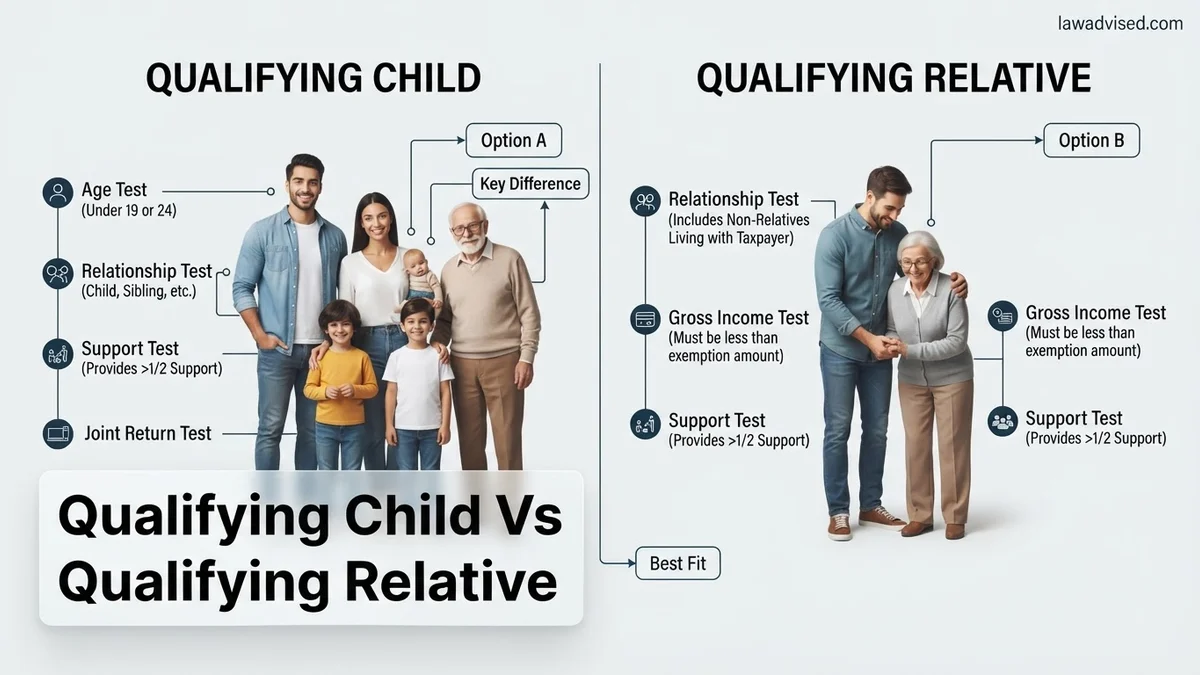
To claim someone as your Qualifying Child on your 2026 tax return, they must pass five specific IRS hurdles without exception:
- Relationship: They must be your son, daughter, stepchild, foster child, brother, sister, half-brother, half-sister, stepbrother, stepsister, or a descendant of any of these.
- Age: They must be under age 19 at the end of 2026, or under age 24 and a full-time student for at least five months of the year. Permanently and totally disabled children have no age limit.
- Residency: They must share your principal place of abode for more than half of 2026, with standard temporary absence exceptions for school or medical care.
- Support: They cannot have provided more than half of their own financial support during the tax year.
- Joint Return: They cannot file a joint tax return for the year, unless they are only filing to claim a refund of withheld income taxes.
The 4 Tests for a Qualifying Relative
If your dependent fails the Qualifying Child tests—perhaps because they are too old or earned too much—they must be evaluated against the four Qualifying Relative tests:
- Not a Qualifying Child: They cannot be your qualifying child, and they cannot be the qualifying child of any other taxpayer for the 2026 tax year.
- Member of Household or Relationship: They must either live with you all year as a member of your household, or be related to you in one of several specific familial ways (such as a parent, grandparent, aunt, uncle, or in-law).
- Gross Income Limit: Their gross taxable income for 2026 must be below the official IRS threshold limit set for the tax year.
- Support Test: You must provide more than 50 percent of their total financial support for the calendar year.
How to Fix Incorrect Dependent Classifications on Your Tax Return
Filing with an incorrect dependent classification can trigger automated IRS notices, delaying refunds and potentially leading to costly audits. According to IRS compliance data, correcting a classification error before the agency flags it significantly reduces penalty risks.
Step-by-Step Amendment Process for 2026
- Wait until the IRS processes your original 2026 tax return and you receive your initial refund or balance due notice.
- Obtain Form 1040-X (Amended U.S. Individual Income Tax Return) to update your filing status and shift the individual between qualifying child and qualifying relative categories.
- Attach any supporting schedules, such as Schedule 8812 for the Child Tax Credit, reflecting the corrected classification.
- Mail the completed paper form to the appropriate IRS campus listed in the 2026 Form 1040-X instructions, unless electronic filing amendments are supported by your software provider.
What If Multiple Taxpayers Claim the Same Dependent
Tie-breaking scenarios frequently occur when divorced parents or extended family members inadvertently claim the same individual. The IRS utilizes strict statutory tie-breaker rules to resolve these duplicate claims for the 2026 tax year.
Applying IRS Tie-Breaker Rules
- Determine if only one taxpayer is the child’s custodial parent; that parent retains default priority under standard rules.
- Evaluate the parents’ Adjusted Gross Income (AGI) if both claim the child as a qualifying child, prioritizing the parent with the higher AGI when the custodial parent is not involved.
- Apply the highest AGI rule if multiple non-parents attempt to claim the same qualifying relative, ensuring only the person with the strongest financial support and highest income retains the claim.
- Prepare for paper filing if an e-filed return is rejected because another taxpayer already claimed the dependent; the IRS will subsequently issue a dual-claim inquiry letter.
What If It Still Doesn’t Work?
If informal corrections and standard IRS processing fail to resolve a dependent dispute or audit flag for the 2026 tax year, taxpayers must escalate the issue through structured professional channels.
- Respond immediately to any IRS CP2000 notice or mathematical error notice by the statutory deadline, usually 30 days from the notice date.
- Consult a certified public accountant (CPA) or Enrolled Agent (EA) specializing in individual taxation to review residency and financial support documentation. Professional fees for audit representation and complex amended returns typically range from $300 to $1,500 depending on complexity.
- Request assistance from the Taxpayer Advocate Service (TAS) if processing delays cause severe financial hardship.
- File a formal appeal through the IRS Office of Appeals if an auditor denies the dependent classification and you possess verifiable proof of eligibility.
Conclusion
Mistakenly labeling a dependent as a qualifying child instead of a qualifying relative can derail your tax refund and trigger unnecessary compliance reviews. According to verified research and expert tax sources, careful upfront evaluation of residency, age, and support tests prevents costly filing errors. Your next actionable step is to review your 2026 support records and cross-reference them with IRS Publication 501 guidelines before submitting your final documentation.
❓ Frequently Asked Questions
What are the five tests for a qualifying child?
To claim a qualifying child, the individual must pass the relationship test, age test, residency test, support test, and joint return test. Failing any single test means you must evaluate them under qualifying relative rules.
How does the gross income limit apply to a qualifying relative?
A qualifying relative cannot have gross income that exceeds the IRS annual limit for the tax year. Tax-exempt income like certain welfare benefits is generally excluded from this calculation.
What is the difference between the Child Tax Credit and the Credit for Other Dependents?
The Child Tax Credit is available for eligible qualifying children under 17 and offers a higher, partially refundable amount. The Credit for Other Dependents is a non-refundable credit for qualifying relatives and older children.
What happens if a child provides more than half of their own financial support?
If a person provides more than half of their own financial support during the calendar year, they fail the support test and cannot be claimed as a qualifying child or qualifying relative.
How do IRS tie-breaker rules work when two people claim the same child?
If parents or other taxpayers try to claim the same child, the IRS applies strict tie-breaker rules favoring parents, length of residency, and highest adjusted gross income.
Can a boyfriend or girlfriend be claimed as a qualifying relative?
An unrelated partner can qualify as a qualifying relative if they lived with you as a member of your household for the entire year and all other support and income tests are met.

Ismail Hossain is the founder of Law Advised. He is an Divorce, Separation, marriage lawyer. Follow him.