Social Security Wages vs Federal Wages A 2026 Guide
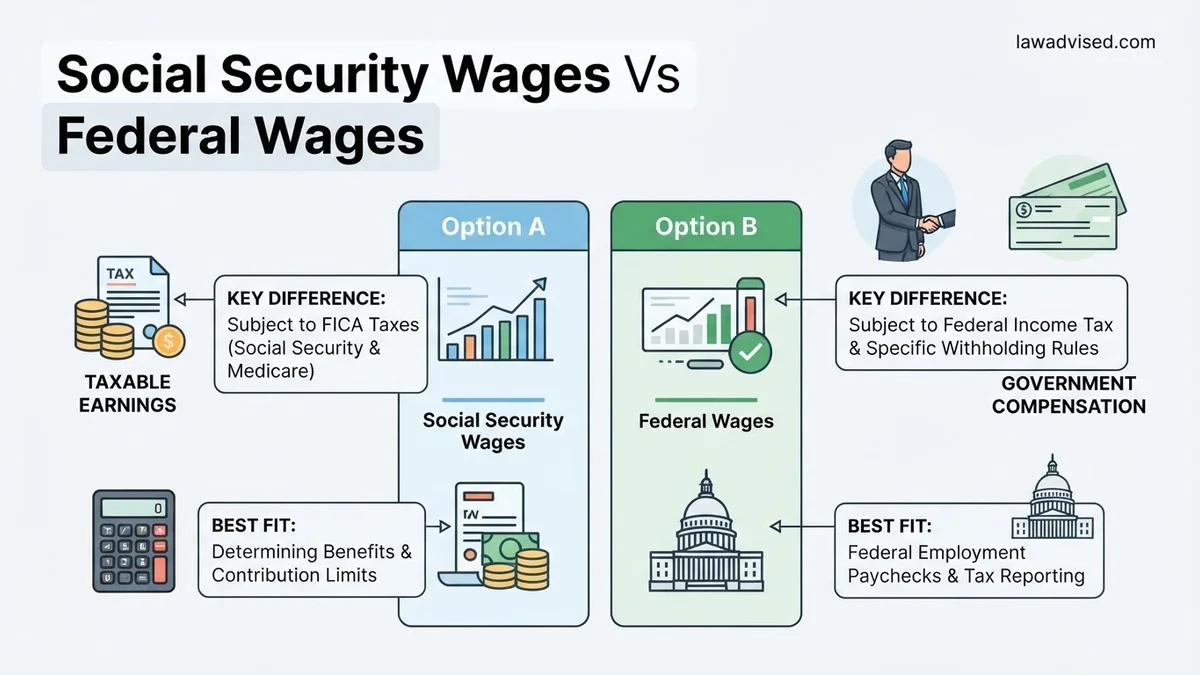
Your social security wages and federal wages often differ on your W-2 because certain pre-tax deductions reduce your federal income tax while remaining fully subject to FICA taxes. Box 1 reports taxable federal income, while Box 3 tracks earnings subject to the Social Security tax wage cap.
Your Social Security wages in Box 3 of your Form W-2 differ from your federal taxable wages in Box 1 because the IRS and the Social Security Administration use entirely different rules for what counts as taxable income. While federal income tax applies to almost all your earnings, Social Security taxes follow stricter guidelines that exclude certain pre-tax deductions and apply a strict annual earnings cap.
Understanding this gap matters when you review your 2026 tax documents to ensure your employer withheld the correct amounts. If you notice a discrepancy, it rarely points to an error. Instead, it usually highlights the specific impact of your workplace pre-tax benefits and retirement contributions.
Key Takeaways
- Box 1 shows federal taxable income, while Box 3 shows wages subject to Social Security tax.
- Traditional 401(k) contributions reduce federal wages in Box 1 but stay in Box 3.
- Health insurance and FSA pre-tax deductions reduce both Box 1 and Box 3 wages.
- The Social Security wage base limit caps the amount of earnings taxed for Social Security.
- Imputed income for group-term life insurance can make Box 3 higher than Box 1.
What Causes the Difference Between Social Security Wages and Federal Wages
The core reason your W-2 numbers diverge comes down to how specific benefits are treated under federal income tax law versus the Federal Insurance Contributions Act (FICA). Certain pre-tax deductions lower your federal taxable income in Box 1 while leaving your Social Security wages in Box 3 completely untouched.
Pre-Tax Fringe Benefits and Health Deductions
Many workplace benefits reduce your federal income taxes, but they do not escape FICA taxes. This creates an immediate gap between your Box 1 and Box 3 totals.
- Health, Dental, and Vision Insurance: Pre-tax health insurance premiums reduce your Box 1 federal wages, but they are still subject to Social Security taxes.
- Health Savings Accounts (HSAs) and Flexible Spending Accounts (FSAs): Contributions made via payroll deduction lower your federal taxable wages, yet they generally remain part of your Social Security wage base.
- Group-Term Life Insurance: The cost of employer-provided group-term life insurance over fifty thousand dollars counts as taxable income for federal purposes, but it may face different FICA inclusion rules.
Retirement Contributions and Deferred Compensation
Your retirement savings strategy is the other major driver of W-2 wage discrepancies. Traditional pre-tax accounts treat federal and FICA taxes very differently.
- Traditional 401(k) and 403(b) Plans: Your regular pre-tax retirement contributions lower your Box 1 federal wages. However, these elective deferrals are still fully subject to Social Security tax, keeping your Box 3 wages higher.
- Section 125 Cafeteria Plans: These plans reduce federal income tax, but certain types still count toward your total Social Security earnings.
How to Reconcile Your W-2 Box 1 and Box 3 Step-by-Step
Reconciling the numbers on your 2026 W-2 requires looking past your gross salary and accounting for the specific pre-tax deductions itemized on your final pay stub of the year. By taking your gross pay and adding back the benefits that federal tax law exempts but FICA taxes include, you can match your Box 1 to your Box 3.
The Math Behind the Reconciliation
You can verify your wage differences using a straightforward calculation based on your end-of-year earnings statement. Grab your final 2026 pay stub and follow this formula to see how your employer arrived at your Box 3 wages.
- Start with your Box 1 Federal Taxable Wages amount.
- Add back your traditional 401(k) or 403(b) pre-tax retirement contributions for the year.
- Add back your pre-tax health, dental, and vision insurance premiums deducted from your pay.
- Add back any pre-tax contributions made to your HSA or healthcare FSA.
- Compare your new total to Box 3. The resulting figure should match your Social Security wages, assuming you have not exceeded the annual taxable maximum limit.
Accounting for the Social Security Wage Base Limit
If your calculated total still does not match Box 3, check whether your earnings crossed the annual threshold. For the 2026 tax year, the Social Security Administration caps taxable earnings at the statutory wage base limit. Any income you earn above this specific dollar threshold is completely exempt from the 6.2 percent Social Security tax, which causes Box 3 to freeze at that maximum cap even if your Box 1 federal wages continue climbing much higher.
How the Social Security Wage Base Limit Affects Your Box 3 Earnings
A primary reason for the gap between your total federal income and your Social Security taxable earnings is the annual contribution and benefit base. Federal wages reported in Box 1 have no upper ceiling. Every dollar you earn from your job is subject to income tax. Conversely, Social Security wages reported in Box 3 face a strict statutory cap known as the maximum taxable earnings limit.
For the tax year 2026, the Social Security Administration projects this wage base limit to reflect ongoing adjustments based on the national average wage index. When your gross earnings exceed this designated threshold, your Box 3 amount stops growing for the remainder of the calendar year. Box 1, however, continues to climb.
Understanding the 2026 Wage Base Cap
High earners often notice a significant divergence between Box 1 and Box 3 in the latter half of the year. Once cumulative earnings surpass the 2026 limit, employers stop withholding the 6.2 percent Social Security tax from your paycheck. Your federal income tax withholding in Box 2, alongside your Medicare withholding in Box 5, continues uninterrupted.
Evaluating Combined Income Scenarios
Workers holding multiple jobs must monitor their combined earnings carefully. Each employer applies the wage base limit independently without accounting for your other sources of income. According to data from the Social Security Administration, individuals who surpass the statutory maximum across multiple employers frequently overpay their FICA taxes. You can reclaim these excess withholdings directly on your 2026 federal income tax return by filing Form 1040.
What If Your W-2 Wage Discrepancy Is an Employer Error
Sometimes the variance between your federal wages and Social Security wages does not stem from pre-tax deductions or statutory caps. Payroll software misconfigurations or human error frequently generate inaccurate W-2 forms. Spotting an unexplainable deficit or surplus requires immediate investigation.
Steps to Resolve Payroll Mistakes
- Review your final year-end pay stub for 2026 and compare cumulative year-to-date totals against the figures printed on your Form W-2.
- Contact your employer’s human resources or payroll department to request a formal audit of your earnings history and FICA withholdings.
- Verify whether your employer correctly processed pre-tax benefits like health insurance or retirement contributions, as these selectively reduce Box 1 and Box 3 wages differently.
- Obtain a corrected Form W-2c (Corrected Wage and Tax Statement) if the payroll department confirms an administrative error occurred.
What If It Still Doesn’t Work?
If your employer refuses to issue a correction or you cannot reconcile the math on your 2026 tax documents, deeper intervention is necessary. Do not ignore persistent discrepancies, as mismatched data with the Social Security Administration can delay future benefit calculations.
- Submit a formal complaint to the IRS by calling their taxpayer assistance line to report an incorrect or missing W-2 form.
- File your 2026 tax return using Form 4852 (Substitute for Form W-2, Wage and Tax Statement) while attaching a detailed calculation of your actual earnings.
- Consult a certified public accountant (CPA) or a federally authorized tax practitioner to handle complex multi-employer overpayment claims. Professional tax assistance typically ranges from $200 to $600 depending on the complexity of your adjustments.
Conclusion
Navigating the distinct rules governing social security wages versus federal wages ensures you neither overpay your taxes nor shortchange your future retirement benefits. By understanding how pre-tax deductions and the annual wage base limit alter your Box 1 and Box 3 figures, you can spot errors quickly. According to verified research and expert sources from the IRS, verifying your year-end tax forms against final pay stubs prevents costly processing delays. Take your next actionable step today by logging into your online SSA account to cross-reference your reported earnings for 2026.
❓ Frequently Asked Questions
Why do my federal wages and Social Security wages never seem to match?
Federal and Social Security taxes follow different tax code rules regarding pre-tax fringe benefits. Retirement contributions lower federal taxable income but remain subject to FICA taxes, creating an automatic discrepancy.
What is the maximum Social Security wage limit for 2026?
The Social Security administration sets an annual maximum wage base limit. Earnings above this specific dollar threshold are not subject to the 6.2% Social Security tax, which caps the number reported in Box 3.
Can Box 3 wages ever be higher than Box 1 wages?
Yes, this commonly happens if you have high pre-tax retirement contributions combined with taxable fringe benefits like group-term life insurance coverage over $50,000, which is added to Box 1 but handled differently elsewhere.
Are tips included in Social Security wages?
Yes, reported cash tips are fully subject to both federal income tax and Social Security tax, meaning they will be included in both Box 1 and Box 3 calculations.
How do Section 125 cafeteria plans affect W-2 wages?
Section 125 plans cover qualified benefits like health insurance and flexible spending accounts. Because these exclusions apply to both federal and FICA taxes, they lower both Box 1 and Box 3 equally.
What should I do if I suspect my employer made a mistake calculating my W-2?
Compare your final paystub of the year against your W-2 totals and calculate your gross pay minus specific pre-tax deductions. If a mathematical error is found, contact your payroll department immediately to request a corrected W-2c.

Ismail Hossain is the founder of Law Advised. He is an Divorce, Separation, marriage lawyer. Follow him.