W2 Employee Tax Deductions 2026 A Step-by-Step Guide
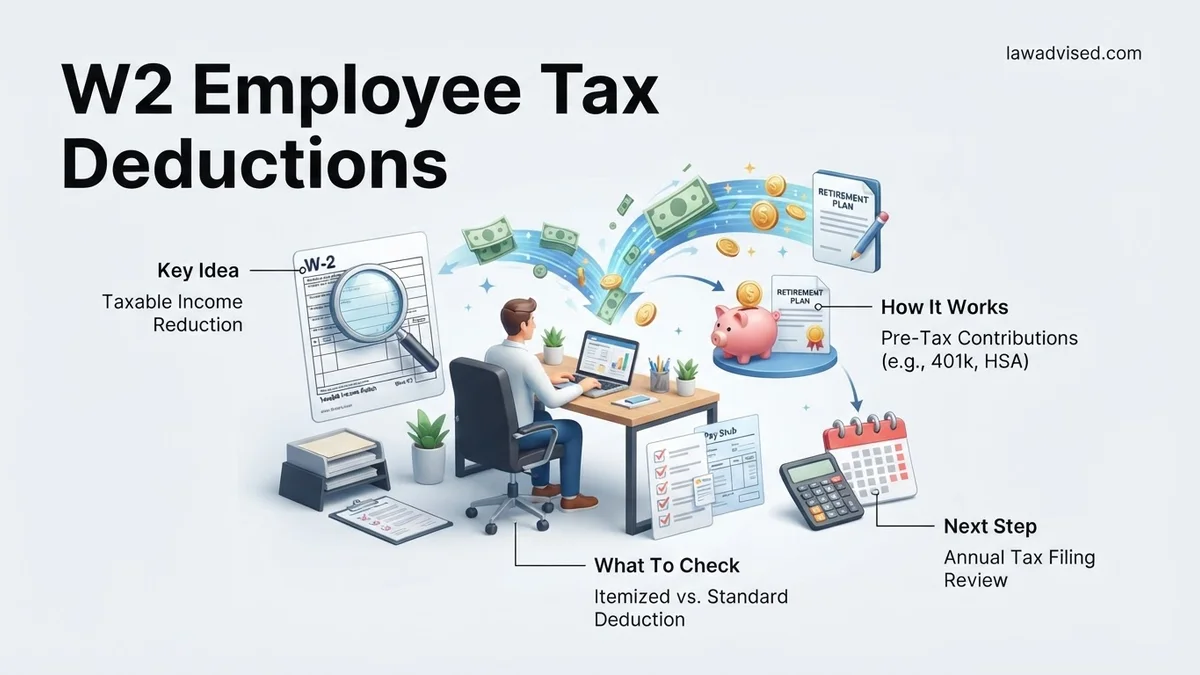
Most traditional w2 employee tax deductions for unreimbursed job expenses remain eliminated under current tax law. However, workers can still significantly lower their tax liability by utilizing above-the-line deductions like retirement contributions, health savings accounts, and student loan interest.
If you are wondering what tax deductions you can claim as a W-2 employee, the short and blunt answer is this: you can no longer deduct standard job expenses like home offices, travel, or uniforms on your federal tax return. The Tax Cuts and Jobs Act completely eliminated miscellaneous itemized deductions subject to the two percent floor, and Congress has not brought them back for the 2026 tax year.
This means your out-of-pocket costs for required work gear, professional development, and remote work tools will not lower your federal taxable income. Understanding this reality right now saves you from wasting hours tracking receipts for non-deductible items, while redirecting your focus toward the “above-the-line” deductions you are actually eligible to take.
Key Takeaways
- Unreimbursed W-2 employee business expenses cannot be deducted on federal returns.
- Above-the-line deductions like HSAs and traditional IRAs lower your adjusted gross income.
- Certain states still allow itemized deductions for job-related expenses.
- W-2 workers should not confuse their tax rules with 1099 independent contractor rules.
- Maximize tax savings by focusing on employer-sponsored pre-tax benefit programs.
Why W2 Employee Tax Deductions For Job Expenses Are Currently Unavailable
The Elimination of Unreimbursed Employee Expenses
For years, W-2 workers could deduct job-related expenses that exceeded two percent of their adjusted gross income on Schedule A. Under current 2026 tax rules, that deduction remains entirely suspended. If your employer requires you to buy a laptop, travel for client meetings, or purchase specialized safety gear without reimbursement, you must absorb those costs entirely out of pocket without federal tax relief.
Exceptions for Specialized Workers
While standard employees are out of luck, a very narrow group of W-2 workers retains limited deduction rights. You can still claim employee expenses if you fall into one of these specific federal categories:
- Qualified performing artists meeting strict adjusted gross income limits.
- Fee-basis state or local government officials performing services for a fee.
- Employees with disabilities claiming impairment-related work expenses.
How to Claim Above-the-Line W2 Employee Tax Deductions Step-by-Step
Utilize Pre-Tax Retirement and Health Accounts
Since you cannot deduct job expenses, your best strategy is reducing your taxable income before the IRS calculates your tax liability. You can do this directly through your employer payroll or via individual contributions for the 2026 tax year:
- Contribute to a traditional 401(k) or 403(b) directly through payroll deductions.
- Fund a traditional IRA independently to lower your adjusted gross income, subject to 2026 income phase-out limits.
- Contribute to a Health Savings Account (HSA) if you are enrolled in a high-deductible health plan.
Claim Eligible Above-the-Line Adjustments on Form 1040
Above-the-line deductions do not require you to itemize your deductions to benefit from them. You simply subtract these qualifying expenses directly from your gross income:
- Deduct up to $2,500 of student loan interest annually if your 2026 modified adjusted gross income falls below the threshold limits.
- Deduct moving expenses if you are an active-duty military member relocating under military orders.
- Check for state-specific above-the-line deductions, as certain states still allow local deductions for educator expenses or union dues that the federal government dropped.
How to Fix Common Confusion Between W-2 and 1099 Tax Rules
A frequent source of tax season stress stems from blurring the lines between W-2 employee rules and 1099 independent contractor guidelines. Because independent contractors can deduct ordinary and necessary business expenses under Internal Revenue Code Section 162, W-2 workers often assume they can claim identical write-offs for home offices, software, or travel. According to IRS compliance data, misclassifying employee expenses as business deductions triggers severe audit flags. W-2 earners cannot use Schedule C to deduct unreimbursed employee expenses on federal returns for the 2026 tax year.
Understanding the Boundaries
Tax experts emphasize that the Tax Cuts and Jobs Act suspended miscellaneous itemized deductions subject to the 2 percent adjusted gross income floor through December 31, 2025. While Congress evaluated extensions for 2026, federal guidelines continue to bar standard W-2 workers from writing off job costs unless they fall into specific exempt categories. Contractors maintain autonomy over their work methods and incur expenses without reimbursement, whereas employees operate under direct employer control. Reviewing the distinction prevents costly filing errors.
- Examine your Form W-2 to confirm your official worker classification status before filing.
- Review your Form 1099-NEC or 1099-MISC if you performed dual roles as an employee and freelancer during 2026.
- Isolate legitimate business deductions strictly to your self-employed income streams rather than your W-2 wages.
- Consult IRS Publication 535 for official definitions of deductible business versus non-deductible employee expenses.
What If Your State Still Allows Employee Expense Deductions
While federal tax law eliminates miscellaneous itemized deductions for W-2 employees in 2026, several state tax codes decouple from federal provisions. States like California, Pennsylvania, and New York historically permitted residents to deduct unreimbursed employee business expenses on state returns if they exceeded specific adjusted gross income thresholds. Navigating this divergence requires careful tracking of both federal and state-level compliance mandates to maximize legal savings.
Leveraging State-Level Opportunities
State tax authorities enforce strict documentation standards for any remaining employee expense deductions. Tax professionals recommend maintaining detailed mileage logs, receipt folders, and employer rejection letters regarding expense reimbursements. Failing to meet state-specific substantiation rules can result in immediate adjustments and state tax penalties during 2026 audits.
- Check your state Department of Revenue website to verify if 2026 guidelines still permit unreimbursed employee expense deductions.
- Complete your federal Form 1040 first, noting that federal taxable wages will differ from state taxable wages.
- File state Schedule CA or equivalent state modification forms to claim eligible employee write-offs.
- Attach required employer reimbursement policy statements if mandated by your specific state taxing agency.
What If It Still Doesn’t Work?
If navigating overlapping federal restrictions and state tax anomalies proves too complex for standard tax software, fallback strategies ensure compliance and prevent costly errors. According to the National Society of Accountants, professional tax preparation fees typically range from $250 to $500 for individuals with mixed-income or multi-state filing situations.
- Request a formal, written accountable plan reimbursement request from your employer’s human resources department to recover out-of-pocket costs tax-free.
- Schedule a consultation with a Certified Public Accountant or Enrolled Agent specializing in 2026 individual taxation rules.
- Utilize IRS Free File or professional-grade tax software guided review features to double-check state versus federal entries.
- File for an extension if employer documentation or state-level clarification is delayed past the April 2026 filing deadline.
Conclusion
Navigating W-2 employee tax deductions in 2026 requires understanding the strict federal ban on unreimbursed employee expenses while capitalizing on any lingering state-level exceptions and employer accountable plans. According to verified research and tax policy experts, proactive record-keeping and correct worker classification remain the best defenses against costly filing errors and audits. Your actionable next step is to audit your 2026 out-of-pocket work expenses and immediately submit an accountable plan reimbursement request to your employer.
❓ Frequently Asked Questions
Why did the tax laws change for W-2 employee expenses?
The Tax Cuts and Jobs Act temporarily eliminated miscellaneous itemized deductions subject to the 2% AGI floor, which included nearly all unreimbursed employee business expenses through 2025.
Can my employer reimburse me for out-of-pocket work expenses?
Yes, employers can set up an accountable plan to reimburse you tax-free for legitimate business expenses like travel, cell phones, and client dinners.
Are educator expenses deductible for W-2 teachers?
Yes, eligible educators can claim an above-the-line deduction of up to $300 for unreimbursed classroom supplies and books.
Can I deduct mileage driven for my W-2 job?
Federal tax rules prevent W-2 workers from deducting commuting or job-related mileage unless reimbursed directly by the employer through an accountable plan.
Does contributing to a 401(k) reduce my taxable income as a W-2 employee?
Yes, traditional 401(k) contributions are made on a pre-tax basis, directly lowering your taxable wages reported on your Form W-2.
What should I do if my employer requires me to buy my own work equipment?
Since you cannot deduct these costs on your federal taxes, you should request an expense reimbursement or negotiate a higher salary to offset the out-of-pocket expense.

Ismail Hossain is the founder of Law Advised. He is an Divorce, Separation, marriage lawyer. Follow him.