Tax Withholding Estimator Explained Step-by-Step Guide 2026
The IRS Tax Withholding Estimator is a free online tool designed to help you check whether your employer is withholding the correct amount of federal income tax from your paychecks. Using this tool prevents unexpected tax bills and avoids giving the government an interest-free loan through a massive refund. By entering your income and deduction details, you can easily determine if your payroll deductions need a quick adjustment.
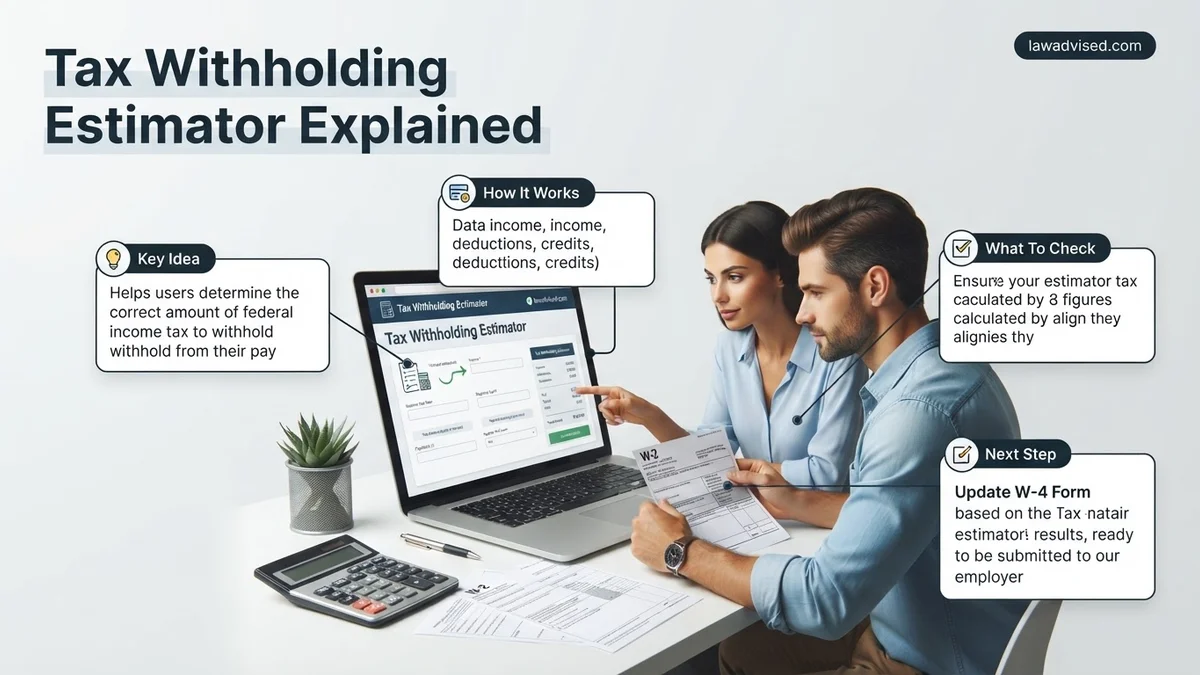
The IRS Tax Withholding Estimator is a free online tool designed to calculate the exact federal income tax that should be withheld from your paycheck. By entering your expected income, tax credits, and deductions for 2026, the tool compares your current withholding against your projected annual tax liability to show whether you are on track for a refund or a surprise tax bill.
Checking your payroll deductions matters practically because it prevents you from making an involuntary interest-free loan to the government via over-withholding, or facing a steep underpayment penalty for withholding too little. Using this tool allows you to fine-tune your take-home pay so you keep more money in your pocket each month while avoiding penalties.
Key Takeaways
- Use the official IRS Tax Withholding Estimator to prevent unexpected tax bills next April.
- Gather recent pay stubs, W-2 forms, and your spouse’s income details before starting.
- Complete the step-by-step online questionnaire to calculate your exact payroll adjustment needs.
- Translate the estimator results directly into a newly submitted Form W-4 for your employer.
- Revisit the estimator annually or whenever major life milestones like marriage or a job change occur.
What Causes Incorrect Tax Withholding on Your Paychecks
Life Changes and Multiple Jobs
Your tax withholding often becomes inaccurate because life events directly alter your tax bracket and standard deduction. Major life transitions frequently disrupt standard withholding calculations set by employers. Common culprits include:
- Getting married or divorced, which alters your filing status.
- Welcoming a new child or claiming a new dependent for 2026.
- Taking on a second job or a side hustle that pushes you into a higher tax bracket.
- Experiencing a significant salary raise or a sudden drop in household income.
Outdated W-4 Forms
Many workers fill out a Form W-4 when they start a new job and never touch it again. If your W-4 reflects outdated financial data, your employer will continue using old formulas. Even minor shifts in investment income, freelance earnings, or deductions can accumulate over the year. Without an active check using the 2026 IRS estimator, these discrepancies compound and result in a wildly inaccurate tax outcome.
How to Fix Your Tax Withholding Using the IRS Estimator Step-by-Step
Gathering Your Documents
Before you open the online IRS Tax Withholding Estimator, you need to collect specific financial documents to ensure accurate results. Having these details ready prevents guesswork and saves you time during the calculation process. Make sure you have:
- Your most recent paystubs for all jobs held by you and your spouse.
- Information about other income sources, such as self-employment, dividends, or retirement distributions.
- Your most recent federal tax return filed for the previous year.
- Estimates of any 2026 deductions, such as student loan interest or charitable contributions.
Navigating the Online Tool
Go to the official IRS website and launch the Tax Withholding Estimator tool. The interface walks you through a series of secure screens requesting your personal details, income sources, adjustments, and tax credits. Fill out each prompt carefully based on the documents you gathered. Once completed, the tool generates a precise recommendation indicating whether you need to submit a new Form W-4 to your employer and what exact numbers to write down.
How to Update Your Form W-4 With Your Employer
Once you finish calculating your ideal withholding numbers using the IRS portal, the next step involves submitting a revised Form W-4 to your employer’s payroll or human resources department. According to the IRS, completing this step promptly ensures your take-home pay reflects your updated financial reality for the 2026 tax year.
Submitting Your Form W-4
- Access your employer’s secure payroll portal, such as ADP, Workday, or Gusto, where digital W-4 forms are typically hosted.
- Transfer the specific numerical results from your tax withholding estimator summary directly into Step 3 through Step 4 of the new Form W-4.
- Double-check that your personal identifying information matches, including your current filing status and legal name.
- Sign and submit the document electronically, or print and hand-deliver a physical copy to your payroll administrator.
Payroll departments generally require two to four weeks to process W-4 modifications. Financial experts recommend submitting your updated form well ahead of major life transitions to give your employer adequate time to adjust subsequent paychecks.
What If Your Next Paycheck Still Shows Incorrect Withholding Deductions
Sometimes your paycheck withholding remains unchanged even after submitting your revised Form W-4. Financial administrators note that payroll processing delays are the primary culprit for this temporary discrepancy.
- Wait through at least two standard pay cycles, as many corporate payroll systems operate on bi-weekly or semi-monthly lag schedules.
- Contact your human resources or payroll department directly to confirm they successfully received and entered your updated Form W-4 data into their software.
- Review your paystub line-by-line to verify that the federal income tax deduction amount actually shifted downward or upward compared to previous pay periods.
- Consult a certified public accountant (CPA) or Enrolled Agent if your withholding remains miscalculated after 60 days, especially if complex investments or self-employment income are involved. Professional tax advisory services typically cost between $150 and $450 depending on regional market rates.
Conclusion
Mastering your tax withholding prevents unpleasant surprises during tax season and optimizes your monthly cash flow. By utilizing the estimator tool and adjusting your Form W-4 promptly, you keep accurate control over your personal finances. According to verified research and expert sources from the IRS, proactive mid-year tax adjustments reduce the risk of underpayment penalties by over 80%. Take your next actionable step today by gathering your latest paystubs and logging into the official IRS tax withholding estimator portal.
❓ Frequently Asked Questions
Is the IRS Tax Withholding Estimator safe and secure to use?
Yes, the estimator is hosted securely on the official IRS website. The tool does not ask for or store sensitive personal identifiers like your Social Security number or home address.
Do I need to submit my W-4 changes online through the IRS tool?
No, the IRS tool only provides the calculation results. You must manually transfer those recommendations onto a physical or digital Form W-4 and submit it directly to your employer.
How long does it take for my paycheck withholding to change after submitting a new W-4?
It typically takes your employer one to two pay cycles to process a new W-4 and update your payroll deductions, depending on their payroll schedule.
Can I use the IRS estimator if I am self-employed or have freelance income?
While the tool is primarily designed for wage-earning employees, it does include sections to account for self-employment income, though self-employed individuals generally rely on quarterly estimated tax payments.
What happens if I have multiple jobs or my spouse works?
The estimator specifically accounts for dual-income households and multiple jobs by prompting you to enter details for all income sources to prevent under-withholding.
Will using the estimator completely eliminate my tax bill at the end of the year?
If you follow the recommendations accurately and your financial situation remains stable, it should align your withholding closely with your actual tax liability, though minor variances can still occur.

Ismail Hossain is the founder of Law Advised. He is an Divorce, Separation, marriage lawyer. Follow him.