W4 for Bonuses in 2026 Expert Guide to Tax Withholding
Bonuses are generally taxed at a flat 22% federal supplemental rate, which can leave you under-withheld if your actual tax bracket is higher. You can use Form W-4 Step 4(c) to adjust your withholding and prevent an unexpected tax bill. Understanding how employers calculate supplemental wages ensures your year-end taxes match your liability.
Bonuses are taxed at a flat federal supplemental rate of 22% for amounts under $1 million, unless your employer uses the aggregate method. This flat rate often fails to match your actual 2026 tax bracket, leading to under-withholding if you are a high earner or over-withholding if your regular income is modest.
To fix this mismatch and prevent an unexpected tax bill, you can proactively adjust your Form W-4. By strategically utilizing specific fields like Step 4(c) for extra withholding, you can take control of how much tax leaves your paycheck when your bonus hits.
Key Takeaways
- Bonuses face a flat 22% federal withholding rate for supplemental wages under $1 million.
- High earners in tax brackets above 22% risk underpaying taxes on their bonus.
- Use Form W-4 Step 4(c) to explicitly request extra withholding dollars per paycheck.
- The aggregate method combines regular pay and bonus pay to calculate withholding.
- State and local taxes also apply to bonuses alongside federal supplemental rates.
Why Your Bonus Tax Withholding Might Be Wrong in 2026
The Mismatch Between Flat Rates and Your Actual Tax Bracket
The IRS mandates a 22% flat withholding rate for supplemental wages like bonuses. In 2026, federal income tax brackets range from 10% all the way up to 37%. If your total taxable income pushes you into the 32%, 35%, or 37% tax bracket, that 22% deduction on your bonus means you are significantly under-withheld.
Conversely, if your regular salary barely scratches the 10% or 12% marginal brackets, having 22% withheld from your bonus means the government is holding onto too much of your cash until you file your tax return next year.
Common Risks of Ignoring Bonus Withholding
Failing to account for how your bonus is taxed can derail your financial planning. Here is what happens when supplemental withholding goes unchecked:
- Surprise tax bills: High earners frequently face unexpected bills and potential underpayment penalties during tax season because the 22% flat rate was too low.
- Unnecessary cash flow loss: Lower-income earners experience tighter monthly budgets because too much money was skimmed off their lump-sum bonus upfront.
- State tax surprises: Remember that state and local governments have their own supplemental tax rates, which also may not align with your actual liability.
Flat Rate vs. Aggregate Method for Bonus Taxes Explained
How the Flat Rate Method Operates
The vast majority of employers use the flat-rate method for bonuses because it is straightforward to calculate. Your bonus is treated as an isolated payment, and payroll software simply multiplies the gross bonus amount by 22% for federal income tax, plus standard FICA taxes.
This method ignores your Form W-4 elections entirely for that specific payment. It assumes everyone receiving a bonus falls squarely into the middle-income brackets.
How the Aggregate Method Changes the Math
Some payroll departments use the aggregate method, especially if your bonus is combined with your regular paycheck. Under this approach, the employer combines your bonus with your normal pay for the pay period, calculates total tax as if that combined sum was your regular periodic wage, and then subtracts what they normally withhold.
The aggregate method actually takes your Form W-4 into account:
- Higher accuracy: Because it factors in your W-4 allowances and deductions, the withholding is often much closer to your actual 2026 tax liability.
- The downside: Because it lumps the bonus in with regular pay, it can artificially inflate your income for that single pay period, pushing you into a temporarily higher tax bracket and resulting in a massive chunk being withheld all at once.
Step-by-Step Guide to Adjusting Your W-4 for Bonus Income
Managing your tax withholding strategically requires proactive paperwork updates through your employer. According to IRS Publication 505 guidance, workers can adjust their Form W-4 at any point during the calendar year to account for unexpected windfall earnings.
How to File Your Adjusted Form W-4
- Access your company’s payroll portal, such as ADP, Workday, or Gusto, to download the most current Form W-4 for the 2026 tax year.
- Calculate your anticipated annual bonus and review your marginal tax bracket to determine the precise additional withholding dollar amount needed per pay period.
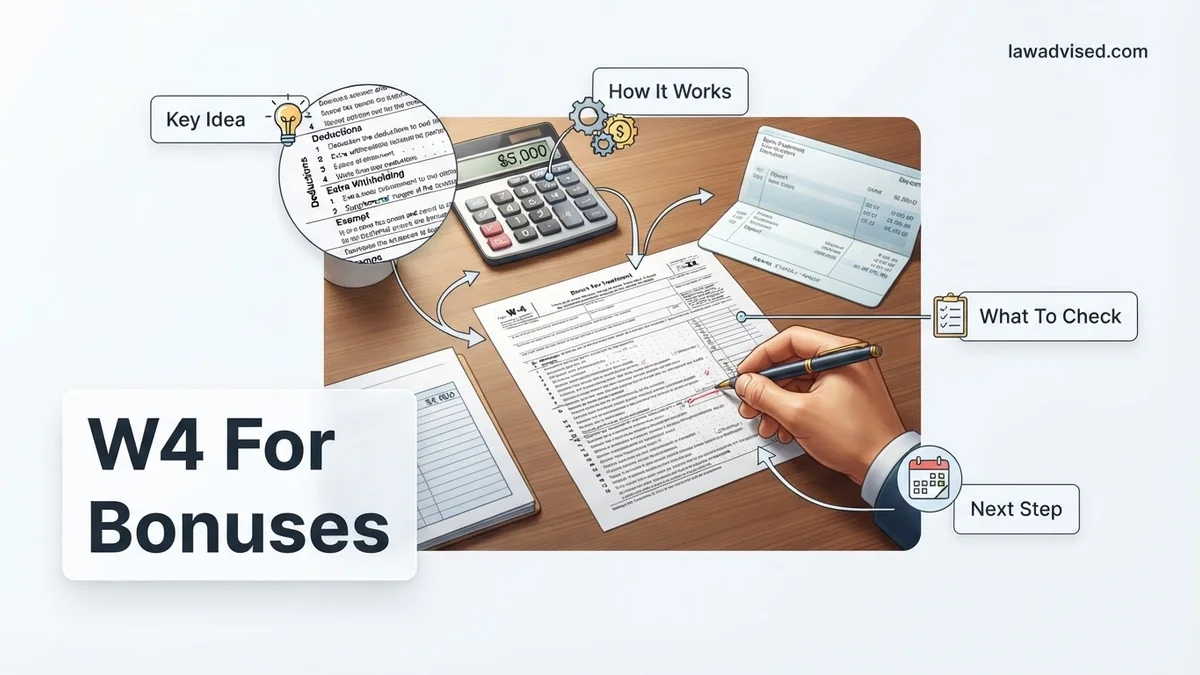
- Enter the specific extra withholding dollar amount directly into Step 4(a) or Step 4(c) of the Form W-4 to ensure your employer withholds correctly.
- Submit the completed form digitally to your human resources or payroll department at least two to three weeks before your bonus payout date.
Payroll departments generally need 14 to 30 days to process W-4 updates. Submitting your paperwork early ensures the supplementary flat rate override or aggregate method adjustment applies accurately to your upcoming bonus.
What to Do If Your Bonus Causes a Massive Tax Bill
Discovering a large tax liability during the tax season despite receiving a bonus can disrupt your financial planning. Financial advisors note that failing to account for high-bracket bonuses often triggers underpayment penalties from the IRS.
Immediate Recovery Steps
- File your annual tax return immediately, and pay any remaining balance due to the IRS to halt the accumulation of failure-to-pay penalties and daily compounding interest.
- Submit a revised Form W-4 to your employer for the current 2026 tax year immediately, significantly increasing the extra withholding amount per pay period to cover future shortfalls.
- Make quarterly estimated tax payments directly to the IRS using Form 1040-ES if your employer cannot withhold enough from your standard wages to offset the bonus liability.
- Consult a certified public accountant or a qualified tax professional to evaluate your liability and determine if you qualify for a first-time penalty abatement waiver.
Working with a licensed tax professional typically costs between $200 and $600 for standard individual advisory services, depending on your geographical location and the complexity of your financial portfolio.
Conclusion
Receiving a large bonus can easily create an unexpected tax shortfall if your employer relies solely on the standard 22 percent supplemental withholding rate. Updating your Form W-4 proactively allows you to bridge the gap between flat-rate withholdings and your actual marginal tax bracket. According to verified research and expert sources from the American Institute of CPAs, reviewing your withholding twice a year eliminates surprise tax bills. Take action today by logging into your employer payroll portal and submitting an updated W-4 to secure your financial future.
❓ Frequently Asked Questions
Why did my employer withhold only 22% on my bonus when I am in the 24% tax bracket?
The IRS mandates a flat 22% supplemental withholding rate for bonuses under $1 million. If your personal tax bracket is higher, that 2% difference means you are under-withheld on that income and may owe money at tax time.
How can I calculate how much extra to withhold on my W-4 for a bonus?
Take your bonus amount, multiply it by the difference between your actual marginal tax bracket and the 22% flat rate, and divide that total by the number of paychecks remaining in the year to determine your per-pay-period adjustment.
Does the aggregate bonus withholding method always result in more tax taken out?
Yes, because the payroll system artificially inflates your regular income for that pay period, pushing that combined paycheck into a higher marginal bracket for that single calculation, which often results in heavy withholding.
Can I submit a temporary W-4 just for my bonus payout?
While you can submit a new W-4 right before a bonus is processed, payroll departments typically apply whatever W-4 is active at the exact time the bonus payroll runs. Many employees forget to change it back afterward, affecting regular paychecks.
What happens if my bonus pushes my total annual income over $1 million?
Any portion of supplemental wages exceeding $1 million in a calendar year is automatically subject to a mandatory flat federal income tax withholding rate of 37%.
Do state income taxes use a flat rate for bonuses too?
It varies completely by state. Some states enforce a flat supplemental tax rate for bonuses, while others require employers to blend the bonus into your regular state income tax calculation using the aggregate method.

Ismail Hossain is the founder of Law Advised. He is an Divorce, Separation, marriage lawyer. Follow him.