Types of 1099 Forms Explained 2026 Expert Guide
Navigating tax season requires knowing which 1099 tax forms apply to your specific income or payouts. This guide breaks down the most common 1099 variants, their specific thresholds, and how to tell them apart so you can file accurately.
The 1099 form family includes dozens of information returns used to report non-employment income to the IRS. For the 2026 tax year, knowing which specific variant applies to your business payments or investments prevents costly IRS matching notices and processing delays.
If you hire independent contractors, earn freelance income, or manage investments, you will encounter multiple 1099 versions. Each form targets a specific type of financial transaction, carrying distinct reporting thresholds and filing deadlines that you must track carefully.
Key Takeaways
- Use Form 1099-NEC to report nonemployee compensation totaling $600 or more.
- Form 1099-MISC covers miscellaneous income like rent, prizes, and awards.
- Form 1099-K tracks payments processed via third-party networks and credit cards.
- Form 1099-INT and 1099-DIV report earnings from bank interest and stock dividends.
- Always verify payer requirements and filing deadlines early to avoid penalties.
What Causes Confusion Between Different Types of 1099 Forms
The primary source of confusion stems from how the IRS split contractor reporting from general miscellaneous payments a few years ago. Many businesses still lump all vendor payments into the wrong category, leading to rejection notices from tax authorities.
The Overlap Between NEC and MISC
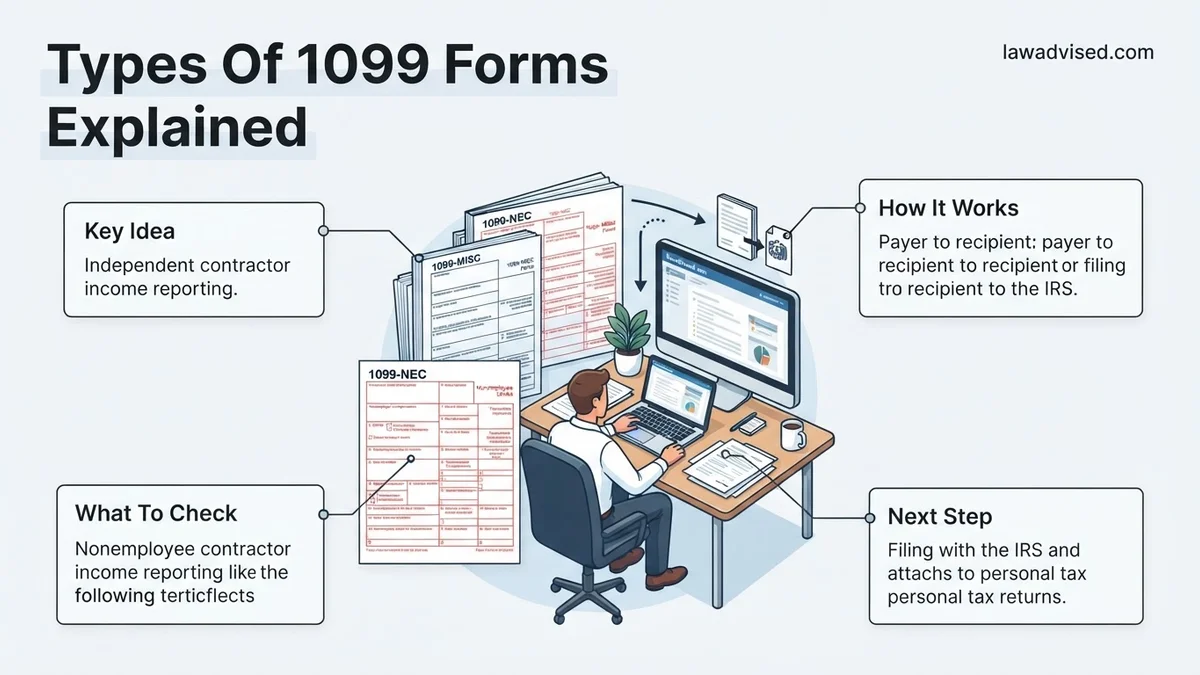
For decades, Form 1099-MISC handled almost every type of non-employee payment. The IRS reintroduced Form 1099-NEC specifically for nonemployee compensation, which completely shifted how you report freelance and contractor labor. If you pay someone for a service, it almost always belongs on the NEC. If you pay for rent or legal settlements, it belongs on the MISC. Mixing these up is the most frequent filing error.
Key factors that create reporting confusion include:
- Shifting thresholds for third-party payment platforms
- Distinguishing between payments for goods versus services
- Tracking multiple payment types issued to the exact same vendor
Misunderstanding Payment Thresholds
Another major trap involves miscalculating the minimum dollar amounts that trigger a reporting requirement. While the baseline threshold for many forms sits at $600, specific variants like 1099-DIV or 1099-INT have much lower triggers for certain types of distributions. Relying on a blanket $600 rule across all financial activities will leave you vulnerable to compliance penalties in 2026.
How to Identify and Distinguish the 5 Most Common 1099 Forms
Navigating the alphabet soup of information returns requires matching your specific financial transactions to the correct IRS document. Focusing on the top five variants covers the vast majority of tax reporting scenarios for individuals and small business owners.
Form 1099-NEC and 1099-MISC
Form 1099-NEC covers nonemployee compensation. You must file this if you paid an independent contractor, freelancer, or sole proprietor at least $600 for services during the 2026 tax year. Form 1099-MISC covers everything else that does not fit into compensation, such as rent, prizes, awards, or gross proceeds paid to an attorney.
Core rules for these two forms include:
- 1099-NEC Threshold: $600 or more in nonemployee compensation, due January 31, 2027.
- 1099-MISC Threshold: Generally $600 or more for rents and other income, due February 1 (or March 31 if filing electronically).
- Exemptions: Payments made to corporations generally do not require either form, except for legal services.
Form 1099-K, 1099-INT, and 1099-DIV
Form 1099-K tracks payments processed through third-party networks like online marketplaces and credit card processors. Forms 1099-INT and 1099-DIV report investment income, capturing interest earned from bank accounts and dividends paid out by stocks or mutual funds.
Quick breakdown of investment and platform forms:
- 1099-K: Issued by payment apps and processors when business transaction thresholds are met.
- 1099-INT: Required from banks or financial institutions if you earned $10 or more in taxable interest.
- 1099-DIV: Issued for capital gain distributions or dividend income totaling $10 or more.
How to Fix Mismatched 1099 Data and Handle IRS Discrepancies
Receiving a 1099 form with incorrect income figures or mismatched taxpayer data triggers an automated notice from the IRS, commonly known as a CP2000 letter. According to the IRS Data Book, millions of income matching discrepancies occur annually due to transposing digits or missing information.
Step-by-Step Correction Procedure
- Contact the issuing payer immediately to request a corrected 1099 form, ensuring they check the “Corrected” box at the top of the new document.
- Calculate the exact variance between your records, the original 1099, and any subsequent corrected versions to determine your true gross income for 2026.
- Attach Form 8484 or a detailed explanatory statement to your federal tax return if the corrected form arrives after filing, or file an amended return using Form 1040-X.
What If You Miss a Form Deadline or Receive an Incorrect 1099
Failing to receive an expected 1099 form or missing an issuing deadline complicates tax preparation for independent contractors and small business owners alike. Tax experts recommend proactive measures rather than waiting for tax authorities to flag the omission, as penalties for unfiled information returns scale quickly throughout 2026.
What If It Still Doesn’t Work?
- Estimate the missing income using your own bookkeeping software, bank statements, and invoices to file an accurate tax return on time, substituting the missing form with Form 4852.
- Send a formal certified written request to the non-responsive payer demanding the issuance of the required 1099-NEC or 1099-MISC.
- File a formal complaint with the IRS by calling their customer service line or submitting Form 3949-A for suspected tax fraud or persistent refusal to issue forms.
- Consult a certified public accountant (CPA) or a federally authorized tax practitioner to handle complex multi-payer discrepancies. Professional tax advisory services typically range from $200 to $500 per hour depending on complexity.
Conclusion
Navigating the complex landscape of 1099 forms requires rigorous record-keeping, strict adherence to shifting filing deadlines, and immediate correction of data mismatches. According to verified research and expert sources from the American Institute of CPAs (AICPA), proactive tax planning significantly reduces audit risks associated with independent contractor income. Your actionable next step for the 2026 tax season is to audit your current vendor payments and cross-reference all incoming contractor documents against your general ledger today.
❓ Frequently Asked Questions
How do I know if I need to issue a 1099-NEC or a 1099-MISC?
You issue a 1099-NEC for payments made to independent contractors or freelancers for services rendered in the course of your trade or business. You use a 1099-MISC for other types of payments, such as rent, medical payments, or legal settlements that do not fit the contractor compensation category.
What happens if a client fails to send me a 1099 form?
You are still legally required to report all of your independent contractor income on your tax return, even if you never receive a 1099 form. Use your own financial records, bank statements, and invoices to calculate your total gross earnings accurately.
What triggers a 1099-K form from online payment processors?
The reporting thresholds for third-party network transactions can vary based on IRS regulations and specific state rules. Generally, processors track business transactions to provide this form when payment volume crosses established annual limits.
Can an individual receive both a W-2 and a 1099 from the same company?
Generally, a company cannot treat the same worker as both an employee (W-2) and an independent contractor (1099) for the same duties simultaneously. However, if you performed completely distinct roles for the same organization, you might receive both.
What are the strict filing deadlines for sending 1099 forms to recipients?
Most 1099 forms, including the 1099-NEC, must typically be furnished to the recipient by January 31st of the following year. Deadlines for submitting the forms electronically or via paper to the IRS often fall around the same period or slightly later in February or March.
What should I do if the amount on my 1099 form is completely incorrect?
Contact the payer immediately and request a corrected 1099 form showing the accurate payment amount. If the issuer refuses or fails to correct the error in time, you can still file your taxes using your actual records and attach a detailed explanation if necessary.

Ismail Hossain is the founder of Law Advised. He is an Divorce, Separation, marriage lawyer. Follow him.