How to Pay Quarterly Taxes Step-by-Step 2026 Guide
Freelancers and self-employed individuals must pay estimated taxes four times a year to avoid costly IRS penalties. Learning how to pay quarterly taxes involves calculating your expected liability, knowing the strict deadlines, and using IRS-approved payment methods like IRS Direct Pay or EFTPS. Missing these payments can result in underpayment interest and unexpected tax bills.
If you earn income not subject to regular withholding—such as freelancing, small business profits, or rental income—you must pay quarterly estimated taxes to the IRS to avoid steep penalties. Paying these amounts four times a year keeps you compliant and prevents a massive, unexpected tax bill every April.
Navigating the quarterly tax system requires understanding who qualifies, how to calculate what you owe, and the exact digital or physical methods to submit your payments. This 2026 guide breaks down the process so you can handle your quarterly obligations efficiently.
Key Takeaways
- Pay estimated taxes if you expect to owe $1,000 or more in federal taxes.
- Use Form 1040-ES to calculate your quarterly payment amounts accurately.
- Submit payments online using IRS Direct Pay, EFTPS, or a credit card.
- Meet the strict due dates:April 15, June 15, September 15, and January 15.
- Use the safe harbor rule to avoid underpayment penalties based on prior year taxes.
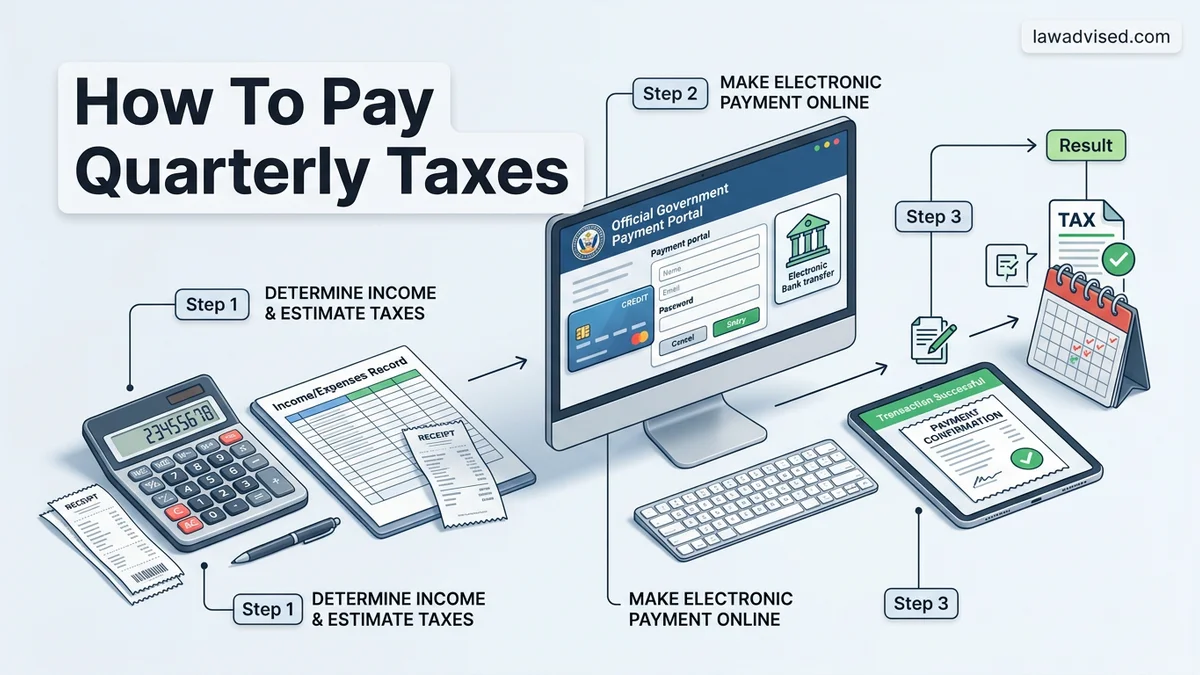
Who Needs to Pay Quarterly Estimated Taxes and Why Penalties Happen
The U.S. tax system operates on a pay-as-you-earn model. If you expect to owe at least $1,000 in taxes when you file your annual return, the IRS generally requires you to make quarterly estimated payments throughout 2026.
Freelancers, Sole Proprietors, and Investors
- Independent contractors, freelancers, and gig workers without W-2 withholding.
- Sole proprietors and single-member LLC owners receiving business profits.
- Partners in partnerships and S-corporation shareholders.
- Individuals with significant investment income, capital gains, or rental income.
The Safe Harbor Rule and Underpayment Penalties
Failing to pay enough tax throughout the year triggers an underpayment penalty. To completely avoid this penalty in 2026, your total quarterly payments and withholdings must meet one of the following safe harbor criteria:
- Pay at least 90 percent of the tax you owe for the 2026 tax year.
- Pay 100 percent of the total tax shown on your 2025 tax return (this jumps to 110 percent if your 2025 adjusted gross income exceeded $150,000).
Paying Quarterly Taxes Made Easy: Your Essential Action Plan
Navigating the world of self-employment or business ownership comes with many perks, but it also introduces the responsibility of paying your own income and self-employment taxes throughout the year. If you wait until April to settle your tax bill, you risk facing hefty penalties and interest charges from the IRS and your state government. This comprehensive guide walks you through the exact process of calculating, scheduling, and submitting your quarterly estimated taxes accurately, ensuring you stay compliant and avoid unpleasant financial surprises.
Step 1: Determine If You Need to Pay Quarterly Taxes
What you need: Your previous year’s tax return, current income records, and IRS Form 1040-ES.
Instructions: Generally, if you expect to owe at least $1,000 in tax after subtracting your withholding and refundable credits, you must make estimated tax payments. This requirement applies to freelancers, independent contractors, sole proprietors, partners, and S-corporation shareholders. If you also have a traditional W-2 job, you can sometimes avoid quarterly payments by asking your employer to withhold extra taxes from your paycheck. Review your financial situation from the previous tax year to establish a baseline expectation for the current year’s earnings.
Pro Tip: Don’t guess your income status. If your freelance income fluctuates wildly, re-evaluate your potential tax liability at the end of every single month.
Step 2: Gather Your Financial Records
What you need: Profit and loss statements, business bank account statements, and expense receipts.
Instructions: Before you can calculate what you owe, you need a crystal-clear picture of your gross income and deductible business expenses for the quarter. Tally up all income received from clients, side hustles, and sales. Next, subtract all legitimate and ordinary business expenses, such as software subscriptions, home office deductions, supplies, and professional fees. Having these numbers organized will prevent you from underreporting your income or missing out on valuable deductions that lower your tax burden.
Pro Tip: Use dedicated accounting software or digital spreadsheets to categorize your business expenses weekly so you aren’t scrambling at the tax deadline.
Step 3: Calculate Your Expected Annual Income and Deductions
What you need: A calculator, estimated tax worksheet (found in IRS Form 1040-ES), and your Q1/Q2 financial totals.
Instructions: Estimate your total adjusted gross income, taxable income, taxes, and credits for the current year. The easiest and safest method for most people is the “safe harbor” rule: calculate what you need to pay based on either 100% of your prior year’s total tax liability (110% if your adjusted gross income exceeds $150,000) or 90% of your current year’s tax liability. Using the prior year’s liability as your benchmark is usually the safest way to avoid underpayment penalties, especially if your income is unpredictable.
Pro Tip: Always lean on the safe harbor rule using last year’s tax return if your current year business growth is experiencing massive, unpredictable spikes.
Step 4: Compute Your Quarterly Payment Amount
What you need: Your calculated annual tax liability and IRS Form 1040-ES instructions.
Instructions: Take your total estimated annual tax liability and divide it by four. This gives you the baseline amount you need to pay each quarter. Remember that self-employment tax (covering Social Security and Medicare) is roughly 15.3% of your net self-employment earnings, in addition to federal and state income taxes. Ensure you account for both federal and, if applicable, state and local estimated taxes, as most states require their own separate quarterly filings and payments.
Pro Tip: Separate 25% to 30% of every client payment the moment it hits your account and transfer it straight into a dedicated high-yield business tax savings account.
Step 5: Mark Your Calendar with IRS Due Dates
What you need: A digital or physical calendar with reminder notifications set.
Instructions: Unlike the standard April 15 deadline, quarterly taxes operate on a slightly unconventional schedule. The four payment periods and their respective due dates are: Q1 (January 1 through March 31) due April 15; Q2 (April 1 through May 31) due June 15; Q3 (June 1 through August 31) due September 15; and Q4 (September 1 through December 31) due January 15 of the following year. If any of these dates fall on a weekend or a legal holiday, the deadline shifts to the next business day.
Pro Tip: Set calendar alerts for two weeks prior to each due date so you have ample time to review your accounts and transfer funds.
Step 6: Submit Your Federal and State Payments Online
What you need: IRS Direct Pay account (or EFTPS), state tax agency login credentials, and your bank routing and account numbers.
Instructions: Head to the official IRS website and use IRS Direct Pay—it is free, secure, and provides instant confirmation numbers. Select “Estimated Tax” (Form 1040-ES) as the reason for the payment and apply it to the correct tax year. Do not forget to repeat a similar process on your state’s department of revenue website if your state collects income tax. Keep digital copies or screenshots of every single payment confirmation number for your permanent financial records.
Pro Tip: Never mail paper checks unless absolutely necessary; electronic payments process instantly, eliminating the risk of lost mail and postal delays.
Step 7: Keep Meticulous Records and Re-evaluate
What you need: A digital tax folder, receipt scanner, and bookkeeping software.
Instructions: File your payment confirmation receipts alongside your quarterly profit and loss statements. As the year progresses, continuously monitor your actual income against your initial estimates. If your business booms and you earn significantly more than expected, you should increase your subsequent quarterly payments to avoid a massive tax bill next April. Conversely, if your income drops drastically, you can lower your remaining payments to avoid overpaying and giving the government an interest-free loan.
Pro Tip: Create a dedicated cloud folder named with the current tax year to store all quarterly confirmations in one easily accessible location.
✅ Final Checklist
- Verified whether you meet the $1,000 liability threshold for estimated taxes
- Calculated your payments accurately using the safe harbor rule or current projections
- Marked all four IRS and state quarterly deadlines in your active calendar
- Submitted payments electronically through IRS Direct Pay and state portals
- Saved digital confirmation numbers and payment receipts in a secure folder
Important Notes:
- Missing a deadline or underpaying can result in IRS penalties and compounded interest charges.
- Seek help from a Certified Public Accountant (CPA) or Enrolled Agent if you have complex multi-state income or business structures.
- Estimated time: 1 to 2 hours per quarter. Cost: Free when using IRS Direct Pay (avoid third-party processing fee services).
How to Calculate Your Quarterly Tax Payment Amount Using Form 1040-ES
Calculating your quarterly tax obligation means estimating your adjusted gross income, taxable income, taxes, deductions, and credits for 2026. IRS Form 1040-ES provides the exact worksheets needed to determine these numbers.
Step-by-Step Worksheet Usage
- Estimate your total expected gross income for 2026 from all self-employment, business, and investment sources.
- Subtract your expected business expenses to find your net self-employment income.
- Calculate your estimated self-employment tax (Social Security and Medicare), which is roughly 15.3 percent on 92.35 percent of your net earnings.
- Factor in your standard deduction or itemized deductions, plus any available tax credits, to determine your total estimated income tax.
Practical Calculation Example
Imagine your freelance business generates $80,000 in net profit for 2026. Your self-employment tax will be approximately $11,300. After accounting for the deduction for half of your self-employment tax, your income tax bracket yields roughly $9,000 in income tax. Your total annual tax liability is $20,300. Divide that total by four, and your required quarterly estimated tax payment is $5,075.
Step-by-Step Instructions on How to Pay Quarterly Taxes Online or by Mail
Executing your quarterly tax payment accurately prevents costly failure-to-pay penalties from the IRS. Modern systems offer multiple secure methods to submit your funds before the 2026 deadlines.
Paying Electronically via IRS Direct Pay
- Navigate to the official IRS Direct Pay website using a secure browser.
- Select “Make a Payment” and choose your reason for payment, such as “Estimated Tax” (Form 1040-ES).
- Verify your identity by entering information from a previously filed tax return.
- Input your banking routing and account numbers to initiate a direct withdrawal.
- Review your transaction details and save the confirmation number for your 2026 financial records.
Paying by Mail with Form 1040-ES
- Download and print the official IRS Form 1040-ES payment voucher for the 2026 tax year.
- Fill out the voucher cleanly with your current name, address, and Social Security Number.
- Write a check or money order payable to the “United States Treasury.”
- Note your Social Security Number, the tax year 2026, and “Form 1040-ES” in the memo line.
- Mail the voucher and payment to the specific IRS address listed in the instructions for your state of residence.
What to Do If Your Income Drops or You Miss a Quarterly Tax Deadline
Freelance and self-employed income fluctuates unpredictably throughout the year. If your revenue drops mid-year, you do not need to overpay your subsequent estimates. Recalculate your projected annual income using an updated 2026 profit-and-loss statement and adjust your remaining quarterly payments downward accordingly.
If you miss a quarterly deadline, submit your payment as soon as possible to minimize compounding interest and penalties. The IRS calculates late payment penalties from the original due date until the date the balance is fully satisfied. Ignoring the missed payment only increases your final tax liability.
What If It Still Doesn’t Work?
If electronic payment systems repeatedly reject your transactions or technical glitches persist, utilize these reliable fallback measures:
- Verify your bank account details and routing numbers carefully against your physical checks to prevent ACH return errors.
- Switch to the Electronic Federal Tax Payment System (EFTPS), though note that first-time users require a few days for postal enrollment verification.
- Utilize an approved IRS third-party credit card processor, keeping in mind that these processors typically charge a convenience fee ranging from 1.8% to 2% of the payment total.
- Consult a certified public accountant (CPA) or licensed enrolled agent to handle complex payment discrepancies, with professional consultation fees generally ranging from $150 to $400 per hour.
Conclusion
Navigating quarterly estimated taxes requires strict adherence to IRS deadlines and accurate income projections to avoid unexpected penalties in 2026. According to verified research from the National Association of Tax Professionals, proactive mid-year adjustments significantly reduce the risk of underpayment assessments. Your immediate next step is to review your current quarterly earnings and schedule your upcoming payment through the official IRS portal today.
❓ Frequently Asked Questions
How do I use IRS Direct Pay to submit my quarterly estimated tax?
Go to the official IRS website, select IRS Direct Pay, and choose ‘Estimated Tax (Form 1040-ES)’ as the reason for payment. Enter your tax year, verify your identity using a prior-year tax return, and authorize the withdrawal from your bank account.
Can I pay my quarterly taxes with a credit card?
Yes, you can pay using a credit or debit card through one of the IRS-approved payment processors. Keep in mind that these third-party processors charge a processing fee, usually around 1.85% to 1.98% for credit cards.
What is the safe harbor rule for quarterly taxes?
The safe harbor rule protects you from underpayment penalties if you pay at least 90% of your current year’s tax liability or 100% of your previous year’s tax liability (110% if your adjusted gross income exceeds $150,000).
What if my income fluctuates throughout the year?
If your income varies significantly by quarter, you can use the annualized income installment method. This allows you to calculate and pay your estimated taxes based on the actual income you earned during each specific period.
Do I need to submit a voucher if I pay online?
No, if you pay online using IRS Direct Pay, EFTPS, or a credit card, you do not need to mail Form 1040-ES payment vouchers. The electronic transaction automatically links the payment to your Social Security number.
How do I mail my quarterly tax payment if I prefer paper checks?
Fill out the 1040-ES payment voucher for the specific quarter, write your Social Security number and ‘2026 Form 1040-ES’ on the memo line of your check, and mail it to the address listed in the instructions for your state.

Ismail Hossain is the founder of Law Advised. He is an Divorce, Separation, marriage lawyer. Follow him.