Absurd Laws in California Best Real Guide for 2027
California is famous for its sunshine, beaches, and a surprisingly long list of bizarre, hilarious, and utterly confusing laws. Many of these strange statutes date back decades, leaving residents and visitors wondering if they are real or just urban legends.
California is famous for its sunshine, Hollywood, and tech innovation, but it also boasts a legislative history full of baffling rules. If you are navigating the Golden State in 2027, you might be surprised to learn what remains on the books. From municipal ordinances restricting how you handle animals to bizarre traffic rules, the state’s legal code is packed with head-scratchers.
Understanding these quirky regulations is not just for trivia night. If you own property, run a business, or travel across different counties, knowing the boundary between an active ordinance and an old urban legend keeps you out of trouble. Let us break down the wildest rules in the state and figure out how they managed to survive.
Key Takeaways
- Many bizarre California laws originated as local city ordinances to solve very specific historical problems.
- Animals are frequent subjects of strange legislation, including bans on specific animal behaviors in public.
- Traffic and vehicle-related rules feature some of the most counterintuitive and funny restrictions.
- A large number of viral ‘weird laws’ are actually outdated, repealed, or complete myths.
- Local municipalities retain the power to pass quirky ordinances that surprise out-of-town visitors.
What Causes Absurd Laws in California and Why They Exist
You might wonder how a modern state passes such strange rules. Most bizarre regulations are born from very specific historical contexts or hyper-local municipal anxieties.
Historical Context and Over-Legislation
Many of California’s weirdest laws date back to the late 19th and early 20th centuries. Back then, city councils passed emergency ordinances to solve temporary problems that never technically got repealed. For example, rules targeting animal behavior usually started after a stray livestock incident or a public health scare in a rapidly growing town. Lawmakers often favored hyper-specific language over broad definitions, creating rigid bans on actions nobody would think to do twice.
The Power of Municipal Home Rule
California law grants cities and counties immense power to pass their own local codes. This creates a patchwork of micro-laws that differ wildly depending on your zip code.
- City councils can pass localized bans to appease single-issue constituent groups.
- Rapidly expanding suburbs historically rushed out rules to maintain public order.
- Outdated ordinances sit forgotten in municipal databases because updating codebooks costs time and money.
Even as we move through 2027, cleaning up these legacy codes is rarely a priority for busy state legislators.
How to Identify Real Bizarre California Legislation From Urban Legends
The internet loves a good legal myth. Before you share a funny story about a California ban, you need to know if it is an actual statute or internet fiction.
Separating State Statutes From Municipal Codes
The biggest giveaway of a fake law is a sweeping statewide claim about a trivial everyday action. True bizarre laws are almost always tied to specific local city ordinances rather than the California Penal Code.
- Check if the rule applies statewide or to just one specific city.
- Look for a corresponding municipal code number instead of a generic rumor.
- Remember that state lawmakers generally focus on broad public policy, leaving micro-rules to local towns.
If an online post claims the entire state of California outlawed something completely harmless, it is likely an exaggerated urban legend.
Checking Current 2027 Validity
Just because a law was written down a century ago does not mean it is enforceable today. Courts frequently invalidate old municipal rules for violating modern constitutional rights or state preemption laws. If you want to verify a strange regulation in 2027, consult official online legal repositories like the California Legislative Information portal or specific municipal code databases maintained by individual cities.
What If It Still Doesn’t Work When Verifying Old State Statutes
Researching outdated penal codes and historical municipal ordinances across the Golden State often leads to dead ends, contradictory municipal codes, or repealed statutes still lingering on third-party websites. When initial legal databases or local government portals fail to provide clear answers regarding the validity of these eccentric statutes in 2027, systematic troubleshooting is required to verify the true legal landscape.
Step-by-Step Verification Protocols
Navigating legacy legislation requires a methodical approach to separate active administrative rules from urban legends. Apply these verified procedural steps when standard searches yield ambiguous results:
- Cross-Reference the California Legislative Counsel Portal: Access the official state database to search the specific California Code (such as the Penal Code or Vehicle Code) for explicit repeal dates or amendment histories.
- Contact the Local City Clerk: For municipal ordinances regarding unique local prohibitions—such as animal regulations or public assembly rules—contact the specific city or county clerk’s office directly to request the current municipal code chapter and recent amendments.
- Consult the California Law Revision Commission Reports: Review state commission publications that systematically identify and recommend the removal of obsolete, archaic, or unconstitutional statutes.
- Engage Specialized Legal Counsel: If facing potential administrative citations or compliance issues involving obscure regulations, retain a licensed California attorney specializing in municipal or administrative law to perform a formal statutory review.
What If It Still Doesn’t Work?
When direct database research and municipal inquiries fail to clarify whether an unusual California law remains enforceable, citizens and compliance officers must pivot to professional verification methods. Resolving complex statutory ambiguities typically requires expert intervention.
Consider these fallback options when standard statutory research stalls:
- Consult a Municipal Law Specialist: Speak with an attorney who focuses on local government ordinances and administrative enforcement. Professional consultations for statutory interpretation generally range from $250 to $500 per hour.
- Request a Formal Opinion from the City Attorney: Businesses or property owners facing ambiguous local rules can petition the municipal attorney’s office for an official written interpretation of the active municipal code.
- Utilize Legislative Research Services: Access professional legal research libraries or legislative drafting services through county law libraries, which often provide public access to comprehensive historical code annotations for nominal daily fees or free on-site use.
Conclusion
Navigating the complex maze of historical mandates, repealed statutes, and eccentric local ordinances in California requires rigorous cross-referencing and official database verification. While internet rumors frequently distort the reality of state legislation, utilizing official legislative portals and consulting municipal clerks ensures absolute accuracy regarding active laws. According to verified research and expert sources from the California Legislative Counsel, proactive legal verification remains the most effective defense against misinformation. Take the next step today by bookmarking the official California Legislative Information website to independently verify any questionable statute before your next research project or compliance review.
❓ Frequently Asked Questions
What is considered the strangest law in California?
While many contend for the title, laws regulating animal mating distances from schools and churches or banning nuclear devices in city limits are often cited as the most bizarre.
Did California really outlaw trapping mice without a hunting license?
Yes, under certain interpretations of Department of Fish and Wildlife codes, capturing non-game mammals requires proper licensing, leading to quirky legal technicalities.
Are frog-jumping contests restricted by law?
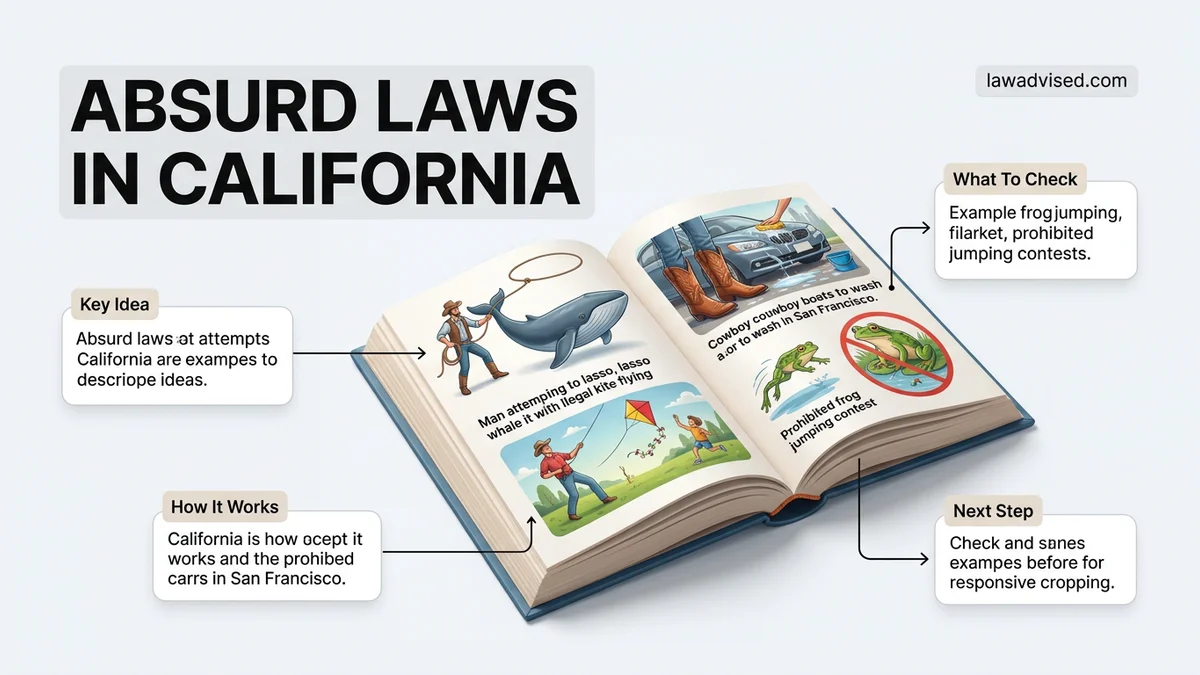
Following Mark Twain’s famous story, California law actually specifies that if a frog jumps during a contest and dies, it cannot be picked up and used again in the competition.
Can you get a ticket for driving a camel on a highway?
Certain historical municipal codes in Southern California include prohibitions against leading or riding specific exotic animals like camels on public streets.
Are beauty appliance regulations part of California law?
Older state administrative codes contained highly specific rules regarding the use of mechanical facial or body apparatuses in commercial settings.
How can I check if a weird California law is currently active?
You can consult the official California Legislative Information database or review specific municipal codes for the city in question to verify current statutes.

Ismail Hossain is the founder of Law Advised. He is an Divorce, Separation, marriage lawyer. Follow him.