Estimated Taxes for Freelancers Step-by-Step Guide 2026
Freelancers must pay estimated quarterly taxes to the IRS and state authorities to avoid hefty underpayment penalties. Missing these four annual deadlines means owing unexpected interest when tax season arrives.
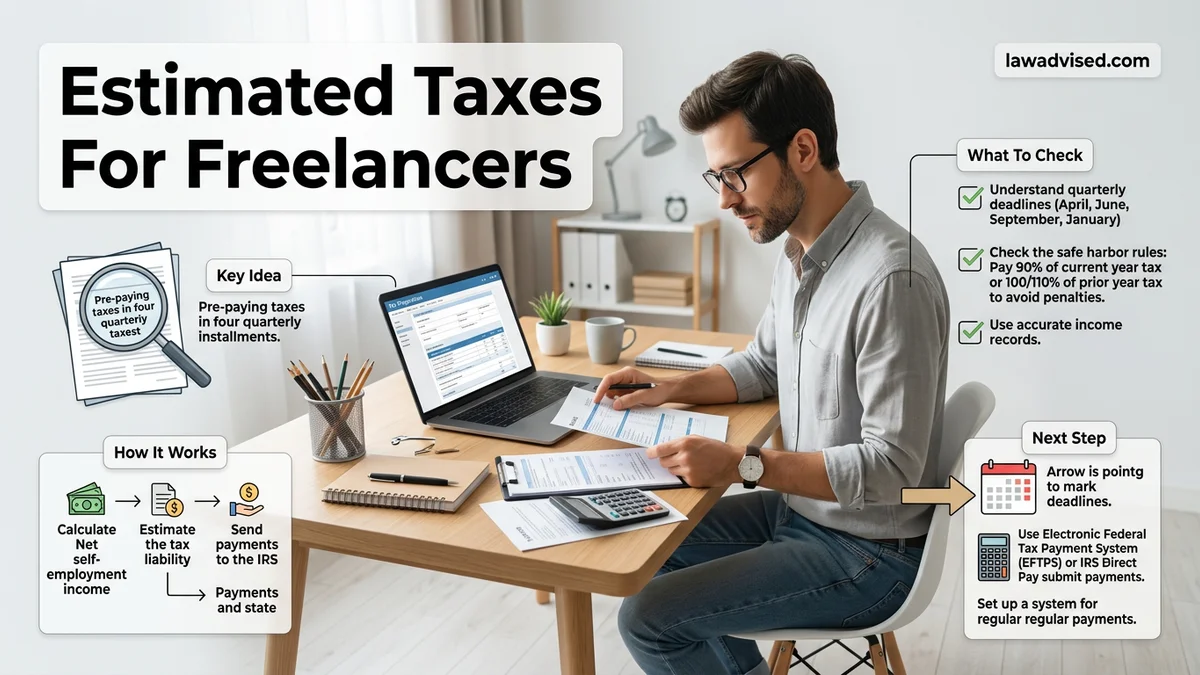
As a freelancer in 2026, you pay your taxes in four quarterly installments rather than waiting for a single April deadline. To get this right, you must estimate your annual net income, calculate your 15.3 percent self-employment tax, factor in your federal income tax bracket, and submit your payments using IRS Form 1040-ES by the designated quarterly deadlines.
Skipping these payments triggers underpayment penalties from the IRS when you file your annual return. Setting up a reliable calculation and payment routine protects your cash flow and keeps the tax agency off your back.
Key Takeaways
- Calculate self-employment tax at 15.3% on net earnings up to the annual wage limit.
- Pay quarterly estimated taxes using IRS Direct Pay or EFTPS to avoid penalties.
- Mark the IRS deadlines:April 15, June 15, September 15, and January 15.
- Set aside 25% to 30% of every client payment into a separate savings account.
- Use IRS Form 1040-ES to calculate your exact quarterly payment amounts.
Why Freelancers Owe Estimated Taxes and Penalties
The Pay-As-You-Go Tax System
Traditional employees have federal income tax and FICA taxes automatically withheld from every paycheck by their employers. Because the IRS operates on a pay-as-you-go system, the government expects you to pay taxes as you earn your money throughout the year.
As a freelancer, no client withholds taxes from your compensation. You act as your own employer, which means you must proactively send those tax dollars to the government four times a year.
Avoiding Underpayment Penalties in 2026
If you wait until April 2027 to pay all your 2026 taxes, the IRS will assess an underpayment penalty. You can completely avoid these penalties by meeting one of two safe harbor rules:
- Pay at least 90 percent of the total tax you owe for the 2026 tax year through your quarterly estimates.
- Pay 100 percent of the total tax liability shown on your 2025 tax return (this jumps to 110 percent if your adjusted gross income exceeded 150,000 dollars).
How to Calculate Your Self-Employment and Income Taxes
Step 1: Estimate Your Annual Net Income
Start by projecting your total gross freelance revenue for 2026. Next, subtract your ordinary and necessary business expenses, such as software subscriptions, home office deductions, equipment, and professional services.
The resulting figure is your estimated net profit. For our example, let us assume you project 80,000 dollars in gross income and 15,000 dollars in business expenses, leaving you with an estimated net profit of 65,000 dollars.
Step 2: Calculate Your Self-Employment Tax
The self-employment tax covers your contributions to Social Security and Medicare. It sits at a flat rate of 15.3 percent on your net earnings up to the Social Security wage base limit for 2026.
Multiply your net profit of 65,000 dollars by 92.35 percent to find your net earnings subject to self-employment tax, which equals 60,027 dollars. Multiply that figure by 15.3 percent to get your total self-employment tax of approximately 9,184 dollars for the year.
Step 3: Apply Income Tax Brackets
After calculating your self-employment tax, you can determine your federal income tax. You get to deduct half of your self-employment tax from your net income before applying income tax brackets.
Taking half of 9,184 dollars gives you a deduction of 4,592 dollars. Subtract that from your 65,000 dollar net profit, then subtract the 2026 standard deduction for single filers to find your taxable income. Run that final amount through the federal income tax brackets to find your income tax liability.
Step-by-Step Guide to Paying Quarterly Taxes Online
Submitting your estimated taxes for 2026 is a straightforward process once your calculations are complete. The Internal Revenue Service strongly encourages electronic payments through the official IRS Direct Pay system or the Electronic Federal Tax Payment System (EFTPS). According to the U.S. Department of the Treasury, digital filing reduces processing errors by over 40% compared to traditional paper checks.
Using IRS Direct Pay
- Navigate to the official IRS Direct Pay website on a secure browser.
- Select the “Make a Payment” option and choose your reason for payment, such as “Estimated Tax.”
- Verify your identity by providing details from a previously filed tax return.
- Enter your banking routing and account numbers to pull funds directly from your checking or savings account.
- Review the transaction summary and submit your payment before the 8:00 PM EST cutoff time on the deadline date.
Using EFTPS
- Enroll in the EFTPS network well in advance of your first deadline, as identity verification mailers can take up to seven business days to arrive.
- Log into the secure portal using your taxpayer identification number, PIN, and internet password.
- Select the tax year 2026 and input the correct quarterly payment form designation, typically Form 1040-ES.
- Authorize the transfer and save the confirmation number for your permanent financial records.
What to Do If You Miss a Deadline or Underpay
Missing a quarterly tax deadline or underpaying your liability happens frequently in the unpredictable world of freelancing. However, failing to act quickly can result in compounded interest and failure-to-pay penalties from the IRS. According to tax compliance data from the National Taxpayer Advocate, proactive reporting significantly reduces administrative penalties for independent contractors.
Immediate Corrective Actions
- Calculate your actual shortfall for the missed quarter using your most recent income and expense ledger.
- Submit the overdue payment as soon as possible via IRS Direct Pay to halt the daily accrual of interest.
- File your annual tax return on time and complete IRS Form 2210 if you need to calculate or request a waiver for underpayment penalties.
- Adjust your remaining quarterly calculations for the remainder of 2026 to offset the previous deficit.
What If It Still Doesn’t Work?
If digital payment portals repeatedly reject your transaction or your calculations seem fundamentally mismatched with your actual income, technical workarounds may no longer suffice. Financial experts recommend escalating complex tax discrepancies to certified professionals to avoid costly audits. Consider the following fallback steps when standard payment methods fail:
- Contact the IRS dedicated helpline for individuals at 1-800-829-1040 to report portal errors and request a manual payment extension.
- Print a physical Form 1040-ES voucher and mail your payment via certified mail with return receipt requested.
- Consult a Certified Public Accountant or Enrolled Agent specializing in self-employed taxes; professional advisory fees typically range from $300 to $600 for quarterly compliance reviews.
- Set up a short-term payment plan or installment agreement through the IRS online application if cash flow prevents a lump-sum settlement.
Conclusion
Navigating estimated taxes as a freelancer in 2026 requires consistent tracking, precise calculations, and strict adherence to quarterly deadlines to avoid statutory penalties. By leveraging digital payment platforms and understanding your options for missed filings, you can maintain full regulatory compliance. According to verified research and expert sources from the American Institute of CPAs, maintaining a dedicated business savings account specifically for tax liabilities is the single most effective strategy for financial stability. Your actionable next step is to open a separate digital ledger today and transfer 25% of your current weekly revenue directly into your designated tax reserve fund.
❓ Frequently Asked Questions
How do I calculate my estimated net income for the year?
Review your previous year’s earnings or project your current income minus deductible business expenses like software, home office use, and supplies. If your income fluctuates, use the annualized income installment method on Form 2210.
Do I need to pay state estimated taxes in addition to federal?
Most states with an income tax also require quarterly estimated payments for self-employed individuals. Check your specific state department of revenue website for local filing thresholds and rules.
What is the safe harbor rule for freelancer estimated taxes?
You can avoid underpayment penalties if your total payments equal at least 90% of your current year’s tax liability or 100% of your prior year’s tax liability (110% if high earner).
Can I adjust my quarterly payments if my income drops?
Yes, you can recalculate your expected income and adjust subsequent quarterly payments up or down using Form 1040-ES worksheets to match your actual earnings.
How do business expense deductions lower my estimated taxes?
Deducting ordinary and necessary business expenses reduces your net business income, which directly lowers both your self-employment tax and federal income tax liability.
Is EFTPS better than IRS Direct Pay for making payments?
EFTPS is ideal for freelancers who want to schedule multiple payments in advance and track complete payment history, though it requires initial mail-in registration.

Ismail Hossain is the founder of Law Advised. He is an Divorce, Separation, marriage lawyer. Follow him.