Gun Buying Laws in California 2027 Step-by-Step Guide
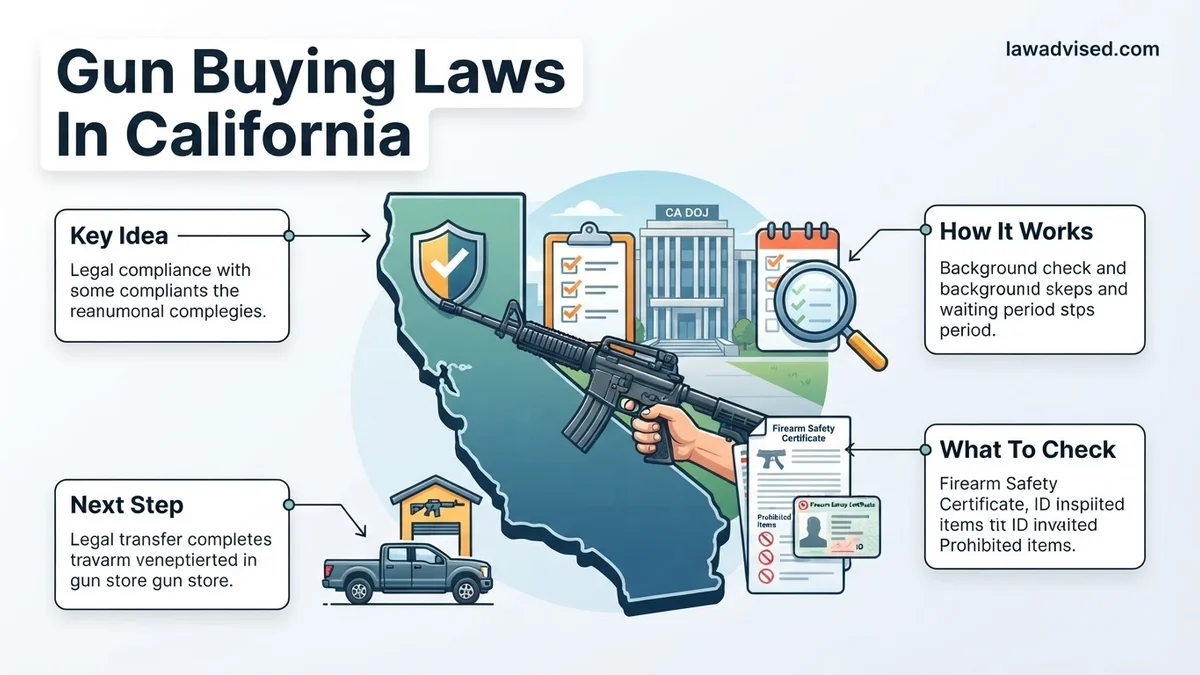
Navigating gun buying laws in California requires following a strict, multi-step legal process that includes obtaining a safety certificate, passing a background check, and observing a mandatory waiting period. Buyers must meet specific age and residency requirements while complying with state roster restrictions and magazine limits.
Purchasing a firearm in California requires navigating one of the strictest legal frameworks in the United States. To legally buy a gun in 2027, you must be at least 21 years old for all handguns and semi-automatic centerfire rifles, possess a valid Firearm Safety Certificate, pass a comprehensive background check through the Dealer Record of Sale system, and complete a mandatory 10-day waiting period.
Missing a single compliance step results in an immediate denial or a delayed transfer from your federally licensed firearms dealer. This guide breaks down the exact prerequisites, common compliance hurdles, and the chronological steps you must follow to successfully purchase a firearm in California without legal complications.
Key Takeaways
- Buyers must be at least 21 years old for all handguns and semi-automatic centerfire rifles.
- A valid Firearm Safety Certificate (FSC) is legally required prior to starting any purchase.
- All firearm transfers must go through a licensed California firearms dealer (FFL).
- The state enforces a mandatory 10-day waiting period starting from DROS submission.
- Proof of California residency and valid identity documents are strictly required.
What Causes Compliance Failures in California Firearm Purchases
Documentation and Identification Errors
The most common reason for an immediate background check delay or outright denial involves mismatched identification details. California requires your government-issued photo ID to match your current residential address exactly. If your California driver’s license displays an old address, you must provide supplemental government-issued documentation, such as a current vehicle registration or a property tax bill, to prove residency.
- Driver’s license or REAL ID with current residential address
- Secondary proof of residency if the ID lists an old address
- Valid Firearm Safety Certificate matching your legal name
Background Check and Eligibility Disqualifiers
California enforces a rigorous screening process through the Department of Justice. Beyond federal prohibitions, state laws restrict firearm ownership based on specific criminal histories, mental health adjudications, and active restraining orders. Even a minor clerical error on your Dealer Record of Sale application can trigger a flagged background check, extending your wait well beyond the statutory minimum.
How to Fix and Navigate the California Gun Buying Process Step-by-Step
Step 1: Obtain Your Firearm Safety Certificate
Before initiating any firearm transaction at a licensed gun store, you must hold a valid Firearm Safety Certificate. You earn this by passing a 30-question multiple-choice test administered by a DOJ-certified instructor at most local firearms dealerships. The test covers basic firearm safety, safe handling, and storage laws. The certificate costs twenty-five dollars and remains valid for five years across the state.
Step 2: Complete the DROS and Background Check
Once you select your firearm at the dealership, you will complete the Dealer Record of Sale process. The licensed dealer submits your fingerprints, personal information, and firearm serial number to the California Department of Justice. The state charges a state-mandated fee for this electronic background check, which cross-references state and federal databases to ensure you are not on the prohibited persons list.
Step 3: Wait Out the 10-Day Period and Take Delivery
California enforces a mandatory 10-day waiting period that begins the exact minute the dealer submits your completed Dealer Record of Sale paperwork. You must return to the same dealership to pick up your firearm once the 10 days elapse and the state issues an approval status. Keep in mind that you must take physical possession within 30 days of the initial submission, or the background check expires and you must restart the entire process.
What to Do If Your Background Check is Delayed or Denied
Navigating the California Department of Justice (CADOJ) background check system can occasionally result in a delay or denial, even for law-abiding purchasers. In 2027, the standard 10-day waiting period can be legally extended if the system requires further investigation into your records. Knowing the precise protocol for these situations ensures you can resolve discrepancies efficiently without forfeiting your purchase fees.
Handling a Background Check Delay
If your 10-day statutory waiting period lapses and the firearms dealer informs you that your status is undetermined or delayed, the dealer has the legal discretion to release the firearm or hold it. According to state guidelines and Second Amendment Foundation legal summaries, many corporate and independent FFLs choose to hold the firearm until an explicit approval is issued. If your check is delayed:
- Contact the firearms dealer to confirm the exact transaction status in the DES system.
- Check your California Firearms Application Reporting System (CFARS) account online to look for pending identity verification requests from the CADOJ.
- Ensure your physical identification documents match your state records precisely, including your current residential address.
Resolving an Outright Denial
An outright denial means the CADOJ has identified a prohibiting factor in your history, such as an out-of-state conviction, a mental health hold, or a clerical error in the state database. To address a denial:
- Request the official Notice of Firearms Prohibition or denial letter directly from the CADOJ Bureau of Firearms.
- Submit a Personal Firearms Eligibility Check (PFEC) application through CFARS to isolate the specific record causing the denial.
- File a formal Record Review application with the California Department of Justice to correct any erroneous criminal history data.
What If It Still Doesn’t Work?
If standard appeals or record corrections fail to resolve a wrongful denial or persistent system lockout under the 2027 framework, you must escalate the issue through formal legal channels. Resolving complex state-level bureaucratic errors often requires specialized intervention.
- Consult with a licensed California civil rights or firearms attorney to review your specific denial notice and evaluate potential writ of mandate options.
- Petition the superior court for a restoration of firearm rights if the denial stems from an old, eligible conviction or resolved non-violent offense.
- Utilize professional fingerprinting and live scan verification services to ensure your identity is not being incorrectly matched to another individual with a criminal record.
- Expect professional legal consultation fees for firearm eligibility restoration to range between $1,500 and $4,500 depending on court appearances and document complexity.
Conclusion
Securing a firearm in California requires strict adherence to multi-layered state regulations, from passing the FSC test to navigating the mandatory 10-day cooling-off period and electronic background checks. While delays and denials can disrupt the acquisition process, utilizing official state portals and maintaining accurate identification records provides a clear path to resolution. According to verified research and expert legal sources from the California Department of Justice, proactive compliance and immediate correction of clerical errors remain the most reliable methods for ensuring a successful purchase. Your next actionable step is to log into the California Firearms Application Reporting System (CFARS) to verify your current eligibility status before visiting a licensed dealer.
❓ Frequently Asked Questions
What documents do I need to prove residency when buying a firearm in California?
For handguns, you typically need a government-issued document like a utility bill or vehicle registration showing your current address. Long guns require a valid California ID, though secondary proof may be requested depending on the ID type.
How much does a Firearm Safety Certificate (FSC) cost and how long does it last?
The FSC test costs $25 and consists of 30 multiple-choice questions regarding firearm safety and laws. Once passed, the certificate is valid for five years from the date of issuance.
What happens during the DROS background check process?
The Dealer Record of Sale (DROS) submits your personal information and fingerprints to the California DOJ and FBI. They run your record against federal and state databases to ensure you are not a prohibited person.
Are private party transfers exempt from the 10-day waiting period?
No, private party transfers conducted through a licensed dealer are still subject to the 10-day waiting period and background check requirements.
What are the magazine capacity restrictions in California?
California strictly prohibits the manufacture, importation, sale, or transfer of any ammunition magazine capable of holding more than 10 rounds.
Can out-of-state residents purchase firearms in California?
Generally, non-residents cannot purchase firearms in California unless they meet very narrow military exceptions, as transactions require a valid California residential address and local ID.

Ismail Hossain is the founder of Law Advised. He is an Divorce, Separation, marriage lawyer. Follow him.