What Documents Are Needed for IRS Audit 2026 Expert Guide
Facing an IRS audit requires gathering specific financial substantiation to prove the claims made on your tax return. Knowing the exact documents needed prevents costly delays and protects you from additional tax assessments.
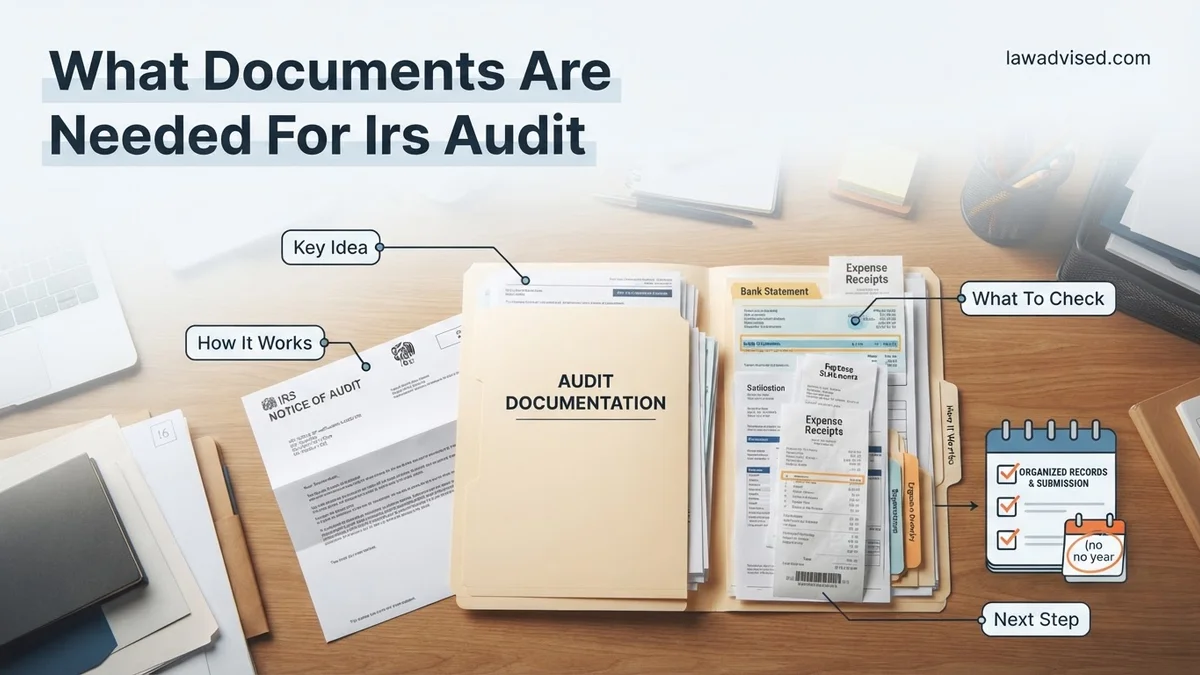
Receiving an IRS audit notice means you must immediately gather specific records to substantiate the income, deductions, and credits reported on your tax return. The exact documents required depend on the scope of the examination, but you will always need foundational financial proof like W-2s, 1099s, bank statements, and corresponding expense receipts.
Being organized in 2026 protects you from having the IRS disallow legitimate write-offs and assess heavy penalties. This guide details the exact paperwork and electronic records you need to assemble right now to successfully navigate your audit.
Key Takeaways
- Gather all W-2s, 1099s, and bank statements matching your reported income.
- Organize expense receipts, invoices, and cancelled checks by category.
- Ensure business logs meet strict IRS substantiation rules for travel and vehicles.
- Submit only requested documents and avoid volunteering extra tax year records.
- Keep digital copies of all submissions while retaining original physical paperwork.
What Causes IRS Audits and Triggers Document Requests
The IRS uses automated scoring systems and targeted initiatives to flag tax returns with statistical anomalies. Understanding what triggered your specific audit helps you focus your document-gathering efforts on the exact items the agent wants to review.
Common IRS Audit Triggers
- Income Discrepancies: Your tax return reports less income than the third-party documents (W-2s, 1099-NEC, 1099-K) sent directly to the IRS by your employers or payment processors.
- High Business Deductions: Claiming large business write-offs relative to your gross income, especially for vehicle expenses, travel, meals, and home offices.
- Unusually Large Charitable Donations: Deducting charitable contributions that significantly exceed the national average for your income bracket without attaching required appraisals.
Types of IRS Document Requests
Depending on the notification letter you received, the IRS will request records via mail or schedule an in-person meeting. A correspondence audit typically asks for specific line-item proofs, such as receipts for charitable giving or medical expenses. A field audit involves an IRS revenue agent visiting your home, business, or accountant’s office to examine comprehensive accounting records, corporate minutes, and bank deposits for an entire tax year.
How to Gather and Organize Your Income and Expense Records
When the IRS requests documentation, presentation matters. Handing over a shoebox of disorganized paper receipts wastes time and can frustrate the auditor. You need to present a clean, chronological paper trail that bridges your tax return figures to your primary source documents.
Income Verification Documents
Your primary objective is proving every dollar of income reported on your return, as well as accounting for any untracked cash or digital asset transactions. Gather the following items immediately:
- All Forms W-2, 1099-NEC, 1099-MISC, and 1099-K received for the tax year under audit.
- Personal and business bank statements for all months, highlighting deposits that match your gross receipts.
- Brokerage statements, Form 1099-B, and cryptocurrency transaction logs if you reported capital gains or losses.
- Ledgers, point-of-sale reports, or invoice logs if you operate a cash-based business.
Expense and Deduction Proofs
The burden of proof rests entirely on you to show that every deduction was ordinary, necessary, and directly related to your trade or business. For standard expense categories, assemble:
- Original vendor receipts, invoices, or canceled checks showing the exact date, amount, and business purpose of the expense.
- Credit card statements matching the expense line items claimed on Schedule C or your corporate tax return.
- Payroll records, Form 941 filings, and contractor onboarding documents if you deducted wages or labor costs.
Step-by-Step Guide to Proving Deductions and Red Flag Items
Proving deductions during a 2026 IRS audit requires matching every line item on your return with contemporaneous records. The IRS strictly scrutinizes high-value deductions like charitable contributions, home office expenses, and business travel. According to tax compliance experts, unsupported deductions are disallowed immediately during the initial review phase.
How to Validate Specific Audit Triggers
- Gather receipt trails: Match bank statements and credit card slips directly to the specific expense line items reported on your 2026 tax forms.
- Reconstruct mileage logs: For vehicle deductions, compile a contemporaneous log showing dates, destinations, business purposes, and total mileage driven.
- Confirm donation compliance: For charitable gifts over $250, retrieve bank records alongside written acknowledgments from the qualified organization specifying the exact date and value.
- Verify home office metrics: Calculate the exact square footage of your dedicated workspace versus the total home area to substantiate utility and rent deductions.
- Submit contractor documentation: Present signed 1099 forms, contracts, and proof of payment for any independent contractor expenses claimed on Schedule C.
What to Do If You Are Missing Critical Tax Documents
Discovering that a vital tax document is missing can trigger unnecessary anxiety during a 2026 IRS audit. Fortunately, the IRS does not require original documents if reliable secondary evidence is available. Tax professionals emphasize that reconstructing records proactively prevents the agency from assessing devastating tax deficiencies and penalties.
Steps to Reconstruct Missing Records
- Download IRS transcripts: Access your official wage, income, and tax return transcripts directly through your online IRS account to verify reported figures.
- Contact third-party issuers: Request replacement W-2s, 1099s, mortgage interest statements, or bank records directly from the original issuing institutions or merchants.
- Utilize digital banking archives: Export PDF statements and transaction histories from online banking portals to prove business and personal cash flow.
- Obtain affidavits and statements: Secure signed statements from third parties, vendors, or clients to corroborate business transactions when direct receipts cannot be found.
What If It Still Doesn’t Work?
If self-reconstruction efforts fail or the IRS auditor rejects your secondary documentation, managing the audit independently becomes a high-risk financial gamble. When negotiations stall or the proposed tax adjustments threaten severe penalties, specialized representation is required.
- Retain a credentialed tax expert: Hire a Certified Public Accountant (CPA), Enrolled Agent (EA), or tax attorney who specializes in IRS audit representation.
- Understand professional fees: Anticipate professional service fees ranging from $2,500 to $7,500+ depending on the complexity of your return and audit scope.
- Request an Appeals Conference: File a formal protest to escalate the case out of the auditor’s office and into the IRS Office of Appeals for an independent review.
- Utilize the Taxpayer Advocate Service: Contact this independent organization within the IRS if you are experiencing systemic financial hardship or agency administrative delays.
Conclusion
Navigating an IRS audit successfully in 2026 hinges on organized documentation, strict adherence to agency deadlines, and prompt substantiation of all reported deductions. According to verified research and tax compliance experts, taxpayers who present clean, contemporaneous records resolve their audits faster and experience significantly lower tax adjustments. Your immediate actionable next step is to log into your official IRS online portal today to download your transcripts and begin organizing your records into secure digital folders before your formal audit appointment.
❓ Frequently Asked Questions
What income documents are required during an IRS audit?
You must provide all forms reporting income, including W-2s from employers, 1099s from freelance or contract work, K-1s from partnerships, and personal bank statements to account for total cash flow.
How should I organize my documents before submitting them to the IRS?
Sort your documents chronologically and categorize them to match the line items on your tax return, such as charitable donations, business expenses, and medical costs, using a clear index or folder system.
What documentation is needed to support charitable contribution deductions?
For cash donations under $250, bank records or receipts are required. For donations over $250, you need a written acknowledgment from the charity stating the value of any goods or services provided in return.
Are digital receipts and electronic bank statements acceptable to the IRS?
Yes, the IRS accepts digital copies and electronic statements as long as they are legible, unaltered, and clearly display the date, vendor, amount, and business purpose.
What specific records do I need for a home office deduction audit?
You must provide floor plans showing the square footage of your home and the exclusive business area, along with utility bills, mortgage interest or rent statements, and maintenance receipts.
Can the IRS request personal bank statements during a business audit?
Yes, if the IRS suspects unreported income or commingling of personal and business funds, they may request personal bank statements to verify the complete financial picture.

Ismail Hossain is the founder of Law Advised. He is an Divorce, Separation, marriage lawyer. Follow him.