What Is a W2 Form? Expert Guide for 2026
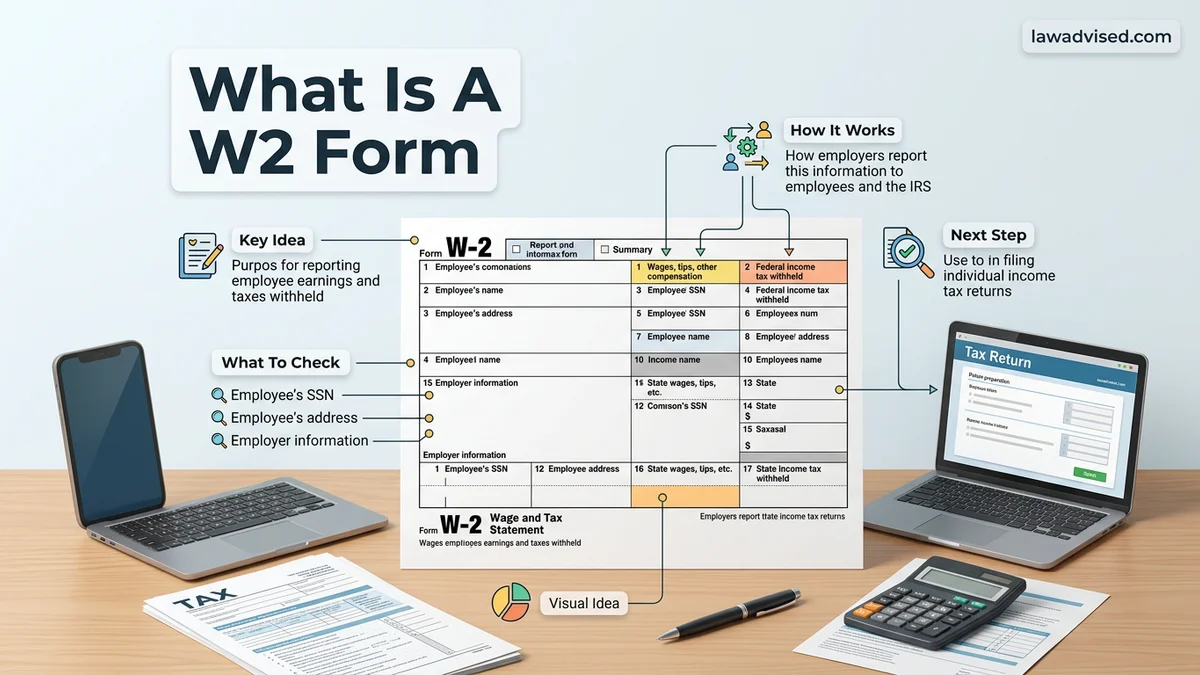
A W-2 form is an official tax document that employers send to employees and the IRS to report annual wages and tax withholdings. It details exactly how much money you earned and how much tax was deducted from your paycheck throughout the year. You must use this information to accurately file your federal and state tax returns.
A Form W-2, officially known as the Wage and Tax Statement, is the official document your employer gives you every year to summarize your total earnings and the income taxes withheld from your paychecks. As a worker, you need this form to file your federal, state, and local tax returns accurately for the 2026 tax season.
Employers are legally required to send out W-2 forms by January 31st each year. If you earned money as a traditional W-2 employee rather than an independent contractor, this piece of paper serves as your primary ticket to claiming tax refunds or ensuring you have paid the correct amount of government tax.
Key Takeaways
- A W-2 reports your annual earnings and tax withholdings to the IRS.
- Only traditional employees receive a W-2, not independent contractors.
- Employers are legally required to provide your W-2 by January 31.
- Box 1 shows your total taxable wages for the year.
- Boxes 3 through 6 detail your Social Security and Medicare contributions.
What Causes W-2 Confusion and Who Actually Gets the Form
Tax season often brings confusion regarding who qualifies for a W-2 and why the numbers rarely match your gross salary. Clear definitions help remove the stress from tax preparation.
Who Receives a W-2
- Traditional Employees: Anyone classified as a standard employee on a company payroll.
- Full-Time and Part-Time Workers: Both schedules trigger a W-2 if income thresholds are met.
- Corporate Officers: Even owners who take a salary receive one.
Independent Contractors vs. Employees
You will not receive a W-2 if you worked as a freelancer or independent contractor. Those workers receive a Form 1099-NEC instead. Employers do not withhold taxes from contractor paychecks, which is the main operational difference that causes confusion for people switching career types in 2026.
How to Read and Interpret the Most Important W-2 Boxes
The layout of a W-2 looks like a grid of numbered boxes, but you only need to focus on a few key sections to file your taxes correctly.
Understanding Wage Income in Boxes 1, 3, and 5
- Box 1 (Wages, tips, other compensation): This is your taxable federal income, which might be lower than your gross pay due to pre-tax deductions like 401(k) contributions or health insurance.
- Box 3 (Social Security wages): The total amount of your earnings subject to Social Security tax, up to the annual government wage cap.
- Box 5 (Medicare wages and tips): Your total earnings subject to Medicare tax, which often includes amounts excluded from Box 1.
Tracking Tax Withholdings in Boxes 2, 4, and 6
These boxes show exactly how much money your employer already sent to the government on your behalf throughout the year. Box 2 displays federal income tax withheld, Box 4 shows Social Security tax withheld, and Box 6 shows Medicare tax withheld. Matching these numbers to your software prompts or tax professional ensures your refund calculation is spot on.
Step-by-Step Guide to Using Your W-2 for Tax Filing
Filing your taxes for the 2026 tax season requires careful entry of your Form W-2 data to avoid IRS processing delays. Whether you use tax preparation software or hire a professional, following a structured process prevents costly math errors.
1. Match Boxes to Your Software Prompts
Modern tax software will ask you to input specific box numbers from your W-2. Match Box 1 (Wages) and Box 2 (Federal Income Tax Withheld) precisely to the software fields. According to IRS compliance data, mismatched income reporting is a primary trigger for automated tax notices.
2. Verify State and Local Data
Do not skip the lower half of your form. Enter your state wages in Box 16 and state income tax withheld in Box 17. If you worked in multiple municipalities, ensure local wages in Box 18 match your locality to claim proper local tax credits for 2026.
3. Double-Check Control Numbers and EINs
Input your employer’s 9-digit Employer Identification Number (EIN) from Box b accurately. Tax filing platforms use this number to verify your wage data against federal databases. Cross-check your final entries against the physical or digital PDF copy before submitting.
What If Your W-2 Is Missing or Incorrect by January 31
Employers are legally required to furnish Form W-2 by January 31, 2026. If your form has not arrived by early February, or if the earnings figures are demonstrably wrong, specific corrective measures protect your filing timeline.
Contact Your Employer First
Reach out to your human resources or payroll department immediately to confirm your current mailing address or request a digital re-issue. Many companies now provide secure online portals where employees can instantly download 2026 tax documents.
Contact the IRS for Assistance
If your employer fails to respond by late February, call the IRS at 800-829-1040. Provide your employer’s details, and the agency will contact the company on your behalf. The IRS will issue Form 4852 (Substitute for Form W-2) if necessary.
File Using Substitute Forms
If the deadline approaches and your employer remains unresponsive, file your 2026 return using Form 4852 by estimating your wages from your final December 2025 pay stub. Be aware that this may slightly delay your tax refund while the IRS verifies the figures.
What If It Still Doesn’t Work?
If standard resolution steps fail and your wage reporting issues persist into the peak of the 2026 filing season, systemic fallback options ensure your compliance:
- Pull IRS Wage and Income Transcripts: Access your official IRS account online to download your official federal wage transcript, which often populates with employer-reported data by mid-February.
- File for a Tax Extension: Request an automatic six-month tax extension using Form 4868 to buy critical time to resolve employer reporting disputes without incurring late-filing penalties.
- Engage a Certified Public Accountant (CPA): Consult a licensed tax professional to navigate complex substitute filings and IRS dispute resolution. Expert CPA consultation fees typically range from $200 to $500 depending on the complexity of your income structure.
- Contact the Taxpayer Advocate Service: If systemic employer non-compliance jeopardizes your refund, reach out to this independent IRS organization for expedited case assistance.
Conclusion
Understanding and utilizing your W-2 form remains a fundamental requirement for accurate tax compliance and maximizing your financial return. By verifying every box, cross-referencing your year-end pay stubs, and addressing missing documents promptly, you safeguard against costly processing delays. According to verified research and expert tax sources, timely and accurate wage reporting is the single most effective way to accelerate your 2026 tax refund. Take your next actionable step today by logging into your employer’s payroll portal to download your official W-2 copy.
❓ Frequently Asked Questions
What is the primary purpose of a W-2 form?
The main purpose of a W-2 is to report an employee’s annual compensation and the amount of federal, state, and other income taxes withheld from their paycheck. The IRS uses this information to verify the data reported on individual income tax returns.
Is a W-2 the same as a 1099?
No, they serve completely different worker classifications. A W-2 is for standard employees whose employers withhold taxes from their pay, while a 1099 is for independent contractors, freelancers, and self-employed individuals who must pay their own taxes.
What information is contained in Box 1 of a W-2?
Box 1 shows your total taxable wages, tips, and other compensation for the year. This amount typically excludes pre-tax deductions like traditional 401(k) contributions and health insurance premiums.
What do FICA taxes on a W-2 mean?
FICA stands for the Federal Insurance Contributions Act, which funds Social Security and Medicare. Boxes 3 and 4 cover Social Security wages and tax withheld, while Boxes 5 and 6 cover Medicare wages and tax withheld.
What happens if my employer fails to send my W-2 by January 31?
If you do not receive your W-2 by mid-February, contact your employer first. If they cannot provide it, you can contact the IRS for assistance or file your taxes using Form 4852 as a substitute wage statement.
Do I need to attach my W-2 to my tax return?
Yes, if you file a paper tax return, you must physically attach Copy B of your W-2. If you file electronically using tax software, the program will prompt you to enter the data directly and transmit it digitally to the IRS.

Ismail Hossain is the founder of Law Advised. He is an Divorce, Separation, marriage lawyer. Follow him.