Crypto Losses Tax Deduction Guide Step-by-Step for 2026
Yes, you can claim a crypto losses tax deduction by selling depreciated assets to offset capital gains and up to $3,000 of ordinary income. Realized capital losses reduce your overall tax liability, while mere unrealized drops in portfolio value cannot be deducted. Knowing the difference between deductible trades and non-deductible scams is critical for accurate reporting.
Yes, you can deduct your cryptocurrency losses on your taxes, and doing so can significantly lower your overall tax bill for the 2026 tax year. The IRS classifies digital assets as property, meaning crypto transactions are subject to capital gains and losses rules just like traditional stocks.
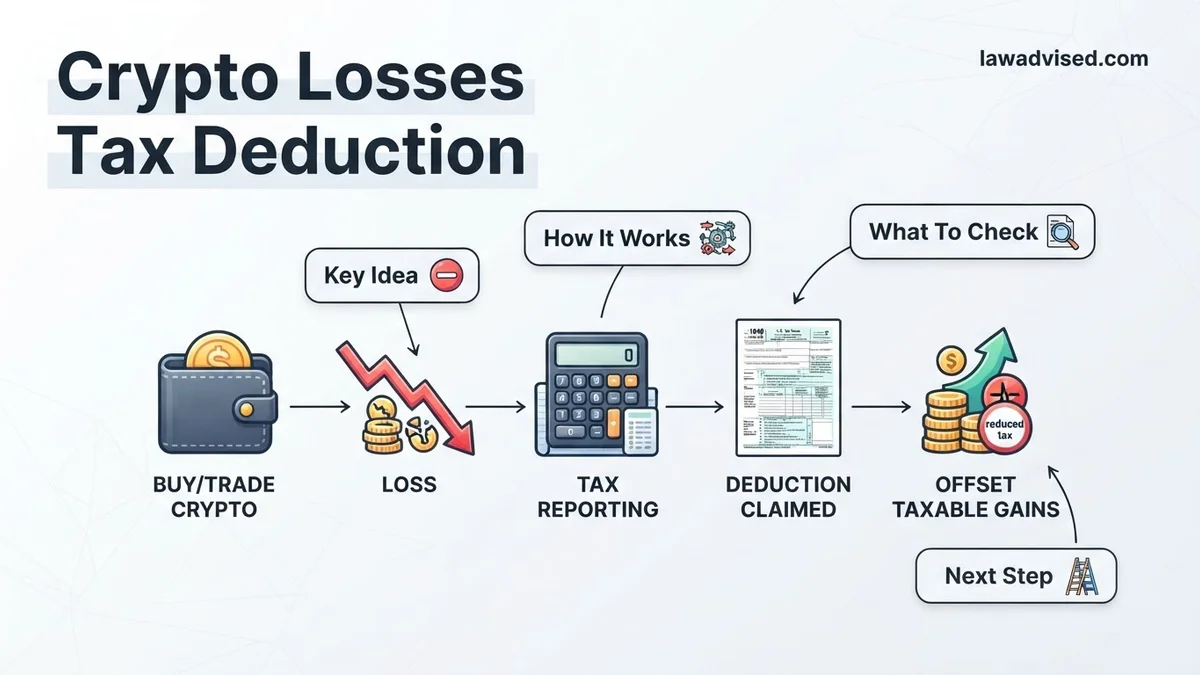
When you sell or trade crypto at a loss, you can use those financial hits to offset your taxable capital gains dollar-for-dollar. If your losses exceed your gains, you can write off up to $3,000 of ordinary income each year, rolling any remaining losses forward into 2027 and beyond.
Key Takeaways
- Sell depreciated digital assets to officially realize a tax-deductible capital loss.
- Offset unlimited capital gains using your realized cryptocurrency losses dollar-for-dollar.
- Deduct up to $3,000 of excess losses annually against your ordinary income.
- Current IRS rules generally exclude personal theft and crypto scams from deductible losses.
- Keep meticulous transaction histories, timestamps, and fair market values for every trade.
What Causes Realized vs Unrealized Crypto Losses
Understanding Unrealized Paper Losses
Holding a coin that has dropped significantly in value does not trigger a tax event. If you bought Ethereum at $4,000 and it currently sits at $2,000 in your private wallet for 2026, that drop is merely an unrealized loss. The IRS only cares about closed transactions. You cannot claim a deduction on paper losses until you actually dispose of the asset. Watching your portfolio bleed hurts, but holding the token gives you zero tax relief.
Triggering Tax-Deductible Realized Losses
You lock in a realized loss the exact moment you convert your crypto into cash, trade it for another digital asset, or use it to purchase goods and services. Selling a depreciated altcoin on an exchange creates a taxable event that generates a capital loss. Keep in mind that current IRS rules make personal wallet thefts and generic scams much harder to deduct as casualty losses, meaning voluntary trading and selling remain your primary legal avenues for writing down portfolio damage.
Key actions that create realized losses include:
- Selling crypto for fiat currency like US Dollars at a lower price than your purchase cost.
- Trading one cryptocurrency for another (such as swapping Bitcoin for Solana) when the initial coin’s value has dropped.
- Using a depreciated token to pay for a product or service.
How to Calculate and Claim Your Crypto Losses Step-by-Step
Gathering Transaction Data and Cost Basis
To claim your 2026 deductions correctly, you must calculate your exact cost basis for every asset you sold. Your cost basis is the original purchase price plus any transaction fees you paid to acquire the coin. If you bought 1 Bitcoin for $40,000 and paid a $40 fee, your cost basis is $40,040. When you sell that Bitcoin later for $30,000, your realized capital loss is exactly $10,040. Export your historical transaction data from every exchange and wallet you used throughout the year to ensure your records are complete.
Reporting Losses on Your Tax Forms
Once you calculate your total net losses, you must report them to the IRS using specific tax forms. You will list individual transactions on Form 8949 (Sales and Other Dispositions of Capital Assets) and then summarize those totals on Schedule D of your Form 1040. Be sure to account for the wash-sale rule if it applies to your jurisdiction, though as of 2026, the strict traditional wash-sale rules historically applied to stocks still face evolving IRS guidance regarding digital assets. Always cross-reference your trades carefully to avoid underreporting gains or overstating deductions.
Follow these steps to file correctly:
- Compile CSV reports from all trading platforms and self-custody wallets used in 2026.
- Match every sale or trade with its corresponding purchase price and acquisition date.
- Subtract your proceeds from your cost basis to find the net gain or loss for each line item.
- Transfer your categorized short-term and long-term losses onto Form 8949 and Schedule D.
What to Do About Scams, Hacks, and Non-Deductible Crypto Losses
Navigating losses from exchange bankruptcies, exit scams, or wallet hacks requires careful adherence to IRS guidelines. According to IRS tax guidance, personal theft losses were temporarily suspended under the Tax Cuts and Jobs Act for tax years 2018 through 2025. However, as the 2026 tax season approaches, traders must evaluate whether their specific situation qualifies as a capital loss or falls under remaining federal exceptions.
Handling Exchange Bankruptcies and Liquidations
If your digital assets are locked in an insolvent platform like Celsius, FTX, or other defunct exchanges, you generally cannot claim a capital loss until the bankruptcy proceedings officially conclude. Once the bankruptcy trustee determines the final recovery percentage, you can calculate your realized loss. Experts recommend following these procedural steps:
- Obtain official documentation of the final bankruptcy distribution or liquidation order.
- Calculate your exact cost basis minus any recovered funds or token distributions received.
- Report the resulting net figure as a capital loss on Form 8949 for the tax year the bankruptcy closure is finalized.
Addressing Wallet Hacks and Rug Pulls
Victims of targeted wallet hacks, phishing attacks, or fraudulent decentralized finance (DeFi) projects face stricter IRS scrutiny. Financial advisors note that voluntary token trades into worthless scam coins may qualify as closed, completed transactions for capital loss purposes. Conversely, outright wallet thefts typically require waiting for federal legislative updates regarding personal casualty and theft losses.
What If Your Crypto Losses Exceed the Annual Limit
The IRS limits the deduction of net capital losses for individual taxpayers. If your total capital losses exceed your total capital gains for 2026, you can deduct up to $3,000 of excess loss against ordinary income per year ($1,500 if married filing separately). Understanding how to handle this limitation prevents filing errors and maximizes long-term tax efficiency.
Tracking Capital Loss Carryovers
Any remaining losses that exceed the annual $3,000 threshold are not lost forever. Instead, they roll over indefinitely into future tax years. Follow these steps to properly manage your carryover balances:
- Calculate your total net capital loss using Form 8949 and Schedule D.
- Apply the maximum $3,000 deduction against your ordinary taxable income for 2026.
- Record the remaining unused loss amount on your personal tax tracking worksheet as a short-term or long-term capital loss carryover for the 2027 tax year.
What If It Still Doesn’t Work?
If tracking historical cost bases or reconciling complex multi-chain wallet transactions proves too difficult, automated software may fail to yield accurate tax forms. When self-preparation falls short, consider these fallback steps:
- Export raw CSV transaction logs directly from every decentralized wallet address and centralized exchange you utilized.
- Reconcile missing historical pricing data manually using reputable cryptocurrency price aggregators for the exact timestamp of the trade.
- Consult a Certified Public Accountant (CPA) or a specialized crypto tax attorney if your portfolio volume exceeds hundreds of thousands of dollars or involves complex cross-chain bridges. Professional tax advisory services for high-volume crypto portfolios typically range from $500 to $3,500 depending on complexity.
- Request an official extension using IRS Form 4868 to secure extra time for accurate reporting, keeping in mind that an extension to file does not grant an extension to pay any estimated tax owed.
Conclusion
Maximizing your crypto loss deductions for 2026 requires strict adherence to IRS capital loss limits, accurate cost basis tracking, and proper documentation of bankruptcies or hacks. By following these structured steps, you can legally offset capital gains and reduce your ordinary income liability. As a definitive next step, export your year-to-date transaction history into a dedicated crypto tax calculator to verify your net position before filing. According to verified research and expert tax sources, proactive portfolio reconciliation remains the single most effective defense against costly IRS audit adjustments.
❓ Frequently Asked Questions
How do I calculate my cryptocurrency capital losses?
Subtract your cost basis (the original purchase price plus transaction fees) from the proceeds you received when selling or trading the asset.
What happens to crypto losses that exceed the $3,000 ordinary income limit?
Any excess losses that cannot be used in the current tax year roll over indefinitely into future tax years until they are fully exhausted.
Can I deduct losses from a decentralized exchange (DEX) hack?
Generally no, as the IRS suspension of miscellaneous itemized deductions and strict rules on personal theft losses mean most hack-related losses cannot be deducted.
Is transferring crypto between my own wallets considered a taxable event?
No, moving crypto between wallets you own does not realize a gain or a loss and cannot be claimed as a tax deduction.
What IRS form is used to report cryptocurrency capital losses?
You must report your capital losses and gains on IRS Form 8949 and summarize the totals on Schedule D of your Form 1040.
Do I need to report a loss if I haven’t converted my crypto back to fiat?
No, holding an asset that has dropped in value is an unrealized loss. You must execute a taxable event like a sale or trade to realize the loss.

Ismail Hossain is the founder of Law Advised. He is an Divorce, Separation, marriage lawyer. Follow him.