Municipal Bond Tax Explained Best Guide for 2026
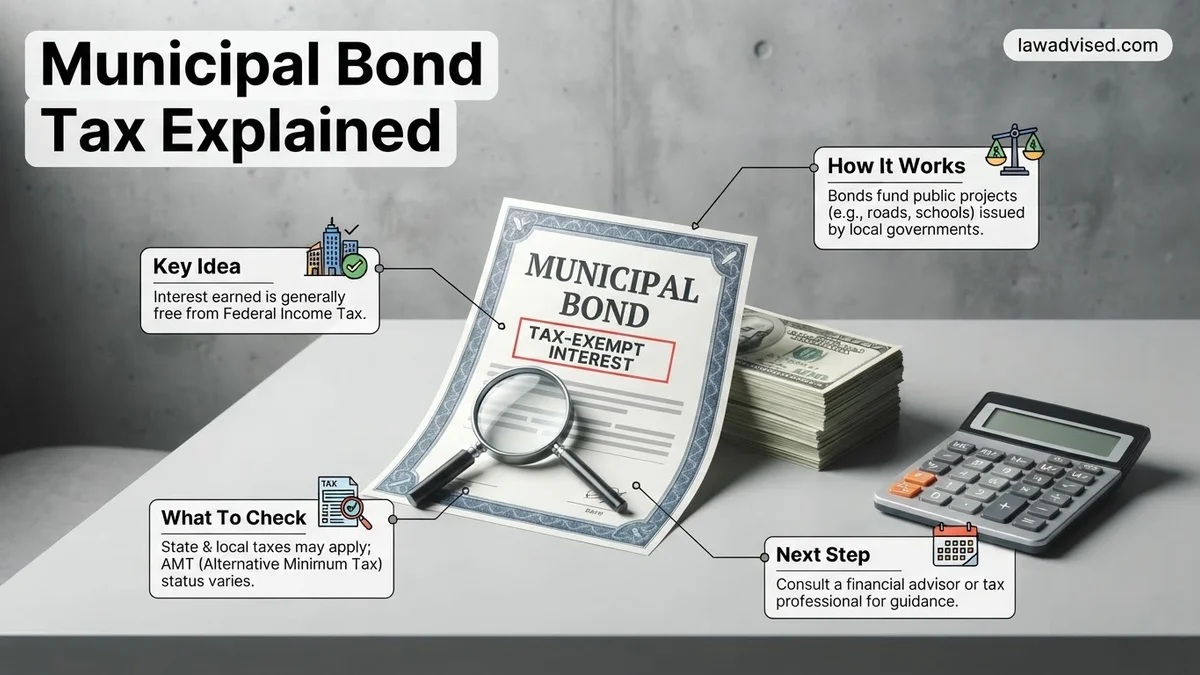
Municipal bond interest is generally exempt from federal income taxes, making them a popular choice for high-income earners. However, navigating state-specific rules and capital gains requires careful attention to avoid unexpected tax liabilities. This guide breaks down exactly how municipal bond taxation works across all levels of government.
Municipal bond interest is generally exempt from federal income taxes, and it can also escape state and local taxes if you buy bonds issued in your home state. However, this triple-tax-exempt status is not guaranteed for every single municipal security you might encounter in the 2026 tax landscape.
You need to know the exact mechanics of muni bond taxation before investing your capital. Certain types of municipal debt trigger federal tax liability, while others subject you to the Alternative Minimum Tax or unexpected capital gains taxes when selling before maturity.
Key Takeaways
- Muni bond interest is typically free from federal income taxes.
- Buy in-state bonds to achieve a double tax exemption.
- Selling bonds at a profit triggers capital gains taxes.
- Private activity bonds may trigger the Alternative Minimum Tax (AMT).
- Taxable municipal bonds exist and do not offer federal exemptions.
What Causes Taxable Municipal Bond Surprises
Most investors assume that anything issued by a city or state comes with a federal tax break. Unfortunately, the Internal Revenue Code includes specific exceptions that strip away this tax-free status. If you are not paying close attention to the bond’s official statement, you could face an unexpected tax bill on your interest income.
Taxable Municipal Bonds and Build America Bonds
Municipalities occasionally issue taxable bonds to fund projects that do not meet strict federal guidelines for tax-exempt status. For instance, bonds issued to finance local sports stadiums, pension obligation shortfalls, or private commercial developments are often fully taxable at both the federal and state levels.
- These taxable munis typically pay higher yields to compensate for the tax burden.
- You must report this interest on your standard Form 1040 just like corporate bond or high-yield savings account interest.
- Always verify the tax status on the bond’s prospectus before purchasing.
Private Activity Bonds and the AMT Trap
Even when a bond is technically tax-exempt, you might still owe federal taxes under the Alternative Minimum Tax (AMT) rules for 2026. Private Activity Bonds (PABs) are issued by municipalities to finance projects involving private entities, such as airports, dock facilities, or private hospital expansions.
- Interest from non-governmental PABs is treated as a tax preference item.
- High-income earners subject to the AMT may have to add this interest back into their taxable income calculation.
- Consult your CPA to evaluate whether specific municipal holdings will trigger your personal AMT liability.
How to Fix Your Tax Strategy Using In-State Munis
Minimizing your tax liability requires moving beyond simple federal exemptions. State and local tax laws can quietly eat into your fixed-income returns unless you strategically structure your portfolio based on your residential zip code. The key mechanism here is the double or triple exemption.
The Mechanics of the In-State Double Exemption
State governments generally do not tax interest earned on municipal bonds issued by their own state or local municipalities. If you live in California and buy a California municipal bond, you pay zero state income tax on those distributions.
- If you buy out-of-state municipal bonds, your home state will typically tax that interest income fully.
- High-tax states like New York, California, and New Jersey make in-state munis exceptionally valuable for high-earning residents.
- Local income taxes, such as those levied by New York City, are also avoided by holding local municipal debt.
Navigating Mutual Funds and ETFs
Buying individual bonds from your home state is straightforward, but many investors prefer the diversification of bond funds or exchange-traded funds (ETFs). Managing the tax status of a fund requires careful attention to the portfolio’s geographic holdings.
- Single-state municipal bond funds invest primarily in debt from one specific state to pass the state tax exemption directly to you.
- National municipal bond funds are exempt from federal taxes, but the portion of interest generated from out-of-state holdings will be taxed by your home state.
- Review the fund’s annual report to track the exact percentage of income that qualifies for your specific state tax exclusion.
Step-by-Step Guide to Calculating Capital Gains on Secondary Market Sales
Buying municipal bonds at a discount in the secondary market introduces unique tax obligations for investors navigating the 2026 fiscal year. While the periodic interest payments remain tax-exempt, selling a bond above your purchase price triggers capital gains taxes. Furthermore, purchasing a bond at a deep market discount invokes the complex Market Discount Rule, which often recharacterizes capital gains as ordinary income.
To accurately determine your tax liability when selling a municipal bond before maturity, follow this structured calculation procedure:
- Determine your initial cost basis: Start with the actual purchase price paid on the secondary market, adding any accrued interest paid at settlement and subtracting any amortized acquisition premium if applicable.
- Calculate the accrued market discount: If you bought the bond below par value, compute the ratable portion of the discount that accrued during your holding period using the constant yield method.
- Subtract selling expenses: Deduct broker commissions and transaction fees from your gross sales proceeds to find your net realized amount.
- Separate ordinary income from capital gains: Apply the accrued market discount amount toward ordinary income tax rates, then designate any remaining profit above the adjusted basis as a capital gain.
What If Your Muni Bond Interest Is Subject to the AMT
Many investors assume that all municipal bonds maintain absolute tax-exempt status under federal law. However, certain bonds issued to finance private activities—such as privately built airports, docks, or corporate-backed facilities—lose this blanket exemption for specific taxpayers. If you fall into this category for the 2026 tax year, your municipal bond interest may be pulled back into taxable calculations.
Navigating Alternative Minimum Tax (AMT) implications requires evaluating specific bond classifications and personal tax thresholds:
- Identify Private Activity Bonds (PABs): Review your 1099-INT statements to see if any municipal bond interest is explicitly flagged as a “Private Activity Bond Interest Dividends” item.
- Calculate your AMTI: Add back preference items, including specific PAB interest, to your regular taxable income to determine your Alternative Minimum Taxable Income (AMTI) for 2026.
- Compare exemption thresholds: Check whether your total AMTI exceeds the statutory exemption phase-out limits established by the IRS for the current tax year.
What If It Still Doesn’t Work?
Tax regulations governing municipal bonds involve intricate rules that frequently defy simple do-it-yourself software calculations. If your tax platform yields conflicting figures or your 1099 forms display discrepancies, execute these fallback steps:
- Cross-reference with your brokerage statement: Review your year-end consolidated 1099 to ensure the cost basis reporting method matches IRS Form 8949 specifications.
- Request a corrected 1099: Contact your brokerage’s fixed-income department immediately if you spot amortized cost basis errors or misclassified tax-exempt interest.
- Consult a certified public accountant: Engage a qualified CPA or tax attorney who specializes in fixed-income taxation to audit your portfolio transactions. Professional consultation fees typically range from $300 to $600 per hour depending on portfolio complexity.
- File for an extension: Request an IRS tax filing extension if unresolved municipal bond reporting issues prevent accurate submission by the primary April deadline.
Conclusion
Navigating municipal bond taxation requires constant vigilance regarding secondary market discounts, private activity bond allocations, and evolving IRS guidelines. According to verified research and expert financial sources, meticulous tracking of your cost basis and timely review of consolidated 1099 forms prevent costly compliance errors. As an actionable next step for 2026, schedule a portfolio review with a certified tax professional to audit your fixed-income holdings before tax season peaks.
❓ Frequently Asked Questions
How do federal tax exemptions apply to municipal bonds?
Under Section 103 of the Internal Revenue Code, interest earned on most municipal bonds issued by state and local governments is excluded from gross income for federal income tax purposes.
What is the ‘double exemption’ rule for state taxes?
When you purchase municipal bonds issued by your own state of residence, the interest is typically exempt from both federal and state income taxes, providing a double tax advantage.
Are capital losses on municipal bonds tax-deductible?
Yes, if you sell a municipal bond on the secondary market for a capital loss, you can use that loss to offset capital gains from other investments, subject to standard IRS loss limits.
What are private activity bonds and how are they taxed?
Private activity bonds are municipal bonds issued to finance projects for private entities, such as airports or sports stadiums. While the interest is usually federally tax-exempt, it may be treated as a preference item for the Alternative Minimum Tax.
How does buying municipal bond mutual funds affect my taxes?
While distributions from municipal bond mutual funds retain their federal tax-free status, capital gains distributions realized by the fund when managers sell underlying bonds are taxable to the investor.
Are zero-coupon municipal bonds taxed differently?
Even though zero-coupon municipal bonds do not pay periodic interest, investors may still need to account for imputed ‘original issue discount’ rules, though the accrued interest generally remains tax-exempt.

Ismail Hossain is the founder of Law Advised. He is an Divorce, Separation, marriage lawyer. Follow him.