Investment Tax Forms Explained 2026 A Step-by-Step Guide
Filing taxes with investment income can be confusing when dealing with a pile of unfamiliar paperwork. Investment tax forms explained provides a clear breakdown of every major 1099 and K-1 form, detailing what they mean and where the data goes on your tax return. Knowing how to handle these forms ensures you report income correctly and avoid IRS processing delays.
Investment tax forms are informational reports sent to you and the IRS detailing the income, dividends, and capital gains generated by your taxable brokerage accounts, retirement accounts, and other financial assets throughout the tax year. When filing your 2026 tax return, you must match the figures on these documents to specific lines on your federal tax forms, such as Schedule B or Schedule D, to avoid processing delays and IRS mismatch notices.
Navigating tax season with a portfolio can feel overwhelming when a dozen different documents land in your digital or physical mailbox. Knowing precisely what each form means, where the data goes on your return, and how to handle delayed or corrected forms will save you hours of frustration and prevent costly reporting mistakes.
Key Takeaways
- Form 1099-INT reports interest earned from cash savings, bonds, and bank accounts.
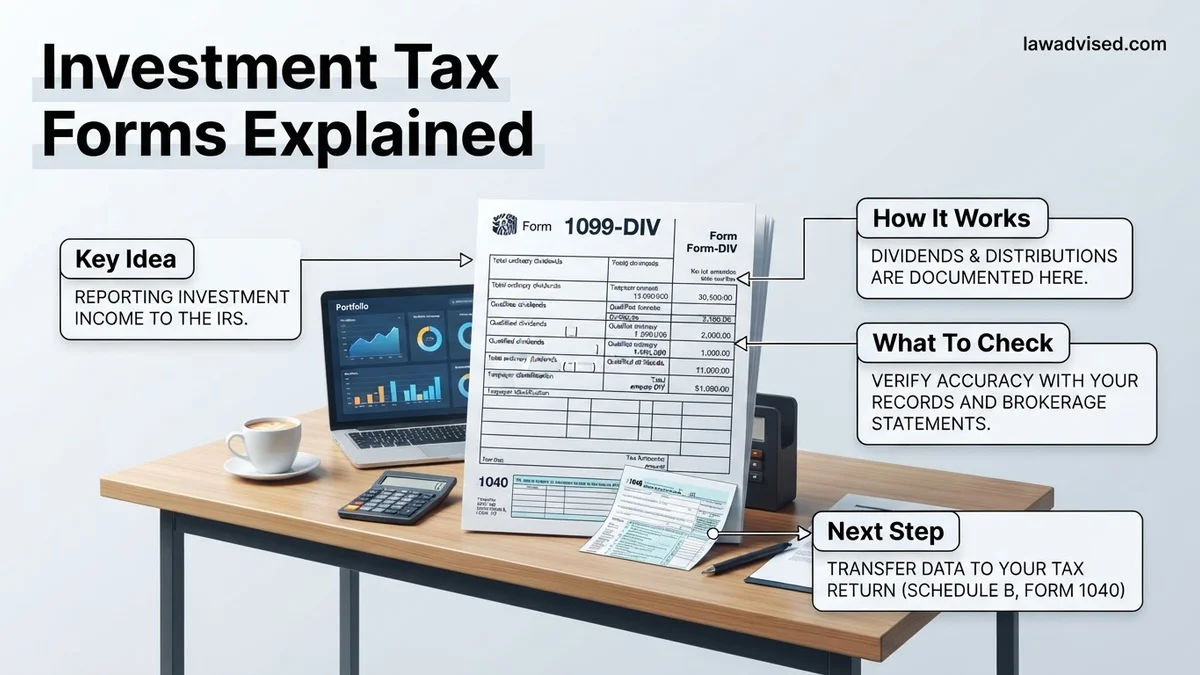
- Form 1099-DIV outlines ordinary and qualified dividends paid out by stocks and funds.
- Form 1099-B tracks proceeds from stocks, bonds, and crypto sales for capital gains.
- Consolidated 1099 statements combine multiple tax documents into a single packet.
- Schedule K-1 reports income and losses from partnerships, S-corps, and REITs.
What Causes Confusion With Investment Tax Forms
The Alphabet Soup of 1099 Variants
The primary source of confusion for investors is the sheer volume of different 1099 variations issued by brokerages. Financial institutions do not send just one tidy tax bill; they often issue separate forms for interest, dividends, and asset sales. Without a roadmap, it is easy to miss a form or report the same income twice. Here are the most critical forms you will encounter for your 2026 filings:
- Form 1099-INT: Reports taxable interest earned from bonds, bank accounts, or money market funds.
- Form 1099-DIV: Details ordinary and qualified dividends, as well as capital gain distributions from mutual funds or exchange-traded funds.
- Form 1099-B: Tracks proceeds from the sale or exchange of stocks, bonds, and other securities through a broker.
The Threat of the Dreaded Amended 1099
Another major headache is receiving a corrected or amended tax form after you have already filed your return. Brokerages often issue initial 1099 statements in early February, only to amend them later in March or even April because underlying investments, mutual funds, or real estate investment trusts (REITs) finalized their reclassifications. If you file too early using an uncorrected statement, you may need to file an amended tax return later using Form 1040-X, creating extra work and potential tax liabilities.
How to Fix and Organize Your Investment Tax Documents
Establish a Waiting Period and Consolidation Strategy
To avoid filing with incorrect information, you need a strict organizational timeline. Most major brokerages like Fidelity, Vanguard, and Charles Schwab provide consolidated 1099 statements that combine your 1099-INT, 1099-DIV, and 1099-B into a single multi-page document. However, they frequently delay releasing these consolidated packages until late February or early March.
- Wait until mid-March: Do not file your taxes the moment you receive your first isolated 1099-INT in early February.
- Check for the “Corrected” box: Always review the top corner of your downloaded PDF statements to ensure the “Corrected” checkbox is empty.
- Import directly: Use tax preparation software like TurboTax or FreeTaxUSA to securely import your 1099 data via your broker’s account number, reducing manual transcription errors.
Handling Missing Forms and Mismatched Cost Basis
Sometimes a form goes missing entirely, or the cost basis reported on your 1099-B does not match your actual purchase records. If you sold an asset and your broker failed to track the correct cost basis, you are still responsible for reporting the accurate gain or loss. Keep your historical trade confirmations and monthly account statements on hand. If a form is entirely missing by late March, contact your brokerage’s customer service department immediately to download a copy or verify if your account met the minimum income thresholds required to trigger a reporting form.
Step-by-Step Guide to Entering Investment Forms Into Tax Software
Modern tax software simplifies data entry, but precision remains critical to avoid IRS flags in 2026. Taking a methodical approach ensures every box matches your official documents.
Importing Digital Files
Most major brokerages offer direct electronic integration with popular tax programs. You can pull data straight from your account using your login credentials.
- Log in to your tax preparation software and navigate to the income or investment section.
- Select the option to import your tax documents automatically from your financial institution.
- Search for your specific brokerage firm in the provided directory and enter your credentials.
- Review the imported data line by line to ensure the software captured every transaction accurately.
Manual Data Entry
If direct electronic import is unavailable, manual entry requires strict attention to detail. Match every box number on your physical or PDF form to the corresponding software field.
- Select manual entry for Form 1099-B, 1099-DIV, or 1099-INT depending on the document type.
- Input the payer’s Federal Identification Number and your account number exactly as shown.
- Enter proceeds, cost basis, and adjustment codes for each covered or non-covered transaction.
- Double-check decimal places and negative signs for capital losses to prevent miscalculations.
What If Your Forms Are Late or Contain Errors
Investment brokerages face strict legal deadlines, typically issuing 1099 forms by February 16, 2026. However, delayed mail, complex partnerships, or corporate restructurings often cause late arrivals or inaccurate numbers.
Handling Delayed and Corrected Forms
According to IRS guidelines, filing with incorrect information triggers automated matching notices and potential audits. If you notice a mistake after filing, you must submit an amended return using Form 1040-X.
- Wait for the official corrected form, which will be clearly marked as “Corrected” near the top.
- Compare the amended numbers against the figures you originally reported on your tax return.
- File an amended tax return using your software or paper forms to reflect the corrected financial data.
- Keep all original and corrected documents together in your permanent tax records for a minimum of three years.
What If It Still Doesn’t Work?
When software integration fails or complex multi-state transactions cause reconciliation errors, fallback measures become necessary. Resolving persistent reporting mismatches requires systematic troubleshooting before filing your return.
- Manually reconcile your year-end brokerage statements against the generated tax forms to identify the exact variance.
- Contact your broker’s dedicated tax support helpline to request an immediate reissued PDF document.
- File for an automatic six-month tax extension using Form 4868 if corrected documents will not arrive before the filing deadline.
- Consult a certified public accountant or enrolled agent for complex portfolio reconciliations, where professional fees typically range from $300 to $1,000+ depending on return complexity.
Conclusion
Navigating investment tax forms requires meticulous attention to detail and adherence to strict IRS deadlines. By carefully matching your 1099 data points and utilizing electronic imports, you can eliminate filing errors and prevent costly processing delays. According to verified research and expert sources from the American Institute of CPAs, organized recordkeeping is the single most effective defense against automated tax audits. Take your next actionable step today by logging into your brokerage portal and downloading all finalized 2026 tax documents.
❓ Frequently Asked Questions
What is the difference between a qualified and unqualified dividend on Form 1099-DIV?
Qualified dividends are taxed at lower capital gains tax rates, while ordinary (unqualified) dividends are taxed at your standard ordinary income tax rate. Form 1099-DIV clearly separates these amounts into distinct boxes for easy reporting.
Why did I receive a corrected 1099 form after filing my taxes?
Brokers frequently issue corrected 1099 forms when mutual funds or ETFs update their underlying tax classifications. If the change significantly alters your taxable income, you may need to file an amended tax return using Form 1040-X.
How do I handle a Schedule K-1 if it arrives late?
Schedule K-1 forms for partnerships and S-corps notoriously arrive late in the tax season, often forcing investors to request an extension to file their tax returns accurately without risking penalties.
What happens if I lose or don’t receive an investment tax form?
You can typically download digital copies of all required 1099 statements directly from your brokerage account’s tax center. If you had no taxable activity or earned less than the statutory minimum threshold, a form may not be generated at all.
Are cryptocurrency transactions reported on investment tax forms?
Yes, centralized crypto exchanges and brokers now issue Form 1099-B or specialized tax summary statements detailing digital asset sales and dispositions for capital gains calculations.
Do I need to mail my physical 1099 forms to the IRS?
If you file your taxes electronically using tax software, you generally do not need to mail physical copies of your 1099 forms unless specifically requested by the IRS, though you must keep them for your personal records.

Ismail Hossain is the founder of Law Advised. He is an Divorce, Separation, marriage lawyer. Follow him.