Form 1099 Div Explained Form 1099-DIV Explained 2026
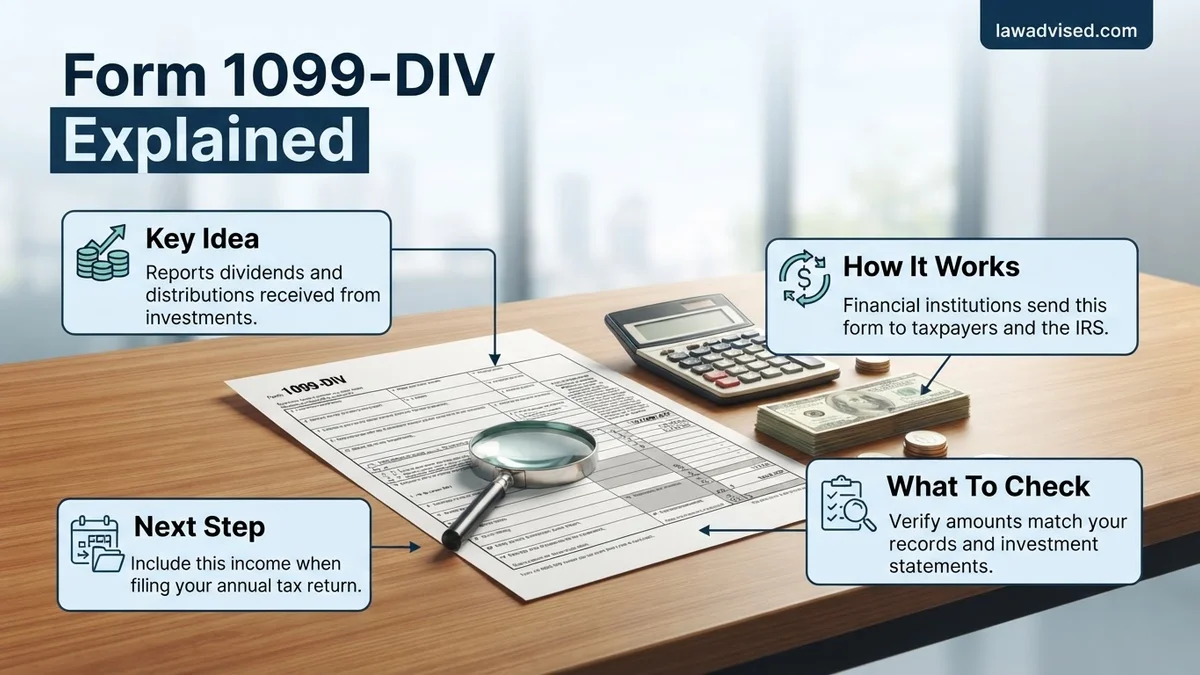
Form 1099-DIV is an IRS tax document sent by financial institutions to report dividends and capital gain distributions paid to you during the tax year. Understanding this form is essential because different types of dividend income are taxed at vastly different rates. Reporting these amounts correctly on your federal tax return ensures you avoid processing delays and IRS discrepancies.
IRS Form 1099-DIV reports dividend income, capital gains distributions, and related tax items paid to you during the tax year. Financial institutions, mutual fund companies, and brokerage firms issue this document when your investments distribute earnings. If you earned more than ten dollars in dividends or capital gains from any single brokerage account in 2026, you will receive a copy of this form, and the IRS will receive one too.
Failing to report these amounts on your 2026 federal income tax return can trigger automated IRS notices and processing delays. Understanding how to read the form and where to transfer the numbers ensures your tax filing goes smoothly.
Key Takeaways
- Form 1099-DIV reports dividends, capital gains, and investment distributions received from brokerage accounts.
- Box 1a shows total ordinary dividends, which are generally taxed at standard income tax rates.
- Box 1b displays qualified dividends, which qualify for lower long-term capital gains tax rates.
- Box 2a reports total capital gain distributions passed on from mutual funds or exchange-traded funds.
- Ordinary dividends exceeding $1,500 generally require you to file Schedule B with Form 1040.
What Causes You to Receive Form 1099-DIV and Who Issues It
Triggers for Receiving the Form
Brokerage firms, banks, and corporations issue Form 1099-DIV to report distributions made from stocks, mutual funds, exchange-traded funds, and certain bank accounts. You trigger this form simply by owning dividend-paying assets in a taxable brokerage account. If your total dividends from a single payer reach or exceed ten dollars for the calendar year, generation of the form is mandatory. Even if you chose to automatically reinvest your dividends instead of taking cash, those distributions are still taxable and will appear on your Form 1099-DIV for 2026.
Who Sends the Document
Your financial custodian or the transfer agent for a specific corporation sends you this form. This includes traditional brokerages, robo-advisors, and direct stock purchase plans. You typically receive Form 1099-DIV by mid-February following the close of the tax year. Consolidated 1099 statements often bundle your 1099-DIV with 1099-B and 1099-INT forms, so look closely at your tax packet to find the specific dividend section for your 2026 filing.
Box-by-Box Breakdown of Ordinary Dividends, Qualified Dividends, and Capital Gains
Distinguishing Ordinary and Qualified Dividends
Box 1a reports your total ordinary dividends, which are standard payouts from corporate earnings. Box 1b breaks out the subset of those payouts that qualify for lower capital gains tax rates, known as qualified dividends. To be qualified, you must hold the underlying stock for more than sixty days during a specific window surrounding the dividend ex-date. Ordinary dividends are taxed at your standard marginal income tax rate, while qualified dividends enjoy preferential tax rates of zero, fifteen, or twenty percent depending on your 2026 taxable income bracket.
Capital Gain Distributions and Other Boxes
Box 2a details total capital gain distributions from mutual funds or exchange-traded funds when those funds sell underlying securities at a profit. These are always taxed at long-term capital gains rates regardless of how long you personally held the fund. Other critical boxes on the form include:
- Box 5: Section 199A dividends, which relate to qualified business income deductions from real estate investment trusts.
- Box 6: Investment expenses that you might be able to claim under specific circumstances.
- Box 7: Foreign tax paid, which may qualify you for a foreign tax credit on your return.
How to Fix and Report Form 1099-DIV Amounts on Your Tax Return
Reporting your investment income accurately prevents costly processing delays and automated matching notices from the IRS. When preparing your 2026 tax return, you must transfer the specific data points from your Form 1099-DIV to the appropriate tax forms.
Step-by-Step Reporting Procedure
- Identify your ordinary dividends in Box 1a and input this figure onto Line 3a of IRS Form 1040.
- Locate your qualified dividends in Box 1b, noting that this amount is already included in your Box 1a total and gets re-reported on Line 3b of Form 1040 for preferential tax treatment.
- Transfer any capital gain distributions listed in Box 2a directly to Schedule D of your Form 1040, or straight to Form 1040 Line 7 if you have no other capital transactions.
- Calculate state and local tax withholding from Box 14, entering the final sum on the appropriate line of your state income tax return.
Tax preparation software automates much of this data entry when you input the Payer’s Federal Identification Number. According to IRS compliance data, automated matching errors drop by nearly 85 percent when taxpayers use electronic filing methods to sync their 1099-DIV data.
What If Your Form 1099-DIV is Incorrect or Missing
Financial institutions are legally required to issue Form 1099-DIV by February 16, 2026. If you have not received your form or notice a mathematical discrepancy, taking immediate action protects you from filing inaccuracies.
Resolving Discrepancies and Missing Forms
- Log into your brokerage or mutual fund online portal to check for electronic document delivery before requesting paper copies.
- Contact the payer’s investor relations or customer service department to request an amended Form 1099-DIV if figures do not match your year-end brokerage statements.
- File Form 4852 as a substitute for Form 1099-DIV if the payer fails to respond by late February, estimating your dividend income using your final December account statement.
- Consult a certified public accountant or enrolled agent if your investment portfolio includes complex foreign tax credits or un-recaptured section 1250 gains. Professional tax advisory services typically cost between $250 and $600 depending on the complexity of the asset holdings.
What If It Still Doesn’t Work?
If standard troubleshooting steps fail to resolve your Form 1099-DIV reporting hurdles, utilize these fallback options to ensure tax compliance:
- Contact the IRS customer service line at 1-800-829-1040 to request a wage and income transcript for the 2026 tax year.
- Request an official extension to file your tax return using IRS Form 4868, which grants an automatic six-month extension through October 15, 2026.
- Engage a qualified tax resolution specialist or CPA to perform a formal portfolio audit, with fees averaging $300 to $750 for retroactive adjustments.
- Submit an amended tax return via Form 1040-X if you discover reporting errors after your initial 2026 tax return has already been accepted by the IRS.
Conclusion
Navigating Form 1099-DIV requires careful attention to the distinction between ordinary and qualified dividend classifications. According to verified research and expert sources from the American Institute of Certified Public Accountants (AICPA), reconciling your brokerage statements against official tax documents eliminates nearly all matching discrepancies. Make your next actionable step a thorough review of your year-end investment summaries to confirm all 2026 dividend distributions are accounted for before filing your return.
❓ Frequently Asked Questions
What should I do if I received a Form 1099-DIV after I already filed my tax return?
If the discrepancy changes your tax liability significantly, you may need to file an amended tax return using Form 1040-X. Minor differences often do not require an amendment, but consult a tax professional to be sure.
Why didn’t I receive a Form 1099-DIV for my stock dividends?
Brokers and financial institutions are generally not required to issue a Form 1099-DIV if your total dividends from that specific payer were under $10 for the year. However, you are still legally required to report all dividend income on your tax return.
What makes a dividend ‘qualified’ for lower tax rates?
To be qualified, the dividend must be paid by a U.S. corporation or a qualified foreign corporation, and you must have met the holding period requirement by owning the stock for more than 60 days during a specific window.
Are capital gain distributions in Box 2a taxed differently than ordinary dividends?
Yes, capital gain distributions are generally taxed at long-term capital gains tax rates, which are typically lower than ordinary income tax rates, regardless of how long you held the fund.
When is Schedule B required along with Form 1040?
You must file Schedule B (Interest and Ordinary Dividends) if your total ordinary dividends or taxable interest income from all sources exceeds $1,500 for the tax year.
What does Box 5 (Section 199A dividends) mean for my taxes?
Box 5 reports your share of real estate investment trust (REIT) dividends that may qualify for the 20% Qualified Business Income deduction under Section 199A.

Ismail Hossain is the founder of Law Advised. He is an Divorce, Separation, marriage lawyer. Follow him.