Roth IRA Tax Rules Expert Guide to Limits and 2026
Navigating Roth IRA tax rules requires understanding specific contribution limits, income thresholds, and withdrawal regulations to ensure tax-free growth. Tax-free withdrawals on earnings are only permitted if you meet the five-year rule and are age 59½ or older. Knowing these federal guidelines helps investors avoid unnecessary IRS penalties.
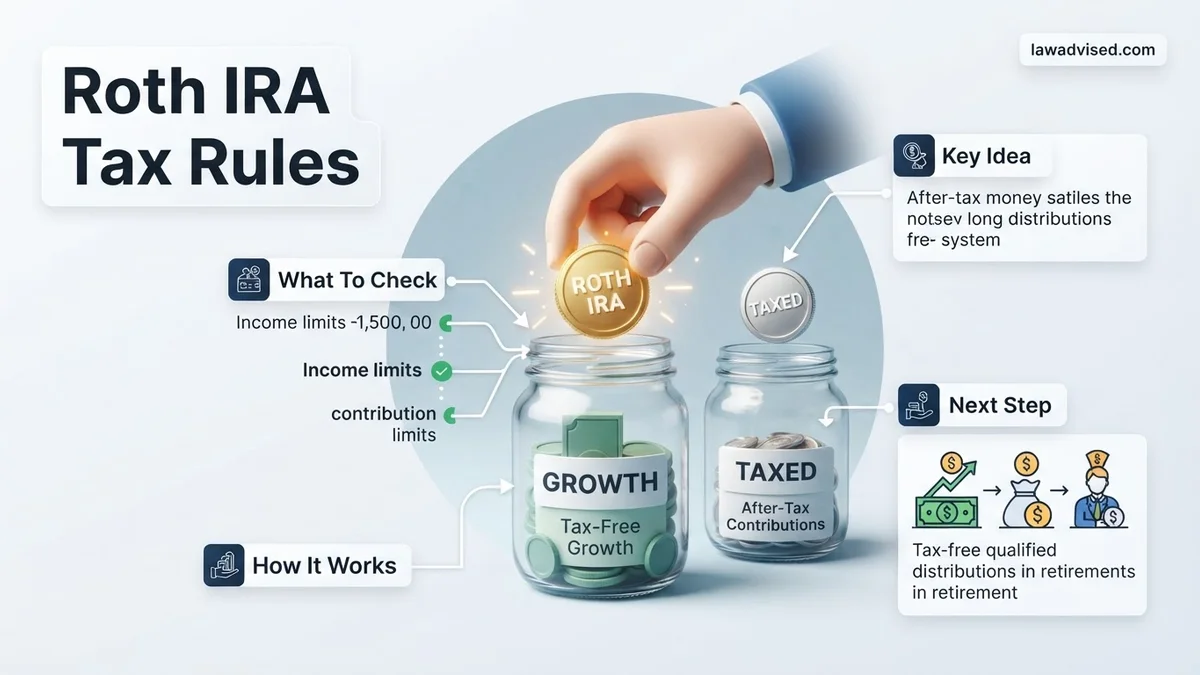
A Roth IRA lets your money grow completely tax-free, and you can withdraw it in retirement without paying a dime in taxes. For 2026, the contribution limit is $7,000 if you are under age 50, and $8,000 if you are 50 or older. You fund this account with money that has already been taxed, which gives you massive tax diversification for your future.
Managing your Roth IRA requires strict attention to IRS limits and withdrawal rules. Missing a threshold or misunderstanding a timeline triggers harsh financial penalties. This guide breaks down the exact rules, limits, and fixes you need to know for 2026.
Key Takeaways
- Contributions are made with after-tax dollars, meaning no upfront tax deduction.
- Qualified withdrawals of earnings are 100% tax-free in retirement.
- You must have earned income to contribute to a Roth IRA.
- The five-year rule dictates when earnings can be withdrawn tax-free.
- Traditional IRAs can be converted to Roth IRAs, triggering immediate income taxes.
What Causes Confusion With Roth IRA Tax Rules
Income Limits and Phase-Out Ranges
The biggest point of confusion stems from modified adjusted gross income (MAGI) phase-outs. You cannot contribute directly to a Roth IRA if your income exceeds specific government thresholds. For single filers in 2026, the phase-out range starts at $150,000 and maxes out at $165,000. Married couples filing jointly face a phase-out range starting at $236,000 and ending at $246,000. Earn more than the ceiling, and direct contributions are prohibited.
The Five-Year Rule Misconceptions
Investors constantly confuse the two separate five-year rules governing Roth IRAs. The first rule applies to earnings withdrawals, requiring you to wait five tax years from your first contribution before taking earnings out tax-free. The second rule applies strictly to Roth conversions. Each conversion starts its own unique five-year clock to avoid the 10 percent early distribution penalty on converted principal if you are under age 59.5.
How to Fix Income Limit Violations and Excess Contributions
Removing Excess Contributions Before Tax Day
If your income spikes in 2026 and you accidentally contribute too much, you must act fast. You can avoid a 6 percent annual penalty by withdrawing the excess contribution plus any earnings it generated before your tax filing deadline. You must report those earnings as taxable income on your return for that year. Leaving the extra money in the account triggers compounding penalties year after year until it is resolved.
Utilizing the Backdoor Roth Strategy
High earners barred by the income limits can legally bypass them using the backdoor Roth IRA method.
- Make a non-deductible contribution to a traditional IRA up to the $7,000 limit.
- Wait a brief period for the funds to settle in the traditional account.
- Convert those traditional IRA funds into your Roth IRA.
- File IRS Form 8606 with your tax return to report the non-deductible basis and avoid double taxation.
Watch out for the pro-rata rule if you have existing pre-tax money in any traditional IRA, as it will make part of your conversion taxable.
Step-by-Step Guide to Managing Tax-Free Withdrawals
Mastering Roth IRA tax rules extends far beyond making contributions. Knowing how to withdraw your money correctly ensures you avoid costly penalties in 2026.
Understanding the Five-Year Rule
The IRS requires accounts to meet a specific aging requirement before earnings can be withdrawn tax-free. Your clock begins on January 1 of the tax year for which you made your first contribution.
- Open and fund your first Roth IRA to start the five-year holding period clock.
- Wait until January 1 of the fifth calendar year following your initial contribution.
- Verify that your account age meets the threshold before initiating any earnings withdrawals.
- Track separate clocks if you maintain multiple Roth accounts, though IRS aggregation rules simplify this for distributions.
Executing Qualified Distributions
Financial planners emphasize that meeting the aging requirement is only half the battle. You must also satisfy a triggering event.
- Confirm that you have reached age 59½ to unlock unconditional tax-free access to earnings.
- Check alternative qualified triggers if you are younger, such as a permanent disability.
- Utilize the $10,000 lifetime exemption for a first-time home purchase if the five-year rule is satisfied.
- Directly withdraw regular contributions at any time without taxes or penalties, regardless of your age.
What If Your Income Exceeds the Roth IRA Limits
High earners often find themselves phased out of direct contributions based on 2026 adjusted gross income thresholds. Fortunately, advanced tax strategies exist to bypass these restrictions.
Executing the Backdoor Roth Strategy
Tax experts frequently recommend the backdoor Roth process for high-income earners who want to build tax-free wealth.
- Make a nondeductible contribution to a traditional IRA account.
- File IRS Form 8606 with your tax return to report the nondeductible basis properly.
- Convert the traditional IRA balance into a Roth IRA soon after funding to minimize taxable growth.
- Calculate potential tax liabilities triggered by the pro-rata rule if you hold existing pre-tax IRA balances.
What If It Still Doesn’t Work?
If complex income phaseouts or excess contributions complicate your tax situation in 2026, standard DIY fixes might fail. Take these corrective steps to resolve compliance issues:
- Contact your custodian immediately to calculate and remove any excess contributions plus net income attributable before the tax filing deadline.
- Amend your prior-year tax returns if an excess contribution carried over into subsequent filing periods.
- Consult a Certified Public Accountant or a Certified Financial Planner specializing in tax optimization. Professional fees typically range from $250 to $600 per hour depending on complexity.
- Utilize specialized tax preparation software designed to handle multi-step backdoor conversions and Form 8606 automation.
Conclusion
Navigating Roth IRA tax rules in 2026 requires careful attention to income limits, contribution caps, and strict withdrawal timelines. By understanding how to leverage strategies like backdoor conversions and monitoring the five-year rule, you protect your portfolio from unexpected tax liabilities. According to verified research and expert sources from leading financial institutions, proactive annual planning remains the most effective defense against IRS penalties. Your actionable next step is to review your current year adjusted gross income projections against the latest 2026 IRS phaseout thresholds today.
❓ Frequently Asked Questions
How do income phase-out limits affect my ability to contribute?
If your modified adjusted gross income (MAGI) falls within the IRS phase-out range, your allowable contribution limit is gradually reduced. Once your income exceeds the upper threshold, direct contributions are no longer permitted for that tax year.
What qualifies as earned income for Roth IRA contributions?
Earned income includes taxable wages, salaries, tips, professional fees, bonuses, and net earnings from self-employment. Passive income sources like rental income, interest, and dividends do not count as earned income.
How does a backdoor Roth IRA work legally?
A backdoor Roth IRA allows high-income earners to make non-deductible contributions to a Traditional IRA and then immediately convert those funds into a Roth IRA. You must pay income taxes on any pre-tax earnings rolled over during the conversion process.
Are early withdrawals of earnings always subject to penalties?
Generally, withdrawing earnings before age 59½ incurs both ordinary income tax and a 10% early withdrawal penalty. However, the IRS grants penalty exceptions for first-time home purchases, qualified higher education expenses, and certain medical costs.
Can I contribute to both a Traditional IRA and a Roth IRA in the same year?
Yes, you can contribute to both, but your combined total contributions across all your IRAs cannot exceed the annual IRS contribution limit for that tax year.
Do inherited Roth IRAs follow the same tax rules?
Most non-spouse beneficiaries who inherit a Roth IRA are required to empty the entire account within 10 years under the SECURE Act. Fortunately, while withdrawals must empty the account in 10 years, the distributions of both contributions and earnings remain tax-free.

Ismail Hossain is the founder of Law Advised. He is an Divorce, Separation, marriage lawyer. Follow him.