Rental Income Tax Explained 2026 A Step-by-Step Guide
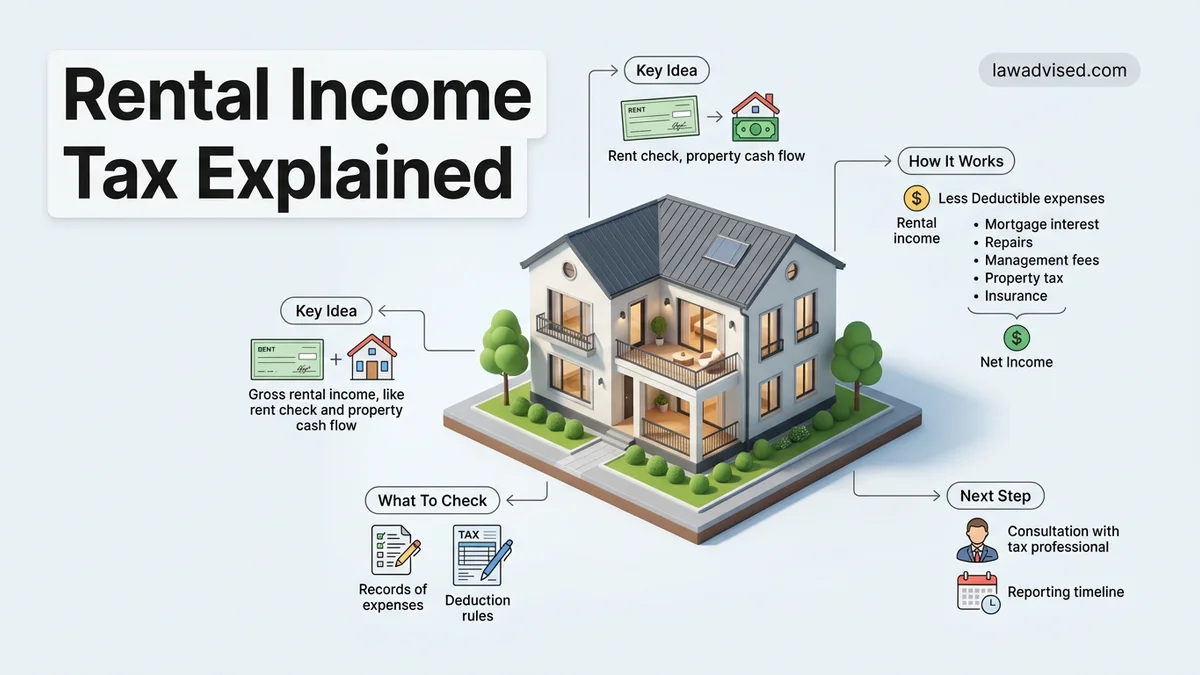
All rental income is generally taxable and must be reported to the IRS, but landlords can significantly lower their tax liability by deducting operating expenses and depreciation. Calculating net taxable income requires subtracting legitimate business costs—such as mortgage interest, repairs, and property taxes—from your gross rental receipts. Proper record-keeping and correct reporting on Schedule E ensure full compliance while maximizing your real estate profits.
Rental income is taxed as ordinary income at your standard federal and state tax rates, meaning every dollar of profit you generate is added to your other annual earnings. However, the IRS does not tax your gross rental receipts; instead, you only pay taxes on your net rental income after subtracting all allowable operating expenses and depreciation write-offs.
Navigating these tax obligations in 2026 requires understanding exactly which deductions apply to your portfolio and how to calculate your net earnings accurately. By maximizing your write-offs and separating routine repairs from capital improvements, you can dramatically reduce your tax liability and keep more cash flow in your business.
Key Takeaways
- All gross rental income must be reported on your tax return, including advance rent and security deposits kept.
- Deductible expenses directly lower your taxable rental income dollar-for-dollar.
- Always separate routine repairs from capital improvements, as they are taxed and depreciated differently.
- Depreciation allows you to deduct the cost of the property’s wear and tear over 27.5 years.
- Use IRS Schedule E to report your rental income and allowable expenses annually.
What Causes High Rental Income Tax Liabilities
Many landlords face unexpectedly high tax bills because they fail to track expenses correctly throughout the year or misunderstand how the IRS treats different types of property maintenance. When you do not log your deductions properly, your taxable baseline stays artificially inflated, forcing you to hand over a massive chunk of your hard-earned rental revenue.
Failing to Distinguish Between Repairs and Improvements
One of the fastest ways to trigger an IRS audit or inflate your taxable income is miscategorizing property work. A repair simply keeps your property in normal, efficient operating condition and is fully deductible in the year you pay for it. An improvement, on the other hand, adds value, prolongs the life, or adapts the property to new uses, and must be depreciated over multiple years.
- Repairs (Fully Deductible Now): Fixing a leaky faucet, patching a small hole in drywall, or servicing the HVAC unit.
- Improvements (Capitalized over Time): Replacing an entire roof, installing a brand-new kitchen layout, or adding a security system.
Overlooking the Power of Depreciation
Depreciation is a non-cash expense that allows you to deduct the cost of buying and improving a rental property over a set period. Under current 2026 tax guidelines, residential rental property is generally depreciated over a 27.5-year period. If you fail to claim this deduction each year, you miss out on a massive paper loss that offsets your physical rental profits, leaving you paying taxes on money you should have sheltered.
How to Calculate Net Taxable Rental Income Step-by-Step
Calculating your taxable rental income is a straightforward mathematical process that bridges the gap between what tenants pay you and what the IRS actually taxes. You must account for every dollar collected and match it against your legitimate business outlays to arrive at your final net figure.
Step 1: Total Your Gross Rental Receipts
Your calculation always starts with the total money you brought in during the 2026 tax year. This gross amount includes standard monthly rent payments, any non-refundable deposits you kept, tenant reimbursements for utilities or property damage, and the application fees you collected. Do not include security deposits that you plan to return to the tenant when their lease ends.
Step 2: Subtract Allowable Operating Expenses and Depreciation
Once you have your gross receipts total, you subtract your deductible operating expenses and your annual depreciation allowance. The resulting figure is your net taxable rental income, which you will report on your Schedule E. Keep detailed receipts, digital logs, and bank statements for every single deduction you claim to protect yourself in the event of an audit.
- List all out-of-pocket costs: Add up property taxes, mortgage interest, landlord insurance, property management fees, and utilities paid by you.
- Include travel and marketing: Factor in mileage driven for property inspections and the cost of advertising vacant units.
- Apply depreciation: Calculate your annual building depreciation and subtract it alongside your operating costs.
How to Fix Common Deduction Mistakes and Lower Your Taxes
Many landlords trigger costly IRS audits by misclassifying capital improvements as routine repairs. According to the Internal Revenue Service tangible property regulations, repairs maintain your property in normal operating condition, while improvements add value or prolong its useful life. Correcting these classification errors requires strict adherence to specific accounting protocols.
Step-by-Step Correction Protocol
- Review your general ledger for the 2026 tax year and isolate all line items categorized as property maintenance exceeding two thousand five hundred dollars.
- Apply the IRS Safe Harbor for Small Taxpayers to immediately expense qualifying improvements on residential buildings valued under one million dollars.
- File Form 3115, Application for Change in Accounting Method, if you previously capitalized routine repairs and need to claim missed depreciation deductions.
- Adjust your depreciation schedules using IRS Publication 527 guidelines to accurately reflect the 27.5-year recovery period for residential real estate.
What If Your Rental Losses Exceed Passive Activity Limits
Real estate investors frequently generate paper losses that exceed their active income thresholds due to aggressive depreciation schedules. Under IRS passive activity loss rules, rental real estate is generally considered passive, limiting your ability to offset ordinary W-2 income. However, specific statutory exceptions exist for active participants and real estate professionals.
Navigating Passive Loss Limitations
- Calculate your modified adjusted gross income to determine if you qualify for the special twenty-five thousand dollar active participation allowance.
- Verify that you own at least ten percent of the property and actively make management decisions, such as approving new tenants or arranging repairs.
- Track your hours rigorously if you claim Real Estate Professional Status, requiring more than seven hundred and fifty hours of material participation in real property trades annually.
- Carry forward any disallowed passive losses indefinitely to offset future rental income or the ultimate capital gain upon property sale.
What If It Still Doesn’t Work?
Complex multi-property portfolios or severe passive loss restrictions often require specialized intervention when standard tax software falls short. If your calculations remain unresolved, consider these fallback steps:
- Reconcile your Schedule E line items directly against your bank statements and 1099-NEC forms to catch forgotten expense categories.
- Consult a Certified Public Accountant (CPA) who holds the Enrolled Agent credential or specializes in real estate taxation.
- Prepare for professional fees ranging from seven hundred fifty dollars to two thousand five hundred dollars depending on your portfolio size.
- Request a formal private letter ruling from the IRS for highly ambiguous transactions involving mixed-use or short-term vacation rentals.
Conclusion
Mastering rental income tax in 2026 requires distinguishing between routine repairs, capital improvements, and passive loss limits to protect your bottom line. According to verified research and expert sources from the American Institute of Certified Public Accountants, proactive documentation remains the single most effective defense against costly IRS audits. Your immediate actionable next step is to audit your current year expense categorization and consult a licensed tax professional before filing.
❓ Frequently Asked Questions
Are security deposits considered taxable rental income when received?
Security deposits are not treated as income when you first receive them if you plan to return them to the tenant at the end of the lease. However, if you keep all or part of a deposit to cover unpaid rent or property damage, that retained amount becomes taxable income in the year you keep it.
Can I deduct travel expenses for visiting my rental property?
Yes, ordinary and necessary local transportation expenses or travel costs for overnight trips taken to manage, inspect, or maintain your rental property are deductible. You must keep a strict log of the mileage or travel receipts and prove that the primary purpose of the trip was business.
What happens if my rental expenses are higher than my rental income?
If your rental deductions exceed your rental income, you have a net rental loss. Under passive activity loss rules, if your modified adjusted gross income is under $100,000, you may be able to deduct up to $25,000 of this loss against your active income, provided you actively participate in the property management.
Are property management fees deductible?
Yes, any fees you pay to a property management company to find tenants, collect rent, handle maintenance emergencies, or oversee daily operations are fully deductible as ordinary operating expenses on your Schedule E.
Do I have to pay self-employment tax on my rental income?
Generally, rental income is considered passive investment income and is not subject to self-employment tax. It only becomes subject to self-employment tax if you provide substantial services primarily for the tenant’s convenience, such as daily hotel-like housekeeping or meals.
How long do I need to keep my rental property tax records and receipts?
You should keep all records, receipts, closing statements, and invoices for your rental property for at least three years from the date you file the tax return that includes those transactions. For records relating to property basis and capital improvements, keep them for at least three years after the year you eventually sell the property.

Ismail Hossain is the founder of Law Advised. He is an Divorce, Separation, marriage lawyer. Follow him.