Fellowship Income Tax Explained 2026 Step-by-Step Guide
Fellowship grants are taxable to the extent they are used for living expenses, but money spent on qualified tuition and required fees is generally tax-free. Because institutions typically do not withhold taxes from fellowship stipends, recipients must calculate and pay quarterly estimated taxes to avoid IRS penalties.
Fellowship grants are generally taxable income, and unlike traditional employment, taxes are rarely withheld from your stipend automatically. If your fellowship pays for your living expenses, housing, or personal travel, the IRS expects you to report that money and pay taxes on it yourself, which usually requires making quarterly estimated tax payments to avoid penalties.
Navigating fellowship taxes can feel like a guessing game when your university or funding institution hands you a paycheck without taking out a single dollar for federal or state taxes. This guide breaks down the 2026 tax rules for fellowships, showing you exactly what portion of your grant is taxable, how to report it correctly, and how to stay ahead of the IRS.
Key Takeaways
- Fellowship funds used for qualified tuition and fees are tax-free.
- Stipends spent on living expenses and housing are fully taxable income.
- Institutions rarely withhold taxes, requiring proactive quarterly estimated tax payments.
- Service-required stipends (like teaching assistantships) are treated as W-2 taxable wages.
- Keep detailed receipts of all educational expenses to prove tax-free status.
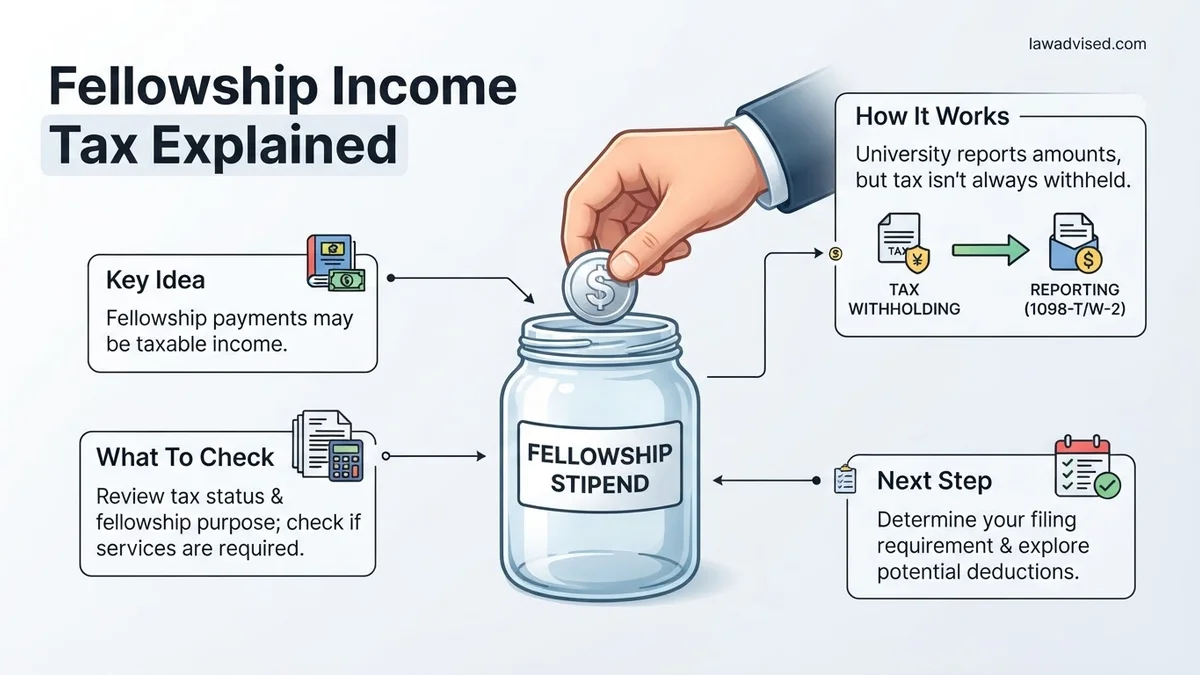
What Causes Tax Liability on Fellowship Income and Stipends
The IRS determines whether your fellowship money is taxable based entirely on how you spend it. This distinction dictates whether you will owe the government a portion of your hard-earned funding.
Qualified Tuition and Related Expenses
The portion of your fellowship used strictly for qualified tuition, fees, books, supplies, and equipment required for your courses is tax-free. To qualify for this exemption, you must be a candidate for a degree at an eligible educational institution. If your entire fellowship goes straight to paying your university bill for tuition and mandatory fees, you do not owe income tax on that amount.
Stipends and Living Expenses
Any portion of your fellowship designated or used for living expenses, rent, food, travel, or optional equipment is fully taxable income. Even if your university calls this money a stipend for research or training, the IRS views it as taxable compensation. Because institutions rarely withhold taxes from fellowship stipends, the responsibility falls squarely on your shoulders to track this money and pay taxes on it.
How to Calculate and File Your Fellowship Taxes Step-by-Step
Handling fellowship taxes requires a proactive approach since you will not receive a standard Form W-2 at the end of the year. Here is how to manage your reporting obligations for the 2026 tax season.
Determine Your Taxable Amount and Reporting Forms
Start by subtracting your qualified tuition and book expenses from your total fellowship income. The remaining balance is your taxable fellowship income. Keep in mind that institutions are not always required to issue a Form 1098-T or a Form 1099-NEC for fellowship stipends, but you are still legally required to report the income. On your federal tax return, report taxable fellowship stipends on the line designated for wages, salaries, and tips, and write SCH on the dotted line to indicate it is a scholarship or fellowship grant not reported on a W-2.
Handle Estimated Quarterly Tax Payments
Because taxes are not withheld from fellowship stipends, you must pay as you go using IRS Form 1040-ES if you expect to owe more than $1,000 in federal taxes for 2026. Divide your estimated annual tax liability into four equal payments and submit them quarterly using the following federal deadlines:
- April 15, 2026
- June 15, 2026
- September 15, 2026
- January 15, 2027
Failing to make these estimated payments can result in underpayment penalties when you file your annual tax return, even if you pay the full balance in April.
How to Make Quarterly Estimated Tax Payments Without Penalties
Because most fellowship sponsors do not withhold federal or state income taxes, recipients often must submit quarterly estimated tax payments to the IRS. Missing these deadlines triggers underpayment penalties governed by IRS Publication 505. To maintain compliance in 2026, fellows must calculate their expected annual liability and submit payments four times a year.
Step-by-Step Estimated Tax Procedure
- Calculate your total expected 2026 taxable fellowship income and subtract the standard deduction ($15,000 for single filers projected for 2026).
- Apply the appropriate marginal tax bracket rate to your net taxable income to determine your baseline annual tax liability.
- Divide your total estimated tax liability by four to find the quarterly installment amount due.
- Submit each payment using IRS Direct Pay or Form 1040-ES by the statutory deadlines: April 15, June 15, September 15, and January 15 of the following year.
According to Internal Revenue Service guidelines, avoiding penalties requires paying at least 90 percent of your current year tax liability or 100 percent of your prior year liability (110 percent if your adjusted gross income exceeds $150,000).
What If Your Fellowship Involves Teaching or Research Service Requirements
The tax classification of a fellowship shifts dramatically if the institution mandates specific service in exchange for the funding. The IRS draws a strict legal distinction between a no-service stipend and compensation for employment services.
Navigating W-2 Versus 1099 Classifications
- Service-Required Stipends: If your fellowship agreement requires teaching, grading, or specific laboratory research as a condition of receiving funds, the IRS typically classifies these payments as wages subject to mandatory W-2 withholding.
- Pure Training Fellowships: If the primary purpose of the award is to further your own education without specific service quotas, the funds remain non-service scholarships, leaving tax withholding entirely up to you.
- FICA Tax Exemptions: Graduate students enrolled at least half-time and working for the university may qualify for the student FICA exception under IRC Section 3121(b)(10), exempting them from Social Security and Medicare taxes during the academic year.
Tax experts emphasize reviewing your formal institutional offer letter and Form 1098-T each January to verify how the payroll department reported your income to federal authorities.
What If It Still Doesn’t Work?
If your calculation software yields conflicting results or you face unexpected IRS penalty notices regarding your fellowship income, resolve the issue using these fallback steps:
- Contact your university or sponsoring institution’s payroll office to request a detailed breakdown of your income reporting codes and verify whether W-2 or 1099-NEC forms were issued.
- Consult a Certified Public Accountant (CPA) or a federally authorized Enrolled Agent who specializes in graduate student and postdoctoral researcher taxation.
- Utilize specialized volunteer tax assistance programs like VITA (Volunteer Income Tax Assistance), which often provide IRS-certified support specifically tailored for fellowship recipients on university campuses.
- If hiring a private tax professional, expect an average cost range of $250 to $600 for a standard individual return involving multi-state fellowship income and estimated payments.
Conclusion
Managing fellowship income taxes requires proactive planning, careful tracking of qualified educational expenses, and strict adherence to quarterly IRS payment deadlines. By separating taxable stipends from tax-free tuition coverage and understanding service-requirement thresholds, fellows can eliminate surprise bills and costly penalties. According to verified research and academic tax specialists, maintaining meticulous financial records throughout the year remains the single most effective strategy for compliance. Your immediate next step is to review your current fellowship agreement and calculate whether your projected 2026 tax liability crosses the threshold requiring quarterly estimated payments.
❓ Frequently Asked Questions
Are international students subject to different fellowship tax rules?
Yes, non-resident alien fellows are generally subject to a flat 14% withholding tax on taxable scholarship and fellowship amounts, provided they hold valid F, J, M, or Q visas, unless a tax treaty exempts them.
What qualified education expenses make a fellowship tax-free?
Qualified expenses include tuition and fees required for enrollment, as well as books, supplies, and equipment required for specific courses at an eligible educational institution.
Can I claim education tax credits like the Lifetime Learning Credit using fellowship funds?
You cannot double-dip; expenses paid with tax-free fellowship grants cannot also be used to claim education tax credits. Only out-of-pocket expenses or loans qualify for credits.
What happens if I miss a quarterly estimated tax payment on my stipend?
Missing quarterly deadlines or underpaying can result in IRS underpayment penalties and interest charges when you file your annual tax return, though penalties can sometimes be avoided if you owe less than $1,000 total.
Do I need to issue a 1099 or file self-employment tax for a fellowship?
No, fellowship stipends are not considered self-employment income, so you do not pay self-employment tax (Social Security and Medicare) on them, and they are not reported on a 1099-NEC.
How should I track my fellowship income and expenses for tax season?
Maintain a dedicated digital folder with your fellowship award letters, 1098-T forms from your university, receipts for required book purchases, and records of all quarterly estimated tax payment receipts.

Ismail Hossain is the founder of Law Advised. He is an Divorce, Separation, marriage lawyer. Follow him.