Driving Laws in California 2027 A Proven Expert Guide
Navigating driving laws in california requires strict adherence to hands-free cell phone mandates, dynamic speed limits, and updated right-of-way rules. Drivers must understand the primary state regulations and recent legal changes to avoid hefty fines, points on their record, and safety hazards.
Navigating California’s roadways in 2027 requires strict adherence to updated vehicle codes, notoriously strict distracted driving statutes, and localized speed limits. If you want to avoid steep fines, points on your record, or collisions, you must master the state-specific rules that catch even seasoned drivers off guard.
Staying compliant protects your financial well-being and your driving privileges. California highway patrol and local law enforcement heavily enforce these regulations using advanced automated technology, making a deep understanding of current legal expectations non-negotiable for anyone operating a vehicle in the Golden State.
Key Takeaways
- Strict hands-free laws prohibit holding or operating a smartphone for any reason while driving.
- California enforces a basic speed law requiring speeds appropriate for current road and weather conditions.
- New legal updates target specific traffic infractions and pedestrian right-of-way protocols.
- Fines for running red lights or texting while driving carry severe financial penalties and DMV points.
- Always consult the California DMV handbook for official verification of current rules and updates.
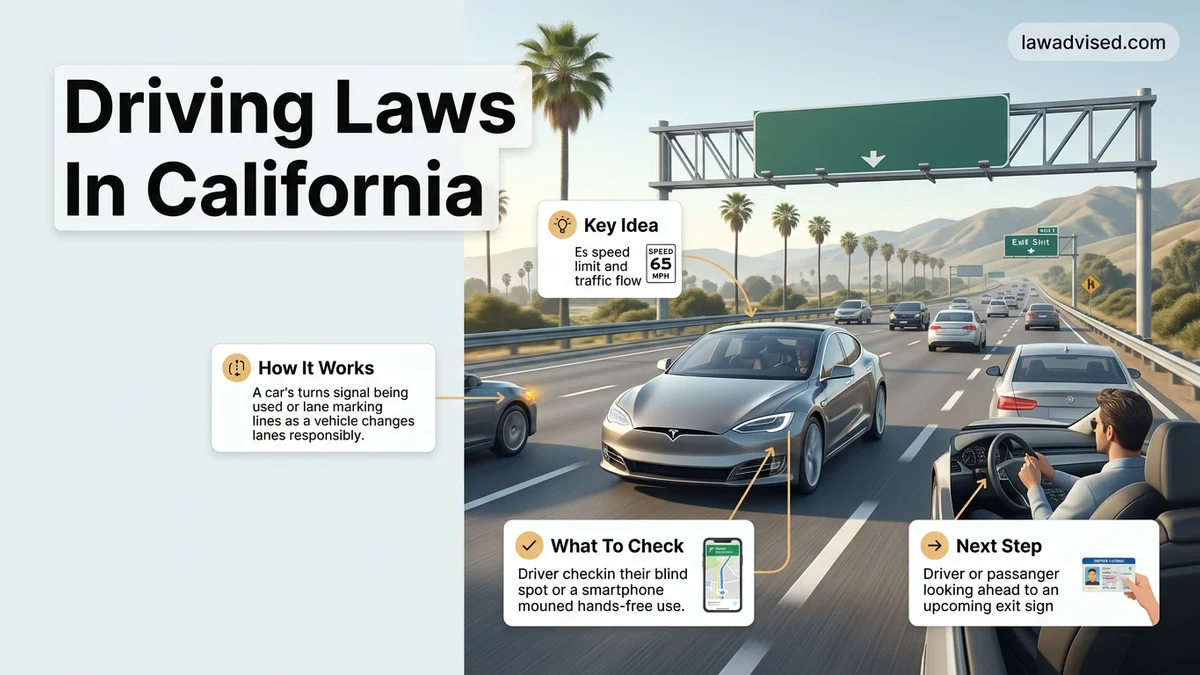
What Causes Driver Confusion and Violations of California Driving Laws
Misinterpreting the Strict California Hands-Free Phone Ban
Many out-of-state drivers and residents violate California Vehicle Code 23123.5 because they misunderstand the absolute nature of the handheld device ban. You cannot hold your phone for any reason while your vehicle is in motion or even temporarily stopped at a traffic light.
- The Core Rule: Your phone must be mounted on the dashboard, center console, or windshield in a way that does not block your view of the road.
- Single Swipe Exception: You are only allowed to activate or deactivate a feature or function with the single motion of a finger or swipe, provided the device is mounted.
- Smartwatch Restrictions: Wearing smartwatches to read or send text messages while driving falls under the same strict handheld ban.
Confusing Right-of-Way and Lane Splitting Legality
California is famous for unique traffic allowances and restrictions that routinely confuse motorists. Lane splitting by motorcyclists is fully legal, provided it is done in a safe and prudent manner, which forces drivers to exercise heightened awareness during heavy congestion.
- Bicycle Clearance: You must leave a minimum of three feet of space when passing a cyclist. If road conditions prevent this, you must slow to a reasonable speed and safely pass only when it is safe.
- Controlled Intersections: California strictly enforces yielding rules at uncontrolled T-intersections, where the terminating roadway must yield to through traffic.
How to Follow Core California Rules of the Road and Speed Limits Step-by-Step
Mastering California Speed Limits and the Basic Speed Law
Speed enforcement in California relies heavily on the Basic Speed Law, which means you can be ticketed for driving too fast for conditions—even if you are traveling at or below the posted numeric speed limit during heavy rain, fog, or congested traffic.
- Standard Freeways: The maximum speed limit on most California freeways remains 65 or 70 miles per hour, unless otherwise posted.
- Business and Residential Zones: The statutory speed limit is 25 miles per hour unless signs indicate a different limit.
- School Zones: When children are outside or crossing, the speed limit drops to 25 or 15 miles per hour.
Executing Safe Turns and Freeway Merging Protocols
Following proper lane discipline and turning procedures will save you from costly moving violations. California law requires specific steps for turning and signaling.
- Signaling Distance: You must activate your turn signal at least 100 feet before making a turn or changing lanes.
- U-Turn Regulations: U-turns are legal in residential districts if no vehicles are approaching within 200 feet, but they are strictly prohibited in business districts unless a sign permits them.
- Red Light Turns: You may turn right on a red light after coming to a complete stop, yielding to pedestrians and oncoming traffic, unless a sign explicitly prohibits a red-light turn.
How to Comply with Distracted Driving and Hands-Free Phone Laws
California enforces some of the strictest distracted driving regulations in the nation. As of 2027, holding a smartphone or electronic device while operating a motor vehicle remains strictly prohibited under Vehicle Code 23123.5. Transport safety studies show that manual device interaction quadruples crash risks. Drivers must rely exclusively on built-in vehicle systems or single-swipe mounts.
Understanding the Single-Swipe Rule
The state legislature allows the use of GPS and voice-operated functions only if the device is mounted on the dashboard or console. Drivers cannot hold the device or navigate menus while the vehicle is in motion. Law enforcement agencies strictly penalize any interaction that requires more than a single tap or swipe. Violations carry baseline fines starting at $20 for a first offense and escalate past $50 for subsequent infractions within a 36-month window.
Steps for Full Compliance
- Secure all mobile devices to an approved dashboard or console mount before starting the ignition.
- Program navigation routes and music playlists prior to moving the vehicle out of park.
- Utilize steering wheel controls or pre-set voice commands for any necessary mid-trip adjustments.
- Pull safely into a designated parking area or completely off the roadway before handling a device manually.
What If You Get a Traffic Ticket and Need to Fix Your Driving Record
Receiving a traffic citation in California can add points to your Department of Motor Vehicles (DMV) record and trigger auto insurance rate hikes. Fixing your record requires immediate administrative action and adherence to strict state deadlines. Ignoring a ticket leads to license suspension and additional civil assessments.
Steps to Resolve a Citation and Protect Your Record
- Review the citation notice for the mandatory appearance or resolution date, typically set within 30 to 45 days of issuance.
- Confirm eligibility for Traffic Violator School (TVS) with the local superior court to prevent point accumulation on your public record.
- Pay the required bail amount plus state administrative fees online or via mail to the designated county court.
- Complete the state-certified traffic school course within the assigned 90-day completion window.
- Verify that the court and the DMV have processed your completion certificate to ensure the point is masked from your insurance provider.
What If It Still Doesn’t Work?
If standard ticket resolution methods fail or administrative errors threaten your driving privileges, secondary measures are required. Complex legal hurdles demand specialized intervention to prevent long-term record damage.
- Contact the county traffic court clerk immediately to request an extension if processing delays occur.
- File a formal motion to vacate a judgment or request a new trial if you missed a court date due to unavoidable circumstances.
- Consult a licensed traffic defense attorney for specialized assistance with severe violations or pending license suspensions. Professional legal representation typically ranges from $500 to $1,500 depending on court appearances required.
- Request an official DMV driving record printout after 39 months to verify that older points have expired according to state statutory guidelines.
Conclusion
Navigating California driving laws in 2027 requires constant vigilance regarding speed limits, hands-free mandates, and prompt ticket management. Failing to address citations or ignoring regulatory updates can result in severe financial penalties and mandatory license suspensions. According to verified research and expert transit sources, proactive compliance remains the most effective strategy for maintaining a pristine driving record. Take the next step today by reviewing your current DMV record online to ensure all past infractions are properly cleared.
❓ Frequently Asked Questions
What are the current child safety seat laws in California?
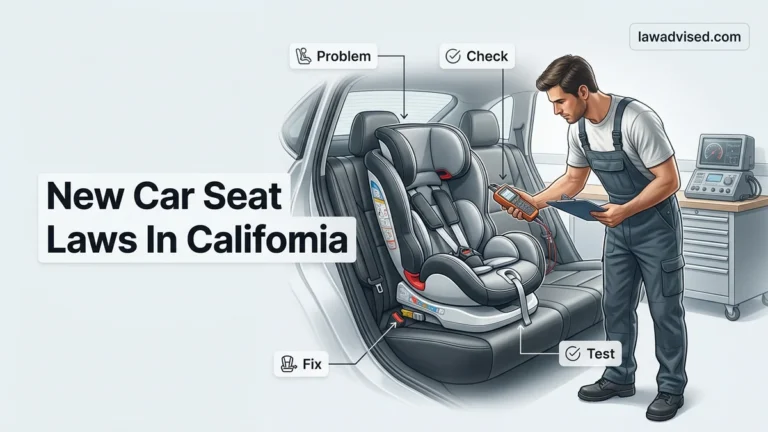
Children under the age of two must ride in a rear-facing car seat unless they weigh 40 or more pounds or are 40 or more inches tall. Children under eight must be secured in a car seat or booster seat in the rear seat.
How does California handle right-of-way at four-way stops?
Vehicles that arrive at the intersection first have the right-of-way. If two vehicles arrive simultaneously, the driver on the right yields to the driver on the left.
What is the penalty for running a red light in California?
Running a red light results in a mandatory court appearance or steep fine exceeding $400, along with one point added to your driver’s license record.
Can I make a right turn on a red light?
Yes, you may turn right on a red light after coming to a complete stop, yielding to pedestrians and oncoming traffic, unless a sign specifically prohibits the turn.
What are the rules regarding bicycle safety on California roads?
Motorists must give bicycles a minimum of three feet of clearance when passing. If road conditions prevent three feet of clearance, drivers must slow down and safely pass when clear.
What should I do if I am involved in a traffic accident?
You must stop immediately, check for injuries, move your vehicle out of traffic if possible, and exchange license, insurance, and registration details with the other parties involved.

Ismail Hossain is the founder of Law Advised. He is an Divorce, Separation, marriage lawyer. Follow him.