Gun Laws in California in Car Step-by-Step 2027 Guide
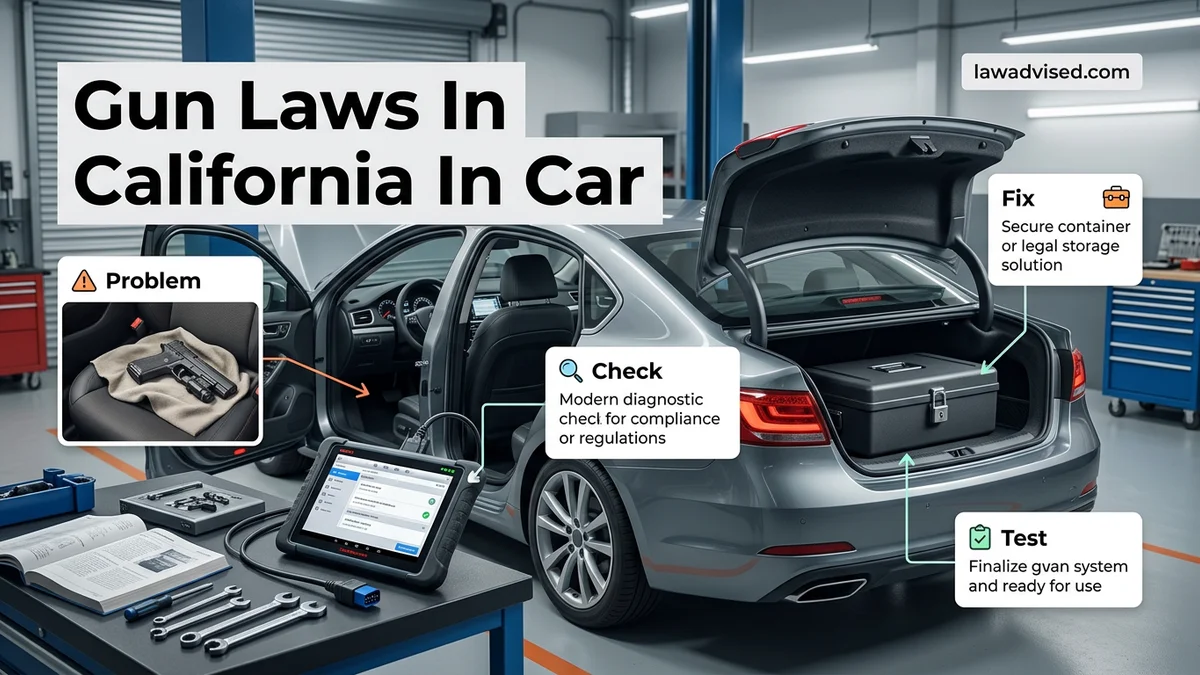
Transporting firearms incorrectly in a motor vehicle can lead to severe criminal charges. Under California law, handguns and long guns must generally be unloaded and stored securely in a locked container that is not the glove box or utility compartment.
Transporting a firearm inside a vehicle in California under 2027 laws requires strict adherence to state statutes, where handguns generally must be unloaded and locked in a secure container inside the trunk or a designated locked box, explicitly excluding the glove compartment or center console.
Failing to follow these precise transport mandates exposes you to severe criminal penalties, including potential felony charges. Knowing the exact legal boundaries ensures you remain compliant during daily commutes or road trips across the state.
Key Takeaways
- All firearms transported in a vehicle must be completely unloaded.
- Use a locked container other than the glove compartment or utility box.
- The vehicle’s trunk qualifies as a legal locked container.
- A valid California CCW permit alters standard vehicle transport rules.
- Violating vehicle firearm laws can result in misdemeanor or felony charges.
What Causes Legal Violations of Gun Laws in California Vehicles
Common Mistake: Using the Glove Box or Center Console
Many gun owners mistakenly believe that placing a firearm inside the glove box or center console satisfies California transport laws. Under 2027 regulations, these compartments are never considered legal storage locations for handguns or long guns. Law enforcement routinely issues felony charges during routine traffic stops when firearms are found easily accessible in these front cabin areas. You must keep all firearms completely out of arm’s reach from the driver and passengers unless you hold a valid concealed carry permit.
Unsecured Ammunition and Accessible Long Guns
Violations also occur frequently due to improper ammunition storage and accessible long guns. While long guns do not always require a locked container under older interpretations, current enforcement strongly prioritizes secure containment to avoid charges of carrying a loaded firearm in public. Leaving loose rounds in the same compartment as an unsecure firearm creates immediate legal exposure. Law enforcement officers treat any firearm combined with readily accessible ammunition as a loaded weapon, escalating minor transport oversights into major criminal offenses.
How to Transport Firearms Legally in a Car Step-by-Step
Step 1: Ensure the Firearm is Completely Unloaded
Before placing any firearm inside your vehicle, you must verify that the weapon is completely unloaded. Remove the magazine and check the chamber to ensure no rounds remain. California law strictly defines a loaded firearm as having live ammunition attached or inserted in a way that allows it to be fired. Taking this preliminary step protects you from accidental discharge risks and satisfies the baseline legal requirement for vehicle transport.
Step 2: Place the Firearm in an Approved Locked Container
Once unloaded, you must place the firearm inside a dedicated locked container. The container must be fully enclosed and secured with a key, combination lock, or padlock.
- Hard-sided locking cases specifically designed for firearms
- Factory gun cases secured with an external padlock
- Specialized vehicle lockboxes bolted directly to the chassis
Remember that utility boxes, glove compartments, and center consoles do not qualify as legal locked containers under California law.
Step 3: Store the Container in the Correct Vehicle Location
The final step involves positioning the locked container within your vehicle. If your car has a trunk, the locked container must go inside the trunk. For vehicles without a trunk, such as SUVs, hatchbacks, or trucks, you must place the locked container out of plain sight and completely inaccessible to the driver and passengers. Following this three-step process guarantees full compliance with California vehicle transport statutes.
What If You Have a California CCW Permit Inside Your Vehicle
Carrying a concealed weapon with a California Carry Concealed Weapon (CCW) permit changes how state laws apply to your vehicle in 2027. Issuing agencies, typically local county sheriffs or police chiefs, set specific terms of restriction. Permit holders must always carry their physical license alongside a valid government-issued photo identification.
CCW Restrictions and Interstate Validity
Even with a valid California CCW permit, specific zones remain strictly off-limits. Federal and state legislation prohibits firearms in designated sensitive places, including school zones, state parks, and government buildings. Furthermore, California does not offer universal reciprocity. Drivers crossing state lines into Nevada or Arizona must review those jurisdictions’ distinct firearm transport statutes immediately.
- Verify that your specific county-issued CCW permit is currently active and unexpired.
- Confirm that the exact firearm make, model, and serial number match your permit documentation.
- Comply immediately with any verbal instructions from law enforcement regarding your firearm during a traffic stop.
- Store your firearm on your person or securely inside the vehicle strictly according to your issuing agency’s guidelines.
What If Your Locked Container Setup Still Fails Legal Standards
Law enforcement officers frequently evaluate vehicle firearm storage during roadside stops. If an officer determines your locked container setup fails California compliance standards, you face immediate misdemeanor or felony charges under Penal Code 25400. Knowing corrective fallback actions ensures you protect your legal standing and property rights.
Immediate Remediation Steps for Transport Compliance
When legal transport methods face scrutiny or equipment failure, swift action prevents severe criminal penalties. According to state legal experts and criminal defense data, resolving firearm transport deficiencies rapidly minimizes long-term legal exposure.
- Request permission from law enforcement to immediately surrender the non-compliant container and firearm to a licensed local gun dealer for secure storage.
- Consult a certified California firearms attorney immediately if a citation or arrest occurs. Legal defense representation for weapons charges typically ranges from $2,500 to $7,500 depending on court complexity.
- Acquire a Department of Justice-approved locked container that utilizes a heavy-duty steel cable or direct seat bracket bolt-down system.
- Schedule a compliance review with a firearms expert to inspect your upgraded vehicle storage setup before undertaking future road trips.
Conclusion
Navigating California vehicle firearm laws requires strict adherence to locked container mandates, ammunition separation rules, and rigorous CCW restrictions. Failure to comply risks severe criminal liabilities under penal codes updated for 2027. According to verified research and legal compliance experts, securing your firearms in DOJ-approved, fully enclosed containers remains the single most effective safeguard against accidental violations. Review your local county sheriff guidelines today and inspect your vehicle transport setup immediately to ensure total legal compliance.
❓ Frequently Asked Questions
What are the exact legal requirements for a locked container in California?
A locked container must be fully enclosed and secured by a padlock, keylock, combination lock, or similar device. Factory hard cases with padlocks or dedicated firearm lockboxes are standard compliant options.
Can passengers in the car transport firearms if they do not own them?
Yes, passengers must follow the exact same rules of keeping firearms unloaded and locked in a secure container away from the passenger cabin if possible.
What are the penalties for violating California vehicle gun laws?
Transporting a loaded firearm in a vehicle is generally charged as a misdemeanor, but can be elevated to a felony under specific aggravating circumstances such as prior convictions or unregistered weapons.
Can I transport ammunition in the same container as the firearm?
California law permits transporting ammunition in the same locked container or trunk as the unloaded firearm, provided neither is loaded into the weapon.
Are long guns subject to the same strict transport rules as handguns?
Yes, while long guns do not legally require a locked container under state law for transport unless specified locally, they must still be completely unloaded and secured.
How do out-of-state residents traveling through California comply with vehicle laws?
Non-residents must follow the same strict California state laws requiring all firearms to be unloaded and stored in a locked container or trunk while driving through the state.

Ismail Hossain is the founder of Law Advised. He is an Divorce, Separation, marriage lawyer. Follow him.