Income Tax vs Payroll Tax A Real Guide for 2026
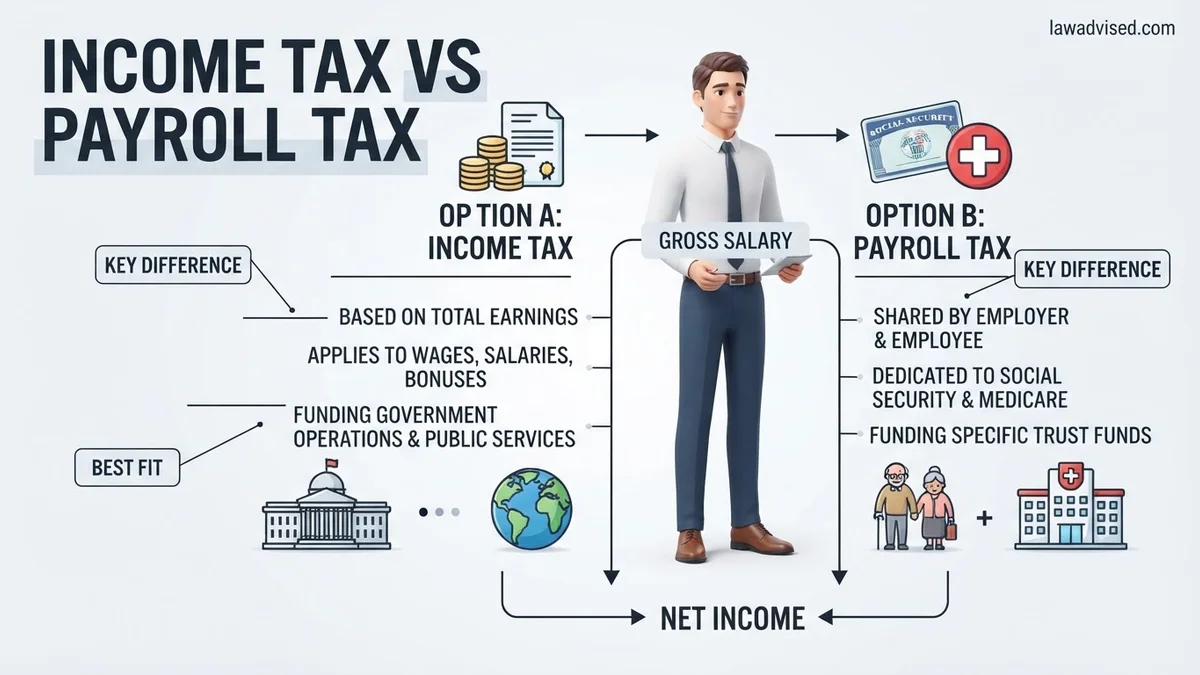
Income tax funds general government operations based on your total earnings and tax brackets, whereas payroll tax funds specific social programs like Social Security and Medicare through flat percentage rates. Understanding how these two deductions affect your paycheck differently ensures you can accurately read your pay stub and anticipate your net take-home pay.
Income tax and payroll tax are both taken directly out of your earnings, but they serve completely different purposes and follow entirely separate rules. Income tax is a progressive levy that funds general government operations based on your total annual earnings and tax brackets, while payroll tax (known as FICA) is a flat-rate tax that strictly funds specific social insurance programs like Social Security and Medicare.
Understanding this distinction changes how you look at your take-home pay in 2026. When you glance at your paycheck, you are seeing two distinct financial mechanisms at play: one that shifts based on your overall financial picture, and another that operates like a mandatory subscription to public safety nets.
Key Takeaways
- Income tax pays for general government programs like defense and infrastructure.
- Payroll taxes specifically fund Social Security and Medicare through FICA deductions.
- Employees pay 100% of income tax, while FICA taxes are split 50/50 with W-2 employers.
- Income tax uses progressive tax brackets; payroll taxes use flat percentages up to a wage cap.
- Self-employed individuals must pay both the employer and employee portions of payroll taxes.
What Causes Confusion Between Income Tax and Payroll Tax
The primary reason people confuse these two taxes is simple: they both appear as automatic deductions on the exact same pay stub every two weeks. When you look at the total tax withholding column, your brain lumps them together as money vanishing into the government’s hands.
The Structural Differences in Calculation
Income tax and payroll tax use fundamentally different mathematical formulas to determine how much money you owe. This structural gap creates vastly different impacts on your take-home pay.
- Income Tax: Uses a progressive bracket system where your rate increases as you earn more money, adjusted for deductions and filing status.
- Payroll Tax: Uses a flat percentage rate applied to your earnings, regardless of how many dependents you have or what your total household income looks like.
- The Wage Cap Factor: Social Security payroll tax applies only up to a specific annual wage limit, whereas income tax applies to every dollar you earn and can even climb into higher marginal brackets.
The Burden of Responsibility
Another major point of confusion involves who actually pays for these taxes. While both are deducted from your paycheck by your employer, the economic reality behind the scenes is very different.
- Income Tax Responsibility: You, the employee, bear 100 percent of the income tax liability on your wages.
- Payroll Tax Sharing: For W-2 workers, FICA payroll taxes are split right down the middle—you pay 7.65 percent, and your employer matches that exact same 7.65 percent behind the scenes.
How to Fix and Read Your Pay Stub Differently
To truly master your personal finances in 2026, you need to stop reading your pay stub as a single block of lost income. Separating these line items allows you to predict how raises, bonus structures, and career moves will actually impact your net take-home pay.
Decoding Your Pay Stub Line Items
Take a close look at your earnings statement and isolate the federal income tax withholding line from the FICA lines. You will notice they react to your life events in entirely opposite ways.
- Federal Income Tax Line: This number fluctuates based on the W-4 form you submitted, your marital status, and any extra withholding requests you made.
- Social Security Line: This sits at a flat 6.2 percent of your gross wages until you hit the 2026 Social Security wage base limit, at which point it drops to zero for the rest of the year.
- Medicare Line: This sits at a flat 1.45 percent on all earnings, with an additional 0.9 percent surtax kicking in if your wages exceed high-earner thresholds.
Practical Application for Your Take-Home Pay
When you receive a 5,000 dollar bonus or a promotion, you cannot apply a single tax rate to the new money. Your payroll tax deductions will take a predictable, flat bite immediately.
Meanwhile, your income tax withholding might push a portion of that bonus into a higher marginal tax bracket, resulting in a heavier overall tax burden for that specific pay period. Recognizing this split helps you avoid budget shortfalls when planning around variable income.
What If Your Withholdings Still Don’t Match Your Expectations
When your year-end tax calculations reveal a massive discrepancy despite monitoring your income and payroll taxes, immediate corrective action is necessary. Tax brackets, standard deduction adjustments, and shifting FICA caps implemented for the 2026 tax year frequently catch workers off guard. Navigating these unexpected variances requires a systematic approach to prevent ongoing financial penalties or large unanticipated tax bills.
Assessing Your Current Pay Stub Breakdown
Begin by auditing your most recent earnings statement to verify that your employer is withholding the exact amounts you specified on your Form W-4. Payroll processing errors happen more often than workers realize. A miscalculated allowance or an outdated tax table can quietly drain your take-home pay or set you up for a harsh April surprise.
Executing Corrective Financial Steps
If your withholdings consistently fail to align with your actual tax liabilities, follow these procedural steps to correct the trajectory before the calendar year closes:
- Run your updated financial details through the IRS Tax Withholding Estimator tool online to determine your precise target withholding figure for 2026.
- Submit a newly completed Form W-4 directly to your company payroll department, adjusting the specific extra withholding dollar amount on Line 4(a).
- Monitor your subsequent two pay stubs to confirm the payroll department successfully implemented the requested adjustments.
- Calculate whether quarterly estimated tax payments are necessary to cover any remaining gap if your side income or investment yields exceed your primary salary withholdings.
What If It Still Doesn’t Work?
If manual adjustments fail to resolve your withholding imbalances or you face complex multi-state tax scenarios in 2026, standard troubleshooting steps may no longer suffice. Escalating the issue ensures you avoid severe underpayment penalties and interest charges from the government.
- Consult a certified public accountant (CPA) or an enrolled agent to perform a comprehensive historical tax audit of your earnings and deductions. Professional tax advisory fees typically range from $250 to $600 depending on the complexity of your financial portfolio.
- Contact the IRS directly through their dedicated taxpayer assistance lines to verify your account status and confirm whether your employer’s federal deposits match your reported withholdings.
- Review your past year’s transcripts via the official IRS portal to identify chronic forecasting errors in your annual deductions and credits.
- Establish a formal communication channel with your corporate human resources department if suspected payroll processing errors persist across multiple pay periods.
Conclusion
Mastering the distinct mechanics of income tax versus payroll tax remains essential for protecting your hard-earned take-home pay and avoiding unexpected financial liabilities. While income taxes fund general government operations based on your total annual earnings, payroll taxes directly support vital social safety net programs through mandatory flat-rate withholdings. According to verified research and expert financial sources, proactive quarterly monitoring of your pay stubs and Form W-4 settings eliminates costly surprises at tax time. Take action today by running your current numbers through an updated withholding calculator to lock in financial stability for 2026.
❓ Frequently Asked Questions
How are income tax brackets structured compared to payroll tax rates?
Income tax uses a progressive system with multiple brackets where higher portions of income are taxed at higher percentages. In contrast, payroll taxes use flat, unchanging percentage rates for all earners up to specific statutory limits.
What is FICA and how does it relate to payroll tax?
FICA stands for the Federal Insurance Contributions Act, which is the legal name for the payroll tax that funds Social Security and Medicare. Both the employee and employer contribute equal percentages under this act.
Do independent contractors pay payroll taxes the same way?
Independent contractors and freelancers do not have an employer to split payroll taxes with, so they must pay the entire self-employment tax, which covers both the employee and employer portions.
Are payroll taxes deductible from your income tax?
Regular payroll taxes withheld from employee paychecks are not tax-deductible. However, self-employed individuals can deduct the employer-equivalent half of their self-employment tax on their income tax return.
What happens if an employer fails to remit payroll taxes?
Employers are legally required to hold and forward payroll taxes to the government. Failing to do so can result in severe federal penalties, including the Trust Fund Recovery Penalty for responsible individuals.
Does state and local government charge both income and payroll taxes?
While most states levy a state income tax, payroll taxes for Social Security and Medicare are strictly federal. However, some local municipalities levy their own local income taxes or specialized employment training taxes.

Ismail Hossain is the founder of Law Advised. He is an Divorce, Separation, marriage lawyer. Follow him.