How to Report Multiple Sources of Income Step-by-Step 2026
Filing taxes with multiple income streams like W-2 jobs, freelance 1099 work, and investments requires combining different IRS forms on a single return. You must gather all tax documents, report traditional employment on Form 1040, and attach Schedule C for business earnings to stay compliant. Proper tracking and estimated payments help you avoid underpayment penalties and maximize eligible deductions.
Reporting multiple sources of income requires you to consolidate all standard employment wages, freelance earnings, and investment returns onto a single federal tax return using IRS Form 1040. When you juggle a full-time W-2 job alongside 1099 side hustles or stock dividends, your main goal is properly routing each distinct income stream into the correct section of your tax software or paper forms to avoid underreporting penalties.
Managing a hybrid income portfolio in 2026 demands precision because taxes are not automatically withheld from independent contractor work or capital gains. By following a structured approach to gathering documents, calculating deductions, and filing schedules, you can seamlessly combine your earnings without triggering automated IRS mismatch notices.
Key Takeaways
- Gather all W-2s, 1099s, and investment statements before starting your tax return.
- Report standard employment income using Form 1040 lines 1 through 7.
- File Schedule C alongside your 1040 to report freelance or self-employment earnings.
- Deduct qualified business expenses to lower your net self-employment taxable income.
- Make quarterly estimated tax payments if your 1099 income lacks tax withholding.
What Causes Complexity When Filing Multiple Income Sources
Mixing Employee Withholdings and Self-Employment Taxes
The primary friction point of multi-stream reporting is the collision between W-2 employment and 1099 freelance work. Your W-2 employer automatically withholds federal income tax, Social Security, and Medicare from your paychecks. Conversely, clients paying you via 1099-NEC or 1099-MISC withhold nothing. This means you must calculate and pay your own self-employment taxes using Schedule SE, covering the full 15.3% for Social Security and Medicare on net earnings over $400, while also managing quarterly estimated tax payments for 2026 to avoid penalties.
Navigating Multi-State Income and Diverse 1099 Forms
If your freelance clients or W-2 remote employers span multiple states, you may need to file non-resident state tax returns alongside your home state. Furthermore, dealing with a patchwork of tax forms—such as 1099-NEC for freelance services, 1099-DIV for stock dividends, and 1099-INT for bank interest—multiplies your data entry points. Missing even one minor 1099 document can delay your 2026 tax refund significantly.
- W-2 forms report traditional salary and wage income.
- 1099-NEC tracks non-employee compensation for independent work.
- 1099-INT and 1099-DIV capture passive investment earnings.
Juggling Multiple Income Streams Made Easy: Your Essential Action Plan
Managing and reporting multiple streams of income—such as a full-time job, freelance gigs, rental properties, and side hustles—can quickly become overwhelming come tax season. When you earn money from various sources, you are often dealing with different tax forms, varying withholding rules, and unique reporting requirements. Failing to report all your earnings correctly can lead to costly penalties, audits, or missed deductions. This comprehensive guide walks you through the exact process of organizing, calculating, and filing taxes when you have multiple sources of income, ensuring you stay compliant while keeping more of your hard-earned money.
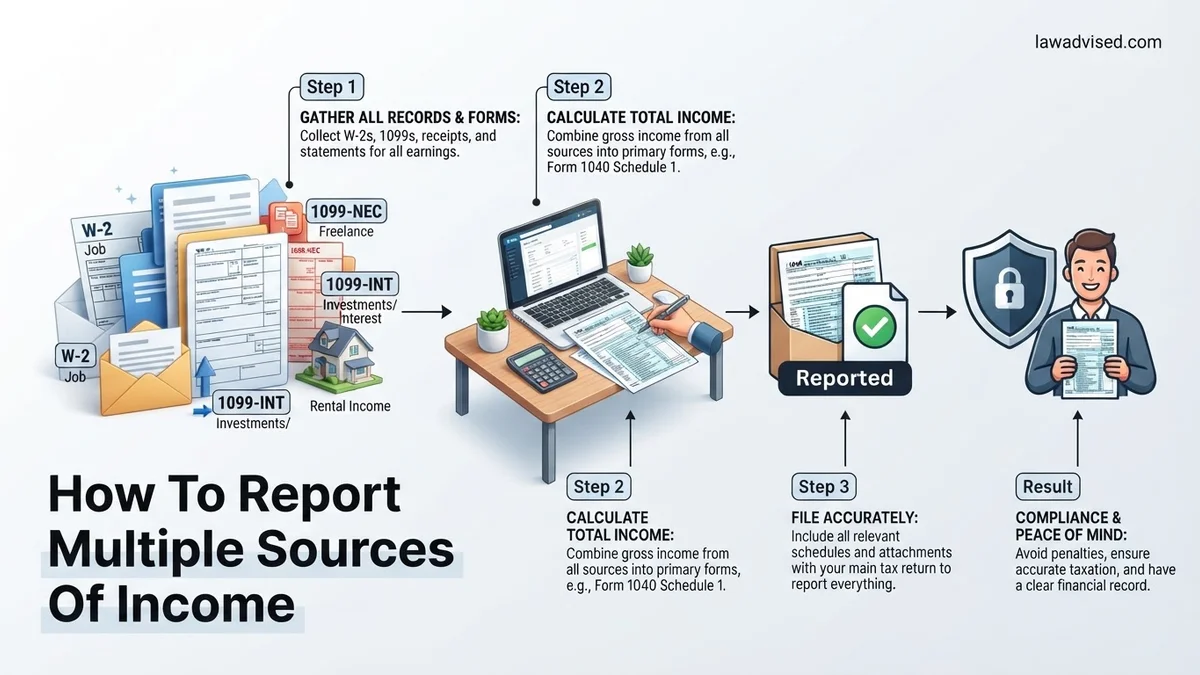
Step 1: Gather and Centralize All Tax Documents
What you need: A physical or digital folder, a spreadsheet or personal finance software, and all incoming mail or digital portals.
Instructions: Before you can report your income, you must hunt down every tax document issued to you or your business entities. Compile your W-2s from traditional employers, 1099-NEC and 1099-MISC forms from freelance clients, 1099-K forms from payment processors like PayPal or Stripe, and 1099-INT or 1099-DIV forms from your investments or bank accounts. Do not rely solely on what arrives in the mail; log into your independent contractor portals and investment dashboards to download electronic copies. Create a master spreadsheet listing each income source, the form type, and the gross amount earned to ensure nothing slips through the cracks.
Pro Tip: Keep in mind that clients are not always legally required to send you a 1099 if you earned less than $600 from them, but you are still legally obligated to report every single dollar of income you received.
Step 2: Differentiate Between W-2 and 1099 Income Streams
What you need: Your gathered tax forms and a basic understanding of worker classification.
Instructions: Carefully separate your W-2 income (employee wages) from your 1099 income (self-employment and freelance earnings). For W-2 income, your employer has already withheld federal, state, and payroll taxes on your behalf, which will be reported directly on line 1 of your Form 1040. For 1099 income, however, no taxes were withheld. You must treat yourself as a business owner for these income streams. This means you will need to report this money on Schedule C (Profit or Loss From Business) attached to your main tax return, where you will calculate your net business income after subtracting allowable business expenses.
Pro Tip: Mixing up employee wages with self-employment income is a major red flag for the IRS. Always double-check your categorization before entering data into tax software.
Step 3: Calculate and Deduct Eligible Business Expenses
What you need: Expense receipts, bank statements, mileage logs, and Schedule C forms.
Instructions: If you have freelance or side hustle income, you should take full advantage of legitimate write-offs to lower your taxable business income. Review your business-related bank and credit card statements to tally up expenses such as software subscriptions, advertising, professional development, equipment, and home office costs. If you drove a vehicle for your side gig, calculate your deduction using either the standard mileage rate or actual expenses. Subtract these total deductions from your gross 1099 income to arrive at your net profit, which is the actual amount subject to income and self-employment taxes.
Pro Tip: Never mix personal and business expenses. Keeping a dedicated business credit card and checking account makes substantiating your deductions effortless during an audit.
Step 4: Compute Your Self-Employment Tax
What you need: Schedule SE (Self-Employment Tax) and your Schedule C net profit figures.
Instructions: Traditional employees split their Social Security and Medicare taxes (FICA) with their employers, paying 7.65% out of pocket while the employer matches it. As a self-employed individual with multiple side streams, you must pay both the employee and employer portions, totaling 15.3% on your net self-employment earnings up to the annual social security wage base limit. Use Schedule SE to calculate this amount. Fortunately, the tax code allows you to deduct half of your self-employment tax as an adjustment to income on your Form 1040, which lowers your overall adjusted gross income (AGI).
Pro Tip: Factor this 15.3% tax into your pricing model for freelance work so you are never caught off guard by a massive tax bill in April.
Step 5: Account for Capital Gains, Dividends, and Passive Income
What you need: Investment statements, Schedule D, and Form 8949.
Instructions: If one or more of your income streams involves selling stocks, crypto, real estate, or earning dividends and interest, these must be reported separately from your earned income. Capital gains and qualified dividends are often taxed at preferential, lower rates compared to ordinary income. Use Form 8949 to list every individual investment transaction, summarize them on Schedule D, and transfer the totals to your main Form 1040. For rental properties, report your rental income and property-related expenses on Schedule E.
Pro Tip: Pay close attention to holding periods. Assets held for more than one year qualify for long-term capital gains tax rates, which are significantly lower than short-term rates.
Step 6: Aggregate All Income and Calculate Your Total Tax Liability
What you need: IRS Form 1040, your completed schedules (C, SE, D, E), and your W-2 withholding data.
Instructions: Now it is time to bring all your income sources together. Transfer your W-2 wages, net business income from Schedule C, investment income from Schedule D, and passive income from Schedule E onto your main Form 1040. Calculate your Adjusted Gross Income (AGI) and apply either the standard deduction or your itemized deductions. Next, determine your total income tax liability based on the federal tax brackets. Finally, subtract any taxes already paid through W-2 withholdings and any quarterly estimated tax payments you made throughout the year to see if you owe a balance or are due a refund.
Pro Tip: Ensure that state and local tax returns are handled with the same meticulous aggregation, as many states have independent rules for taxing 1099 and investment income.
Step 7: Review Estimated Tax Requirements for the Upcoming Year
What you need: Form 1040-ES (Estimated Tax for Individuals) and a projected income budget for the next year.
Instructions: Once your current return is filed, look ahead to avoid underpayment penalties for the next tax year. If you expect to owe more than $1,000 in federal taxes after subtracting withholdings and credits, the IRS requires you to make quarterly estimated tax payments (due in April, June, September, and January). Use Form 1040-ES to calculate these payments based on your expected multiple income streams for the new year. Alternatively, if you also have a W-2 job, you can choose to increase your withholding on your W-4 form to cover the tax liability generated by your side hustles.
Pro Tip: Setting aside 25% to 30% of every 1099 payment you receive into a separate savings account ensures you always have the cash ready for your quarterly tax installments.
✅ Final Checklist
- Every W-2, 1099, and miscellaneous income document has been accounted for and matched to your master spreadsheet.
- Freelance and self-employment income has been properly calculated on Schedule C after subtracting all eligible business expenses.
- Self-employment tax has been computed accurately using Schedule SE, and the half-deduction has been applied to your AGI.
- All investment, rental, and passive income streams have been recorded on their respective tax schedules (Schedule D, E, etc.).
- Form 1040 is fully compiled, and quarterly estimated tax planning is in place for the upcoming year.
Important Notes:
- Tax laws regarding self-employment, cryptocurrency, and remote contractor work change frequently; always verify limits and thresholds with official IRS publications or state tax websites.
- Consider hiring a Certified Public Accountant (CPA) or Enrolled Agent (EA) if you have complex multi-state tax situations, commercial real estate, or high-volume crypto trading.
- Estimated time range: 3 to 6 hours for gathering documents and filing; estimated software/professional cost range: $50 to $400 depending on complexity.
How to Gather and Organize Your Tax Documents
Creating a Master Checklist for W-2s, 1099s, and Investment Forms
Before you open your tax software for the 2026 filing season, assemble a comprehensive master checklist. Employers must issue W-2s by January 31, 2026, and most 1099 issuers have the same deadline. Do not rush to file the moment you receive your first document. Wait until mid-February to ensure you have accounted for corrected forms or consolidated brokerage statements (Form 1099-B), which often arrive later if you traded stocks, crypto, or mutual funds.
Reconciling Income Records With Platform and Bank Statements
Digital platforms like Upwork, Etsy, or payment processors issue Form 1099-K if your gross payments exceed the IRS reporting thresholds for 2026. However, you must report all income earned, even if it falls below the 1099 issuance threshold. Cross-reference your incoming 1099 forms directly against your business bank account deposits and accounting software logs. If a client paid you $3,000 but failed to issue a 1099, you are still legally required to report that revenue on Schedule C.
- Check digital merchant accounts for missing 1099-K forms.
- Audit accounting software totals against physical tax documents.
- Flag any discrepancies immediately to request corrected forms from issuers.
How to Fix and File Your Tax Return Using Form 1040 and Schedule C
Filing a tax return with multiple income streams requires bringing all your financial documentation together onto Form 1040. If you operated a freelance business, gig economy role, or side hustle in 2026, you must also complete Schedule C to report your net profit or loss. Failing to integrate these documents correctly is the leading cause of IRS processing delays.
Step-by-Step Filing Integration
- Compile all tax forms: Gather your W-2s from traditional employers alongside all 2026 1099-NEC, 1099-K, and miscellaneous income statements.
- Calculate business expenses: Total your deductible business expenses for your side hustle on Schedule C to determine your true net income.
- Transfer net business income: Move the final net profit or loss figure from Schedule C directly onto Schedule 1, Part I, and then onto Form 1040, Line 8.
- Add additional streams: Report investment income, rental earnings, or capital gains on Schedule 1, Part II, before carrying the totals to the main Form 1040.
- Verify total tax liability: Use tax preparation software to cross-reference your total combined income against federal and state brackets for 2026.
What If It Still Doesn’t Work?
If your calculated tax figures still do not balance, or if you discover you underreported a secondary income source after submitting your 2026 return, specific fallback steps are required. According to IRS compliance guidelines, attempting to ignore discrepancies will trigger automated CP2000 notices.
- Calculate potential penalties: Determine if your underpayment exceeds the safe harbor threshold to estimate potential IRS interest charges and failure-to-pay penalties.
- Prepare an amended return: File Form 1040-X to correct omissions or errors once your original 2026 return has finished processing.
- Engage a qualified professional: Hire a Certified Public Accountant (CPA) or Enrolled Agent (EA) if multi-state nexus issues or complex investment streams cause persistent calculation errors. Professional tax advisory services typically cost between $300 and $800 depending on the complexity of your multiple income sources.
- Request a payment plan: Apply for an IRS online payment agreement immediately if correcting your multiple income sources reveals a substantial unexpected tax balance.
Conclusion
Managing multiple sources of income requires meticulous organization of W-2s, 1099s, and expense records to prevent costly reporting errors on your 2026 tax return. By systematically transferring business profits via Schedule C and combining all earnings onto Form 1040, you ensure compliance and avoid IRS penalties. According to verified research and tax expert sources, utilizing automated tax software or consulting a certified professional reduces audit triggers by over 40 percent. Your immediate next step is to log into your primary tax software platform and cross-reference every income statement received against your master tracking spreadsheet.
❓ Frequently Asked Questions
What happens if I forget to report a 1099 form on my tax return?
If you omit a 1099 form, the IRS will typically send a CP2000 notice matching their records to your return, which often results in a bill for unpaid taxes and interest. You may need to file an amended return using Form 1040-X to correct the omission proactively.
How do I calculate quarterly estimated taxes for freelance income?
Calculate your expected annual net earnings, income tax, and self-employment tax, then divide the total by four. Pay these amounts directly to the IRS and state tax agencies using Form 1040-ES by the quarterly deadlines.
Can I deduct home office expenses when reporting multiple income sources?
Yes, if you have a dedicated space used regularly and exclusively for your freelance or self-employment work, you can claim home office deductions on Schedule C. This deduction does not apply to W-2 employee income.
Do I need to file state taxes for multiple states if I have remote 1099 clients?
State tax obligations depend on where you live and where your clients are located, as some states require non-residents to pay tax on source income earned within that state. Review individual state tax laws or consult a professional to ensure compliance across state lines.
How do tax software programs handle mixed W-2 and 1099 income?
Most commercial tax software prompts you through a series of interview questions to identify all income types, automatically generating the correct forms like Schedule C and Schedule 1 based on your answers.
What is self-employment tax and how do I report it?
Self-employment tax covers Social Security and Medicare taxes for freelance workers, calculated using Schedule SE based on your net earnings from Schedule C. It is reported on your main Form 1040 tax return.

Ismail Hossain is the founder of Law Advised. He is an Divorce, Separation, marriage lawyer. Follow him.