How Paycheck Tax Withholding Works Step-by-Step Guide 2026
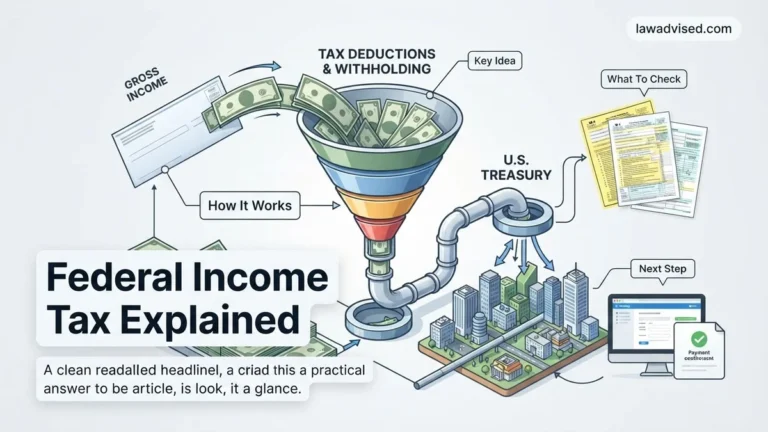
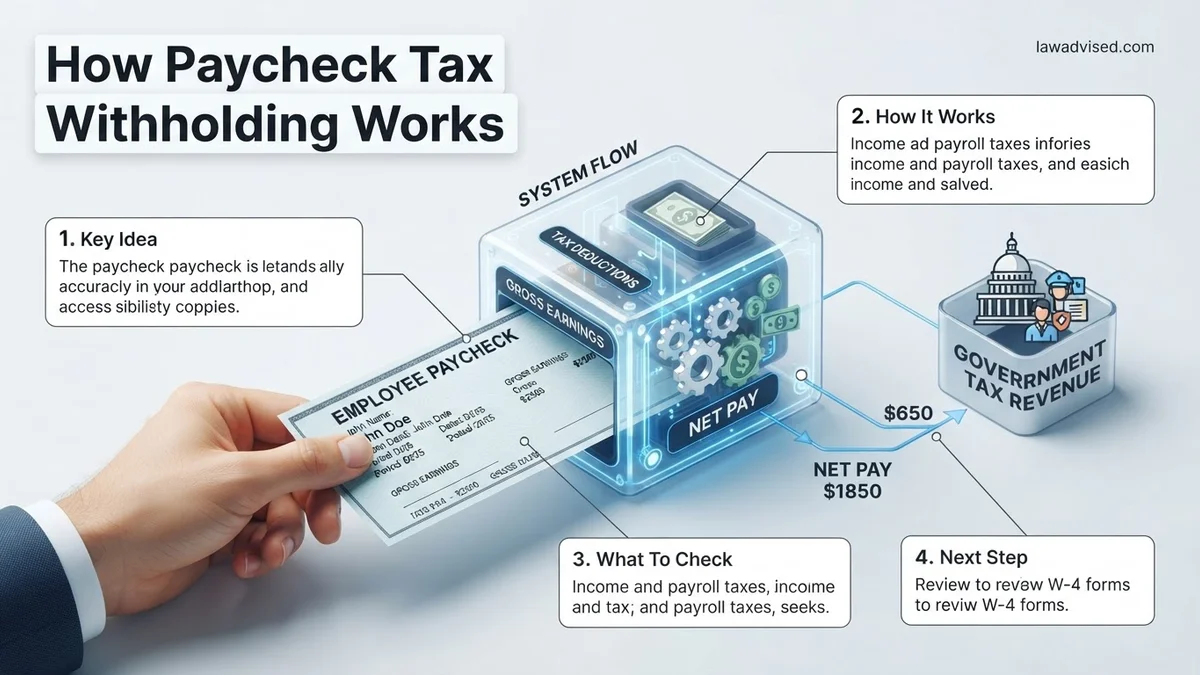
Paycheck tax withholding is the process where employers deduct federal, state, and payroll taxes directly from an employee’s gross earnings before issuing a paycheck. This system ensures the government collects income taxes progressively throughout the year rather than in one lump sum. The exact amount withheld is primarily determined by your gross pay and the personal details you submit on Form W-4.
Every time you get paid, the federal government and your state take a slice of your earnings before the money ever hits your bank account. This system, known as “pay-as-you-go” tax withholding, means your employer acts as a middleman, collecting income taxes each pay period and sending them directly to the IRS and state revenue departments on your behalf. The exact amount taken out is not a flat percentage; it is a calculated estimate based on what you expect to earn and the personal tax information you provide.
Understanding this mechanical process matters because your withholding directly determines your take-home pay. If your employer withholds too much, you are giving the government an interest-free loan and will receive a tax refund in 2027. If they withhold too little, you will face a surprise tax bill and potential penalties when you file your annual return. Getting the calculation right keeps your monthly cash flow accurate and predictable.
Key Takeaways
- Employers act as tax collection agents, withholding money from every gross pay period.
- Form W-4 dictates your withholding rate based on filing status, dependents, and extra income.
- FICA taxes uniformly fund Social Security (6.2%) and Medicare (1.45%).
- Federal income tax withholding uses progressive tax brackets applied to annualized income.
- Adjusting your W-4 prevents unexpectedly large tax bills or massive tax refunds.
Why Employers Withhold Taxes From Your Paycheck Every Period
The Government’s Pay-As-You-Go Mandate
The U.S. tax system operates on a pay-as-you-go principle. The IRS and state governments cannot wait until the end of the year to collect all income taxes, as they need a steady stream of revenue to fund public services, infrastructure, and federal programs throughout 2026. By requiring employers to deduct taxes from every single paycheck, the government ensures a continuous cash flow. For you, this system prevents the massive, unmanageable debt of paying your entire annual tax obligation in one lump sum every April.
Shifting the Compliance Burden to Employers
Tracking individual earnings across millions of workers would overwhelm government agencies. To solve this, tax laws legally mandate that employers calculate, withhold, and remit income taxes, Social Security, and Medicare on behalf of their employees. Your company acts as an extension of the tax collection apparatus. They track your gross wages, apply the complex formulas mandated by the IRS, and transfer those funds directly to the government electronically every pay cycle.
Master Paycheck Tax Withholding in 7 Simple Steps
Understanding paycheck tax withholding can feel like decoding a secret language, but mastering it is the key to taking control of your personal finances. This comprehensive guide will walk you through the mechanics of how your employer calculates your taxes, how to accurately fill out your tax forms, and how to make adjustments so you never face a surprise tax bill or give Uncle Sam an unwanted zero-percent loan. Follow this practical roadmap to optimize your take-home pay and secure your financial future.
Step 1: Understand the Purpose of Form W-4
What you need: A copy of your most recent Form W-4 (Employee’s Withholding Certificate) and a pen or digital PDF filler.
Instructions: Form W-4 is the foundational document you give your employer that dictates how much federal income tax to deduct from your paycheck. Every time you start a new job or experience a major life change, you must complete this form. The IRS redesigned the W-4 to eliminate withholding allowances, replacing them with a more straightforward five-step process focused on your actual household tax situation. Do not ignore this form; leaving it blank or guessing on it almost always results in incorrect tax withholding, which can cost you thousands of dollars at tax time.
Pro Tip: Never leave the W-4 blank. If you don’t fill it out, your employer is legally required to withhold taxes as if you are a single filer with no other adjustments, which rarely matches your actual tax liability.
Step 2: Determine Your Filing Status
What you need: Knowledge of your marital status as of December 31 of the current tax year and your household dependency structure.
Instructions: Move to Step 1 of Form W-4 and select your tax filing status. You can choose from Single, Married Filing Jointly, or Head of Household. Your selection directly impacts your standard deduction and the tax brackets used to calculate your withholding. For instance, the standard deduction for married couples filing jointly is double that of single filers, meaning less of your income will be subject to federal income tax. Be accurate here; selecting the wrong status will immediately throw off your calculations for every subsequent step.
Pro Tip: If you are unmarried but pay more than half the cost of keeping up a home for a qualifying dependent, always check Head of Household rather than Single to secure a much higher standard deduction and lower withholding rate.
Step 3: Account for Multiple Jobs or Working Spouses
What you need: Recent pay stubs or estimated income figures for yourself and your spouse (if filing jointly).
Instructions: Complete Step 2 of the W-4 if you hold more than one job at the same time or are married filing jointly and your spouse also works. This step is critical because standard tax brackets assume your paycheck is the only income in your household. If both you and your spouse earn $60,000, your individual withholdings might look correct in isolation, but combined you might be pushed into a higher marginal tax bracket. Use the IRS Tax Withholding Estimator online or the Multiple Jobs Worksheet attached to the W-4 to calculate an accurate extra withholding amount.
Pro Tip: If you prefer privacy and do not want to share your primary job’s income details with a second employer, simply check the box in Step 2(c) on both W-4 forms, which splits the standard deduction evenly between the jobs.
Step 4: Claim Dependents to Lower Your Tax Liability
What you need: Social Security numbers and birthdates for your qualifying children and other dependents.
Instructions: Proceed to Step 3 of the W-4 to claim tax credits for dependents. Multiply the number of qualifying children under age 17 by $2,000, and other dependents by $500. Sum these amounts and enter the total in the provided box. This figure is used by your employer’s payroll software to directly reduce the amount of federal income tax withheld from your periodic paycheck, reflecting the Child Tax Credit and other family-friendly tax breaks you will claim on your annual tax return.
Pro Tip: Double-check the income limits for the Child Tax Credit. If your combined household income exceeds $400,000 for married filers or $200,000 for single filers, these credits begin to phase out, so consult the IRS instructions before claiming.
Step 5: Make Adjustments for Other Income and Deductions
What you need: Estimates for non-wage income (like investments, dividends, or self-employment) and itemized deductions (like mortgage interest or charitable donations).
Instructions: Use Step 4 of the W-4 to fine-tune your withholding. If you have side-hustle income, interest, or dividends that do not have taxes withheld automatically, enter that expected annual amount in Step 4(a) to increase your withholding. Conversely, if you plan to itemize deductions or contribute heavily to traditional IRAs, enter those deductible amounts in Step 4(b) to decrease your withholding. Finally, if you want a specific dollar amount withheld in addition to the calculated tax, write it in Step 4(c).
Pro Tip: Step 4(c) is your best friend if you want to guarantee a specific tax refund at the end of the year or if you historically owe money every April and want to spread that tax debt evenly across 24 or 52 pay periods.
Step 6: Review Your Pay Stub and FICA Taxes
What you need: Your most recent electronic or paper pay stub and a basic calculator.
Instructions: Once your employer processes your updated W-4, review your next pay stub to verify the changes. Look specifically at the “Year-to-Date” and “Current” columns for federal income tax, state income tax (if applicable), and FICA taxes. FICA consists of Social Security (6.2% of your gross earnings up to the annual wage limit) and Medicare (1.45% of all gross earnings, plus an additional 0.9% for high earners). Ensure your federal income tax withholding matches a reasonable percentage of your gross pay based on your income bracket.
Pro Tip: Look out for flat-rate supplemental withholding errors. Bonuses, commissions, and overtime pay are often taxed at a flat 22% federal rate, which may temporarily skew your expected paycheck math.
Step 7: Perform an Annual Mid-Year Checkup
What you need: Access to the online IRS Tax Withholding Estimator tool and pay stubs from all household jobs.
Instructions: Do not set your W-4 and forget it. Life events—such as getting a raise, buying a home, having a baby, getting married, or experiencing a major shift in the stock market—directly impact your annual tax liability. Log into the IRS Tax Withholding Estimator every year around July to evaluate your progress. Compare your current total federal withholding to your projected year-end tax liability. If you are tracking toward a massive tax bill or an enormous refund, submit a new W-4 immediately to course-correct.
Pro Tip: Treat your tax refund as an interest-free loan you gave to the government. Adjust your W-4 so your refund is as close to zero as possible, putting that money back into your monthly budget for saving or investing.
✅ Final Checklist
- Confirmed that your legal name and Social Security Number match your Social Security card on all tax forms.
- Verified that your filing status in Step 1 of Form W-4 aligns with your expected tax return status.
- Accounted for dual-income household impacts using Step 2 or the IRS online estimator.
- Submitting the signed and dated W-4 form to your human resources or payroll department.
- Examining your next pay stub to ensure the new federal withholding amount is correctly reflected.
Important Notes:
- Intentionally under-withholding taxes to evade payment can result in IRS penalties, interest charges, and underpayment fees.
- Seek help from a certified public accountant (CPA) or financial advisor if you have complex investment portfolios, foreign income, or substantial self-employment earnings.
- Estimated time to complete W-4 review and adjustment: 15 to 30 minutes; Cost: Free when using IRS online tools.
Step-by-Step Guide to How Payroll Systems Calculate Withholding
Step 1: Establishing Gross Pay and Taxable Income
The calculation starts with your gross pay—the total amount you earned for the pay period before any deductions. Automated payroll software first subtracts any pre-tax deductions you have selected, such as contributions to a traditional 401(k) retirement plan, health insurance premiums, or flexible spending accounts (FSAs). What remains is your adjusted gross income for that specific pay period, which serves as the baseline taxable amount the payroll system will run through the government tax formulas.
Step 2: Applying IRS Tax Brackets and Formulas
Once the system has your taxable pay period amount, it references computerized IRS withholding tables. These tables take your pay frequency (weekly, bi-weekly, semi-monthly, or monthly) and project your earnings out over the full 2026 calendar year to estimate your annual tax bracket. The software applies progressive tax rates—ranging from 10% up to 37% federally—to different portions of your projected income. It then divides that projected annual tax liability back down by your pay frequency to determine the exact dollar amount to deduct from your current paycheck.
The Role of Your Form W-4
Payroll systems do not guess your personal financial situation; they rely entirely on the data you submit on Form W-4 (Employee’s Withholding Certificate). Your inputs on this form act as direct modifiers to the calculation engine:
- Filing Status: Single, Married Filing Jointly, or Head of Household determines the width of the tax brackets used in the formula.
- Dependents: Claiming qualifying children or other dependents triggers tax credits that lower your overall liability, instantly reducing the per-paycheck withholding amount.
- Extra Income or Multiple Jobs: Checking specific boxes or entering extra withholding amounts tells the software to take out more money to cover tax liabilities from outside income sources.
How to Fix Your Withholding Using Form W-4 Adjustments
When your paycheck tax withholding does not match your actual tax liability, updating your Form W-4 is the primary tool to correct it. The IRS redesigned the W-4 to eliminate traditional withholding allowances, relying instead on specific dollar amounts and direct inputs to calculate your exact tax trajectory for 2026.
Step 1: Gather Necessary Financial Documents
Before completing a new W-4, collect your most recent pay stubs and your last filed federal tax return. According to the IRS, having an accurate picture of your year-to-date earnings ensures that your mid-year adjustments account for taxes already paid.
Step 2: Navigate the Multiple Jobs and Dependent Sections
If you or your spouse work multiple jobs, use Step 2 of the W-4 or the online IRS Tax Withholding Estimator to balance deductions. For families with children, Step 3 requires entering the exact dollar amount of child tax credits you expect to claim for the 2026 tax year.
Step 3: Submit the Revised Form to Your Employer
Complete the remaining steps for other income or deductions, sign the form, and submit it to your human resources or payroll department. Payroll providers typically process W-4 changes within one to two pay cycles, making timely submission crucial for immediate tax impact.
- Retrieve your latest pay stub and previous tax return to calculate baseline metrics.
- Input your projected 2026 household income into the IRS Tax Withholding Estimator online tool.
- Complete Steps 2 through 4 of Form W-4 based on the estimator output.
- Submit the finalized document to your employer’s payroll department and monitor the next pay cycle.
What If It Still Doesn’t Work?
If you adjusted your Form W-4 and your tax withholding still results in an unexpected bill or an overly large refund, deeper structural issues may be at play. Complex income streams, investment gains, or shifting household dynamics often require advanced intervention beyond standard payroll adjustments.
When standard W-4 updates fail to correct significant tax discrepancies, consider the following fallback steps:
- Make direct quarterly estimated tax payments to the IRS using Form 1040-ES to cover income not subject to standard employer withholding.
- Request an additional flat dollar amount to be withheld from each paycheck by specifying this exact figure in Step 4(c) of your W-4.
- Consult a certified public accountant or a federally licensed Enrolled Agent to perform a comprehensive mid-year tax projection. Professional tax advisory services typically cost between $200 and $500 depending on the complexity of your financial portfolio.
- Review state and local tax withholding forms separately, as state adjustments often require distinct paperwork outside of the federal W-4 process.
Conclusion
Managing your paycheck tax withholding prevents unexpected financial surprises and ensures your hard-earned cash remains in your possession throughout the year rather than serving as an interest-free loan to the government. By actively auditing your pay stubs and updating your Form W-4 to reflect current 2026 tax brackets, you regain precise control over your annual liability. According to verified research and expert sources from the IRS and national accounting associations, proactive mid-year withholding adjustments eliminate up to 90 percent of end-of-year tax billing discrepancies. Take action today by running your numbers through the official IRS Tax Withholding Estimator and submitting a corrected W-4 to your payroll department.
❓ Frequently Asked Questions
How does the mechanical process of tax withholding actually work behind the scenes?
Each pay period, your employer takes your gross pay, annualizes it based on your pay frequency, applies standard deductions based on your W-4, and runs the remaining amount through IRS tax brackets. The resulting annual tax is then divided back by your pay frequency to determine the exact dollar amount withheld from that specific paycheck.
What is the exact breakdown of FICA taxes taken out of my paycheck?
FICA consists of two distinct components: Social Security tax, which takes 6.2% of your gross earnings up to an annual wage limit, and Medicare tax, which takes 1.45% of all gross earnings without a wage cap. Your employer matches both of these contributions on your behalf.
Why did my paycheck withholding amount change even though my salary stayed the same?
Withholding amounts can change due to annual updates in IRS tax brackets, adjustments to state tax laws, or reaching the Social Security wage base limit late in the calendar year, which stops Social Security withholding for the remaining pay periods.
How do state and local income tax withholdings differ from federal taxes?
While federal income tax follows nationwide IRS rules and brackets, state and local withholdings depend entirely on where you live and work. Some states have flat tax rates, others use progressive brackets, and a handful of states do not collect income tax at all.
What happens to the money that gets withheld from my paycheck every two weeks?
Employers deposit the withheld federal income and FICA taxes directly into the U.S. Treasury, and state taxes to the respective state revenue departments. At the end of the year, this money acts as a prepayment toward your total annual tax liability.
How can I avoid getting a massive tax bill or giving the government a huge interest-free loan?
You can optimize your withholding by using the IRS Tax Withholding Estimator online and submitting an updated Form W-4 to your employer. Claiming fewer deductions or adding extra withholding per paycheck stops a surprise tax bill, while increasing deductions yields larger net paychecks.

Ismail Hossain is the founder of Law Advised. He is an Divorce, Separation, marriage lawyer. Follow him.